
 CA
 NZ
 UK
 US
 IND

 AU

 Share
 X (Formerly Twitter)
 Whatsapp
 Facebook
 LinkedIn
 Telegram
 Email This Article
 Copy Link
 Summarize with AI
 Chat GPT
 Perplexity

Key Highlights
- Strong H1 FY2026 Performance: ANZ delivered a $3.78 billion cash profit, supported by improved operating efficiency and a solid capital position.
- Suncorp Integration Presents Opportunities and Risks: The acquisition strengthens ANZ's long-term growth outlook but may pressure near-term earnings through integration costs.
- Bearish Trend Remains Intact: ANZ is staging a potential dead-cat bounce following a Head & Shoulders breakdown, with $35.32 acting as critical resistance.
- Downside Risk Persists: Failure to reclaim the resistance zone could lead to a renewed decline toward the $30.52 technical target.
While ANZ Group Holdings Limited (ASX:ANZ) entered the 2026 fiscal year backed by a high-velocity transformation agenda, marked by aggressive cost-to-income compression and a strengthening CET1 ratio, the technical and fundamental landscape has shifted toward distribution. Despite the headline-grabbing H1 result and a boost in franking credits to 75%, the market appears to be "selling the fact." As institutional capital reassesses the group's ability to maintain high margins in a hyper-competitive mortgage environment, the technical tape has responded with a decisive move toward the downside, marking the end of the prior cyclical markup phase.
Guidance Upgrades Meet the Suncorp Integration Squeeze
ANZ’s fundamental narrative is currently balanced between near-term earnings strength and the long-term capital demands of its massive operational reset:
- H1 2026 Earnings Resilience: The primary fundamental pillar for ANZ is its recently disclosed H1 2026 result, featuring a Cash Profit of $3,780 million. The bank’s ability to compress its cost-to-income ratio to 49.4% (down from 54.6% in the prior half) provides clear evidence that management’s simplification strategy is delivering genuine operating leverage.
- The Suncorp Acquisition Milestone: The acquisition of Suncorp Bank remains the centerpiece of ANZ's growth thematic. With the Australian Competition Tribunal overruling the ACCC’s initial rejection, ANZ is positioned to absorb 1.2 million new customers and significantly bolster its presence in the Queensland market. However, with an estimated $196 million hit from one-off accounting adjustments and software amortization, the market remains cautious regarding the immediate drag on net interest margins (NIM).
- Capital Management and Provisioning: Backed by a healthy CET1 ratio of 12.39%, ANZ continues to manage capital conservatively. While the board proposed an interim dividend of 83 cents per share, the decision to increase collective provisions—specifically a $175 million charge for potential geopolitical volatility—indicates that management is bracing for a potential deterioration in credit quality across the commercial portfolio.
Associated Risks
A primary risk for ANZ remains the intense competition within the Australian domestic mortgage market, which continues to exert downward pressure on Net Interest Margins. As the "big four" banks struggle for market share in a cooling property market, any unexpected spike in individual provision (IP) charges or bad debt realizations would materially impact earnings resilience. Furthermore, the complex technological integration of Suncorp Bank onto the ANZ Plus platform presents localized execution risk; any delays in realizing the projected $260 million in pre-tax synergies would likely result in a further de-rating of the group’s valuation multiples.
Technical Outlook
The daily chart for ANZ Group provides a textbook masterclass in structural exhaustion and trend reversal, highlighting a complete transfer of power from aggressive buyers to a dominant distribution phase.
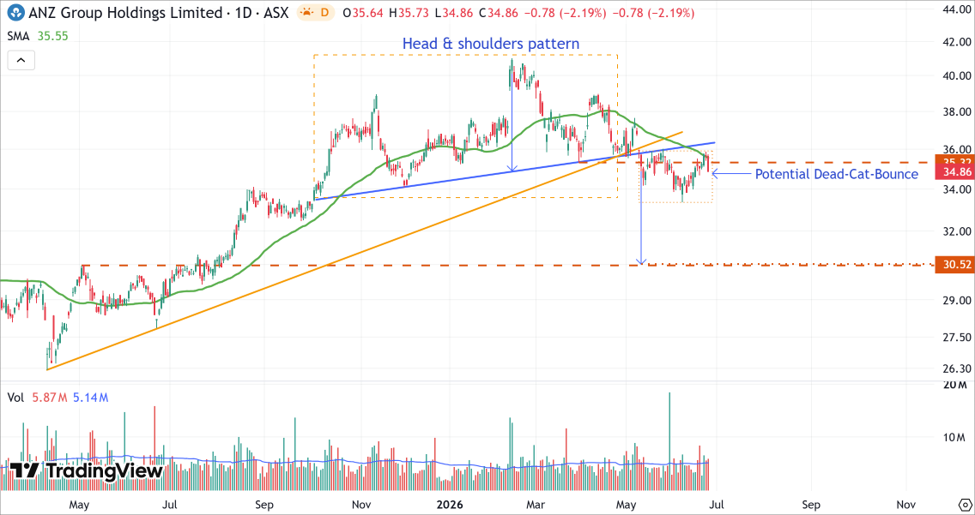
ANZ’s Daily Price Chart (at the closing price of 26/06 2026). Powered by: tradingview.com
- The daily chart for ANZ Group Holdings continues to exhibit a bearish technical structure despite signs of a short-term recovery. The stock previously completed a well-defined Head & Shoulders pattern, confirming a transition from a prolonged consolidation phase into a medium-term downtrend. Following the decisive break below the neckline, selling pressure accelerated, driving the share price toward the projected downside objective.
- More recently, ANZ has staged a modest rebound after reaching an intermediate low, producing what appears to be a potential dead-cat bounce. The recovery has lifted the stock back toward the former neckline and the declining short-term trendline, both of which now act as significant resistance levels.
- Key resistance is located at $35.32, followed by the descending trendline near $36.00. On the downside, the primary support remains at $30.52, corresponding to both the measured objective of the Head & Shoulders pattern and an important historical support level established during 2025.
Bottom Line
Although ANZ Group Holdings (ASX: ANZ) continues to demonstrate resilient earnings, disciplined capital management, and long-term strategic growth through the integration of Suncorp Bank, near-term headwinds from mortgage competition, margin pressure, and execution risks continue to weigh on investor sentiment. From a technical perspective, the stock remains in a confirmed medium-term downtrend following the completion of a Head & Shoulders pattern. While the recent recovery suggests a potential dead-cat bounce, the rebound has yet to invalidate the prevailing bearish structure and is currently testing a significant resistance zone at $35.32, reinforced by the former neckline. Unless ANZ can secure a sustained breakout above this area, the path of least resistance remains to the downside, with a rejection likely to expose the stock to a renewed decline toward the $30.52 measured objective.


 Nov 12, 2026





 Please wait processing your request...