
 AU
AU CA
CA NZ
NZ UK
UK US
US IND
IND

 Share
Share
 X (Formerly Twitter)
 Whatsapp
 Facebook
 LinkedIn
 Telegram
 Email This Article
 Copy Link
 Summarize with AI
 Chat GPT
 Perplexity
Highlights
- Larger funds typically offer narrower bid-ask spreads and lower transaction costs.
- Economies of scale help big funds operate more efficiently and track benchmarks more closely.
- Smaller funds may experience higher tracking error due to limited scale and liquidity.
- Management fees often decrease as fund size grows, improving cost efficiency.
- Low-AUM funds face greater risk of closure, creating potential disruptions for holders.
Fund size is often overlooked when people evaluate exchange-traded funds (ETFs) or mutual funds. Many readers focus mainly on returns, holdings, or strategy. However, the total assets a fund manages—commonly called Assets Under Management (AUM)—plays an important role in shaping how the fund operates and how efficiently it can deliver on its objectives. Larger and smaller funds each come with their own implications, particularly around liquidity, efficiency, and costs. Understanding these dynamics can help individuals make more informed decisions when comparing different funds.
Liquidity: The Ability to Trade Smoothly
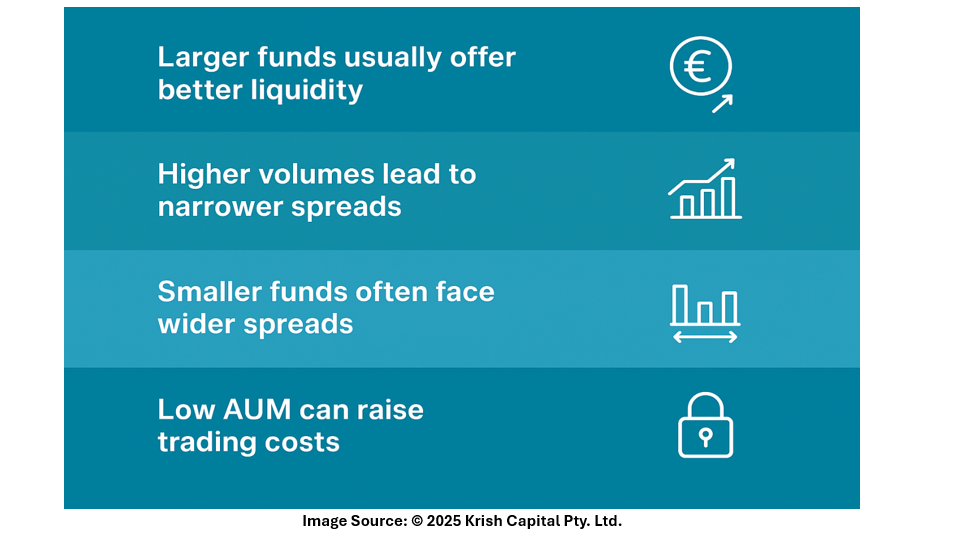
Liquidity refers to how easily a fund’s units can be bought or sold without affecting the market price. In general, larger funds tend to have better liquidity. This is because they usually attract higher trading volumes, narrower bid-ask spreads, and a deeper pool of buyers and sellers. With smaller spreads, the price difference between buying and selling narrows, reducing the trading cost for the participant.
Smaller funds, especially newly launched ones, may experience lower daily trading volumes. This does not necessarily mean they cannot be traded, since ETF liquidity is partly derived from the liquidity of underlying securities. However, low AUM funds often see wider bid-ask spreads, which can raise transaction costs and make it less efficient to enter or exit positions. In extreme cases, very small funds may face the risk of closure if they fail to attract sufficient AUM, creating additional uncertainty for unit holders.
Operational Efficiency: Scale Advantages and Stability
Fund size is closely linked to operational efficiency. Large funds benefit from economies of scale, meaning certain fixed costs—such as administration, custody, and regulatory expenses—are spread across a broader base of assets. This scale can support more stable operations, better technology systems, improved risk management, and tighter portfolio tracking relative to the fund’s benchmark.
Smaller funds often have more concentrated cost burdens, which can influence how effectively they replicate their targeted index or strategy. They may also face greater challenges maintaining liquidity in fast-moving markets, particularly if they hold less liquid securities such as small-cap stocks, emerging-market bonds, or niche commodities. Tracking error—the difference between the fund’s performance and its benchmark—can be slightly higher in smaller funds due to these structural limitations.
Large funds, especially those tracking popular indices, also tend to benefit from strong market-maker support. This support helps keep trading smooth and prices aligned with the fund's Net Asset Value (NAV). Smaller funds may not always attract the same level of market-maker activity, which can translate into occasional price deviations or wider spreads during turbulent market conditions.
Costs: How Fund Size Affects Fees and Trading Expenses
One of the most direct ways fund size impacts participants is through costs. Larger funds generally offer lower expense ratios because their operational scale allows them to spread costs more efficiently. Many major ETFs with billions in AUM have been able to reduce fees over time due to intense competition and economies of scale.
Smaller funds often have higher management fees since they must cover fixed costs across a smaller base of assets. Additionally, the wider bid-ask spreads commonly found in smaller funds lead to higher implicit trading costs. While these may not appear as line-item expenses, they are real costs experienced whenever units are bought or sold.
It is also important to consider the risk of fund closure. If a fund remains small for too long, the issuer may decide to shut it down due to unprofitability. While closures typically include returning capital to holders, the process may require forced selling, create potential tax implications, and lead to temporary disruptions.
Conclusion
Fund size plays a meaningful role in shaping the overall experience of holding an ETF or mutual fund. Larger funds typically offer better liquidity, improved operational efficiency, and lower expenses thanks to economies of scale. Smaller funds may still be attractive for niche exposures or specialized strategies, but they often carry additional risks such as wider bid-ask spreads or potential closure. Understanding how fund size influences liquidity, efficiency, and costs can help individuals compare options more clearly and select funds that align well with their objectives and risk considerations.


 Mar 06, 2026




 Please wait processing your request...