Highlights
- Thematic ETFs provide targeted exposure to long-term global megatrends.
- They work best as satellite allocations alongside core diversified holdings.
- Position sizing is critical to manage volatility and concentration risk.
- Blending multiple themes can improve diversification within the satellite bucket.
- A disciplined rebalancing approach keeps portfolio risk aligned with goals.
A core portfolio typically consists of broad-based, low-cost funds that deliver market-linked returns with high diversification. These often include total market equity ETFs, large-cap index funds, or diversified fixed income instruments.
Thematic ETFs, by contrast, are inherently concentrated. They select companies aligned with a single structural trend rather than the broader economy. This makes them more volatile but also gives them the potential to outperform during periods when the theme gains momentum.
For this reason, they are generally more effective as satellite allocations, complementing the stability of the core rather than replacing it.
Accessing Structural Growth Stories
One of the strongest arguments for including thematic ETFs in a long-term portfolio is their ability to capture transformational trends early. Many traditional indices are backward-looking and heavily weighted toward established sectors. By the time a new industry becomes large enough to influence benchmark weights, a significant portion of its growth phase may already be over.
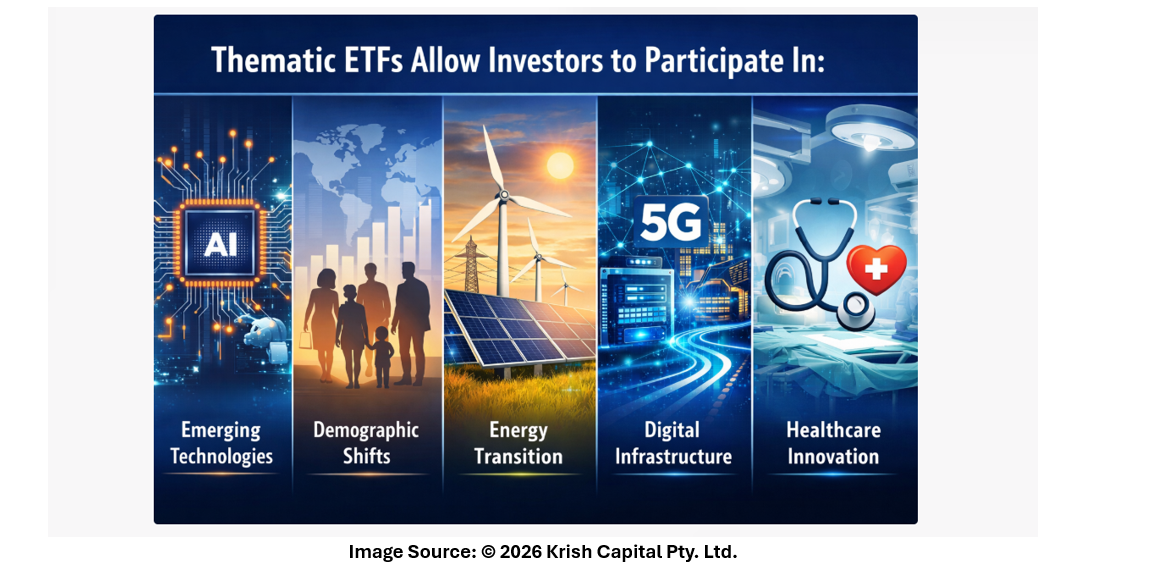
This forward-looking exposure can enhance the overall growth profile of a portfolio.
The Diversification Paradox
At first glance, thematic investing appears to reduce diversification because of its narrow focus. However, when used in moderation, it can actually increase diversification at the portfolio level.
For example, a traditional core portfolio may be heavily tilted toward financials, large technology firms, or cyclical sectors, depending on the benchmark. Adding a theme such as clean energy or global robotics introduces exposure to different revenue drivers and innovation cycles.
The key lies in the allocation size. A modest exposure can broaden opportunity without overwhelming the portfolio’s risk structure.
Managing the Risks: Concentration, Valuation and Timing
Thematic ETFs come with distinct risks:
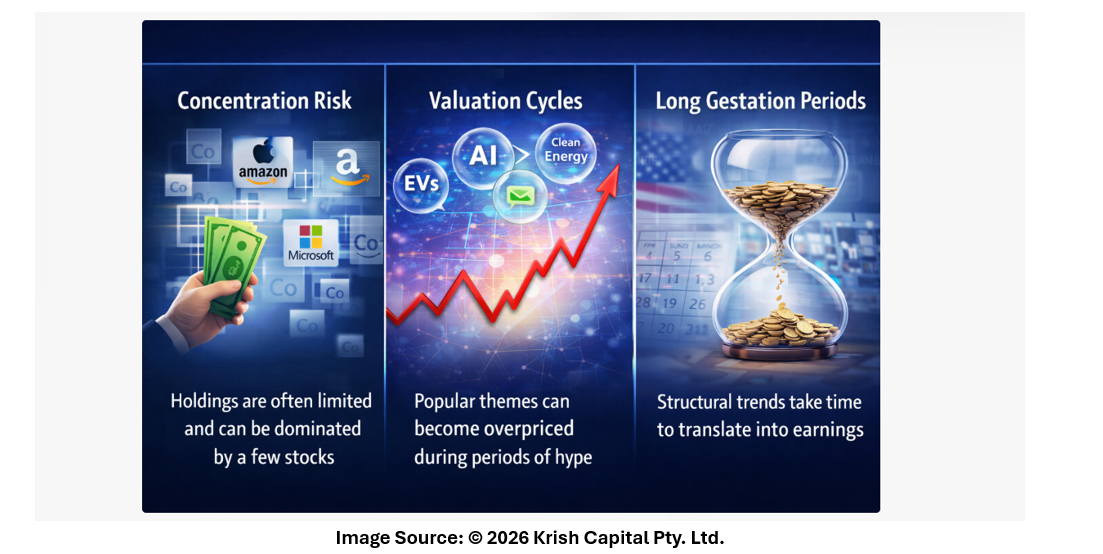
Investors who treat thematic funds as short-term momentum trades often experience disappointment. Their real strength lies in long-term holding periods aligned with the underlying trend.
A disciplined allocation—typically a small percentage of the total portfolio—helps manage these risks.
Blending Multiple Themes for Balance
Instead of making a large bet on a single idea, investors can build a basket of complementary themes. For instance:
- Technology innovation
- Climate transition
- Digital consumption
This approach reduces dependence on the success of any one theme while maintaining exposure to structural growth.
Rebalancing: The Discipline That Makes It Work
Because thematic ETFs can outperform sharply in certain cycles, they can quickly grow beyond their intended allocation. Regular rebalancing ensures that:
- Profits are systematically booked
- Risk remains aligned with the core strategy
- Capital is redeployed into underweight areas
This transforms thematic exposure from a speculative position into a structured portfolio component.
A Growth Engine, Not the Foundation
Thematic ETFs are not designed to replace broad market exposure. The core portfolio remains the foundation for stability, income, and long-term compounding.
However, when used thoughtfully, thematic ETFs act as a growth engine—providing access to future-focused sectors that traditional benchmarks may underrepresent.
In a modern portfolio, their role is clear: not to dominate the asset mix, but to enhance it with precision, innovation, and the potential for differentiated returns.
Disclaimer:
This article (“Article”) has been prepared by Kalkine Pty Limited (ABN 34 154 808 312) (Australian financial services licence number 425376) (“Kalkine”) and its related bodies corporate who are authorised to provide general financial product advice. Kalkine.com.au and its associated pages are published by Kalkine.
Any information/advice provided in this article is general in nature and does not take into account your objectives, financial situation or needs. You should therefore consider whether the information is appropriate for your objectives, financial situation and needs before acting upon it.
There may be a Product Disclosure Statement, Information Memorandum or other offer document (“Offer Document”) for the securities or other financial products referred to in Kalkine articles. You should obtain a copy of the Offer Document and consider it before making any decision about whether to acquire the security or financial product.
Kalkine strongly recommends that you seek advice from a financial adviser, stockbroker or other professional (including taxation and legal advice) before acting on any advice/information in this Article or on the Kalkine website. Not all investments are appropriate for all people.
The information in this Article and on Kalkine website has been prepared from a wide variety of sources, which Kalkine, to the best of its knowledge and belief, considers accurate. Kalkine has made every effort to ensure the reliability of the information contained in its articles (including this Article), newsletters and websites. All information represents our views at the date of publication and may change without notice.
The information in this Article does not constitute an offer to sell securities or other financial products or a solicitation of an offer to buy securities or other financial products.
Kalkine does not issue, sell or deal in any financial products.
This Article may contain information on past performance of particular investments. Please note past performance is neither an indicator nor a guarantee of future performance.
To the extent permitted by law, and excluding any dishonesty or gross negligence by Kalkine, Kalkine disclaims and excludes all liability for any direct, indirect, implied, punitive, special, incidental or other consequential loss or damage arising from the use of or reliance on this Article, the Kalkine website and any information published on the Kalkine website without any warranties or representations by Kalkine to you. To the extent the law prohibits or limits this exclusion, Kalkine limits its liability to the resupply of services.
Please also read our Terms & Conditions and Financial Services Guide for further information.
Employees and/or associates of Kalkine and its related entities may hold interests in the securities or other financial products covered in this Article or on the Kalkine website. Any such employees and associates are required to comply with certain safeguards, procedures and disclosures as required by law.
Some of the images/music that may be used in the Article are copyright to their respective owner(s). Kalkine does not claim ownership of any of the pictures displayed/music used in the Article unless stated otherwise. The images/music that may be used in the Article are taken from various sources on the internet, including paid subscriptions or are believed to be in public domain. We have used reasonable efforts to accredit the source wherever it was indicated or was found to be necessary.
Kalkine Media Pty Ltd, an affiliate of Kalkine Pty Ltd, may have received, or be entitled to receive, financial consideration in connection with providing information about certain entity(s) covered on its website.
Copyright 2026 Krish Capital Pty. Ltd. (ABN 61629651510). All Rights Reserved. No part of this Article, or its content, may be reproduced in any form without our prior consent.

 AU
AU CA
CA NZ
NZ UK
UK US
US IND
IND

 Share
Share
 X (Formerly Twitter)
 Whatsapp
 Facebook
 LinkedIn
 Telegram
 Email This Article
 Copy Link
 Summarize with AI
 Chat GPT
 Perplexity


 Mar 06, 2026




 Please wait processing your request...