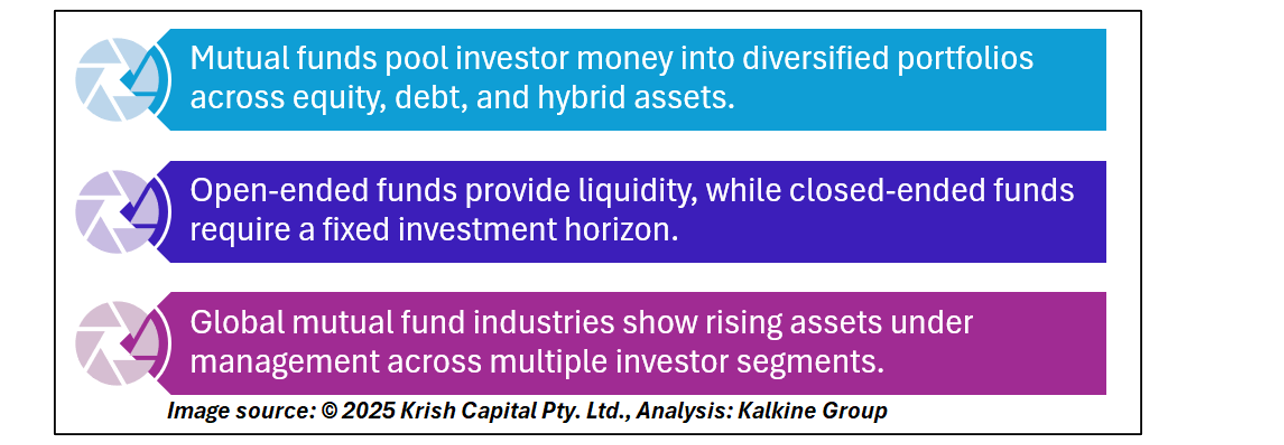
A mutual fund is an investment vehicle that collects capital from multiple investors and allocates it across a range of securities such as stocks, bonds, and other instruments. Investors receive units of the fund, with the value of these units, measured as Net Asset Value (NAV), fluctuating according to the performance of the underlying securities. The pooled nature of mutual funds allows even small investors to access a diversified portfolio that might be difficult to replicate individually.
Professional fund managers handle the selection, buying, and selling of these securities, monitoring economic trends and adjusting the portfolio as required. This professional oversight ensures investors are not responsible for detailed market analysis themselves.
Open-Ended vs Closed-Ended Funds
Open-Ended Funds - Units can be bought or redeemed at any time at the prevailing NAV, offering high liquidity. Most mutual funds available today, including equity, debt, hybrid, and index funds, are open-ended.
Closed-Ended Funds - Units are available only during an initial offering, and redemption occurs at maturity, often 3–5 years or longer. These funds may also be traded on stock exchanges, with prices determined by market demand rather than NAV. Closed-ended funds suit investors who can commit for the full term without requiring quick liquidity.
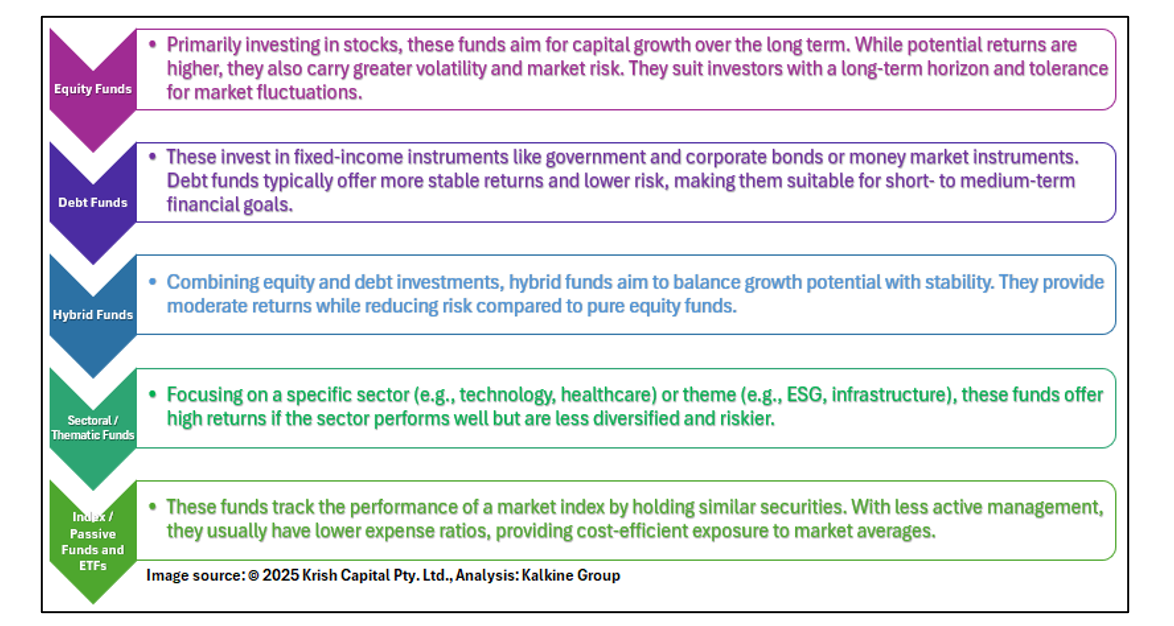
Types of Mutual Funds
Advantages of Mutual Funds
Mutual funds offer several advantages that make them a popular investment option. By pooling various securities, they spread investment risk across multiple assets, which helps mitigate the impact of poor performance in any single security.
The presence of professional fund managers ensures that portfolios are actively monitored and managed, saving individual investors from the need to conduct intensive research or track market movements themselves.
Open-ended funds provide liquidity and flexibility, allowing investors to redeem their units at any time, offering convenience compared to other investment instruments. Many mutual funds also have low minimum investment requirements, making them accessible to beginners, while passively managed or index funds often come with lower costs due to reduced active management.
Mutual funds can be aligned with different financial goals, whether for long-term wealth accumulation or short- to medium-term objectives, allowing investors to select funds that match their specific targets.
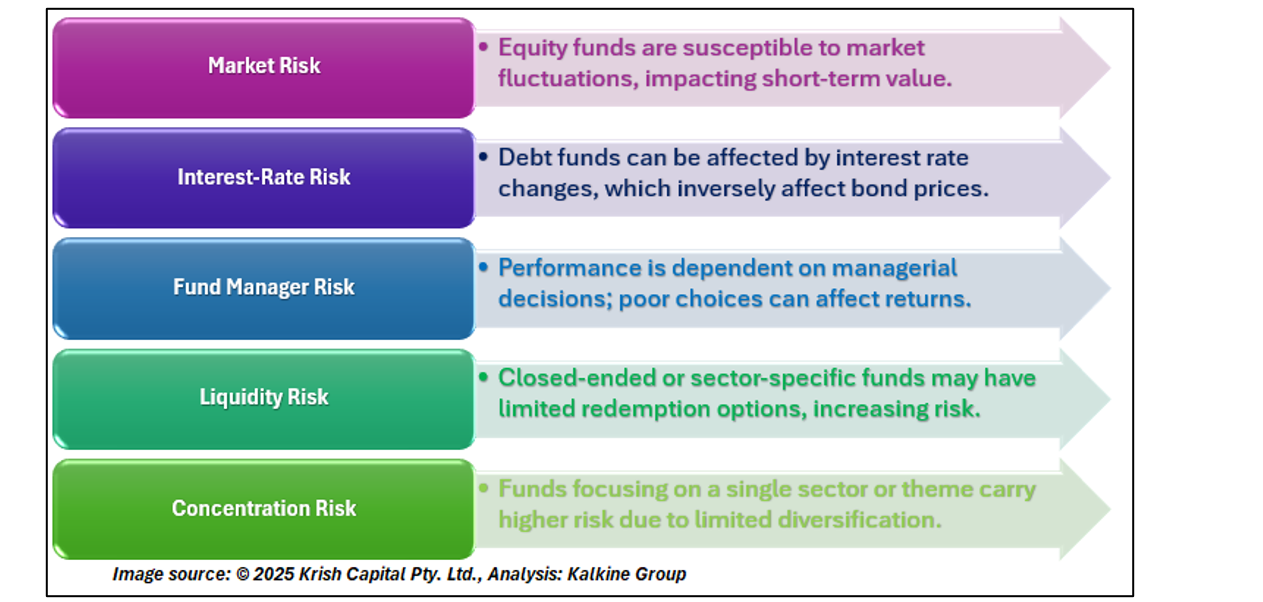
Risks to Consider
In Summary
Mutual funds pool money from investors and allocate it across diversified portfolios that are managed by professional fund managers. They provide liquidity, accessibility, and cost-efficient options that suit different financial goals. With multiple fund categories available, investors can choose options that match their risk tolerance and investment horizon. Overall, mutual funds offer a structured approach to building wealth across varying market conditions.
Disclaimer:
This article (“Article”) has been prepared by Kalkine Pty Limited (ABN 34 154 808 312) (Australian financial services licence number 425376) (“Kalkine”) and its related bodies corporate who are authorised to provide general financial product advice. Kalkine.com.au and its associated pages are published by Kalkine.
Any information/advice provided in this article is general in nature and does not take into account your objectives, financial situation or needs. You should therefore consider whether the information is appropriate for your objectives, financial situation and needs before acting upon it.
There may be a Product Disclosure Statement, Information Memorandum or other offer document (“Offer Document”) for the securities or other financial products referred to in Kalkine articles. You should obtain a copy of the Offer Document and consider it before making any decision about whether to acquire the security or financial product.
Kalkine strongly recommends that you seek advice from a financial adviser, stockbroker or other professional (including taxation and legal advice) before acting on any advice/information in this Article or on the Kalkine website. Not all investments are appropriate for all people.
The information in this Article and on Kalkine website has been prepared from a wide variety of sources, which Kalkine, to the best of its knowledge and belief, considers accurate. Kalkine has made every effort to ensure the reliability of the information contained in its articles (including this Article), newsletters and websites. All information represents our views at the date of publication and may change without notice.
The information in this Article does not constitute an offer to sell securities or other financial products or a solicitation of an offer to buy securities or other financial products.
Kalkine does not issue, sell or deal in any financial products.
This Article may contain information on past performance of particular investments. Please note past performance is neither an indicator nor a guarantee of future performance.
To the extent permitted by law, and excluding any dishonesty or gross negligence by Kalkine, Kalkine disclaims and excludes all liability for any direct, indirect, implied, punitive, special, incidental or other consequential loss or damage arising from the use of or reliance on this Article, the Kalkine website and any information published on the Kalkine website without any warranties or representations by Kalkine to you. To the extent the law prohibits or limits this exclusion, Kalkine limits its liability to the resupply of services.
Please also read our Terms & Conditions and Financial Services Guide for further information.
Employees and/or associates of Kalkine and its related entities may hold interests in the securities or other financial products covered in this Article or on the Kalkine website. Any such employees and associates are required to comply with certain safeguards, procedures and disclosures as required by law.
Some of the images/music that may be used in the Article are copyright to their respective owner(s). Kalkine does not claim ownership of any of the pictures displayed/music used in the Article unless stated otherwise. The images/music that may be used in the Article are taken from various sources on the internet, including paid subscriptions or are believed to be in public domain. We have used reasonable efforts to accredit the source wherever it was indicated or was found to be necessary.
Kalkine Media Pty Ltd, an affiliate of Kalkine Pty Ltd, may have received, or be entitled to receive, financial consideration in connection with providing information about certain entity(s) covered on its website.
Copyright 2026 Krish Capital Pty. Ltd. (ABN 61629651510). All Rights Reserved. No part of this Article, or its content, may be reproduced in any form without our prior consent.

 AU
AU CA
CA NZ
NZ UK
UK US
US IND
IND

 Share
Share
 X (Formerly Twitter)
 Whatsapp
 Facebook
 LinkedIn
 Telegram
 Email This Article
 Copy Link
 Summarize with AI
 Chat GPT
 Perplexity


 Mar 06, 2026




 Please wait processing your request...