
 AU
AU CA
CA NZ
NZ UK
UK US
US IND
IND

 Share
Share
 X (Formerly Twitter)
 Whatsapp
 Facebook
 LinkedIn
 Telegram
 Email This Article
 Copy Link
 Summarize with AI
 Chat GPT
 Perplexity
Highlights
- A fund fact sheet gives a quick snapshot of what the fund does and how it performs.
- Understanding fees and risk is crucial for making informed investment decisions.
- Long-term trends matter more than short-term gains when evaluating a fund.
When you’re thinking about investing in a mutual fund or similar product, one of the first documents you’ll encounter is the fact sheet (sometimes called a “fund facts” or a “fund factsheet”). This is a condensed summary of the fund’s purpose, performance, holdings, and costs. The good news: you don’t need an advanced finance degree to make sense of it. The trick is knowing what to focus on, what to skip over (or at least take lightly), and how to use it to decide if the fund aligns with you. In this article, we’ll walk you through how to read a fund fact sheet, what really matters and what doesn’t matter as much.
What is a Fund Fact Sheet?
Put simply: a fact sheet is a one‑to‑three-page document produced monthly or quarterly by the fund house, giving the basics of the fund’s “who, what, how, how well” and “how much it costs”. It’s meant to be user‑friendly—so even newer investors can read it and get a sense of what the fund is about. Think of it like the “nutrition label” for the fund: ingredients (where the money will go), calories (risk/volatility), past meals (performance history) and the cost of the “meal”.
What matters: Key sections to focus on
Here are the parts of a fact sheet you should pay close attention to, because they tell you whether the fund might suit you.
1. Investment Objective & Strategy
Right at the top you’ll typically find a short paragraph called “Investment Objective” or “Fund Strategy”. It describes things like:
- What the fund aims to achieve, i.e. capital growth, income, or a mix.
- Where it invests geographically and what kind of assets (equities, bonds, balanced) the fund indulges in.
This section matters because it tells you what the fund is. If you have a goal of, say, “steady income with low risk”, and the fund’s goal is “global equity small‑cap growth”, then maybe it doesn’t match you.
2. Asset Allocation / Portfolio Composition
Look for a breakdown of how the fund invests: how much in stocks vs bonds vs cash; which sectors; top holdings; geographic spread.
This matters because it shows where your money will go. If you fear volatility, but you see a large portion in very risky small‑cap stocks, you’ll know to pause.
3. Performance History
You’ll usually see past returns over various time periods (1‑year, 3‑year, 5‑year, maybe since inception) and sometimes a comparison against a benchmark index.
Important note: past performance is not a guarantee of future returns—but it does give you context. Suppose a fund has consistently under‑performed its benchmark for many years and high fees—then you’ve got reason for caution.
4. Risk Metrics
Some simple risk labels like low / medium / high will show up. Even better: numbers like “standard deviation” (how much returns vary) or “Sharpe ratio” (return per unit risk).
This is important because risk matters: maximize returns, but not at the cost of sleepless nights. If the fund is labeled “High Risk” but you’re someone who can’t tolerate big swings, that mismatch can hurt you emotionally and financially.
- Costs / Fees
Look for terms such as Expense Ratio, Total Expense Ratio, or “Management Fee”. These are the fees you’ll pay, implicitly or explicitly, for investing.
Why it matters: high fees eat away on your returns. Two funds with similar performance – the one with lower fees leaves more money for you.
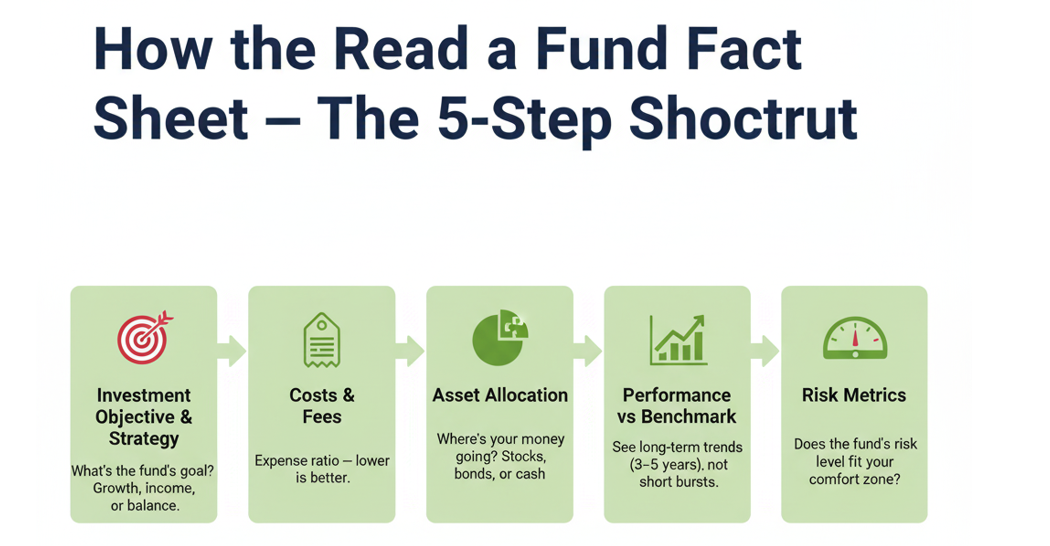
Image source: © 2025 Krish Capital Ptd Ltd
What to take with a grain of salt
Now that you know what to focus on, here are parts of the fact sheet you can treat more cautiously.
· Buzzwords & Marketing Language
Many fact sheets have phrases like “best‐in‐class”, “high conviction”, “team with strong track record”. While nice to read, they don’t replace concrete data which is communicated by performance + cost + risk. The factsheet may use marketing language, but that doesn’t change the facts.
· Very Short‑Term Performance
A fund may show that in the last 3 months or 6 months it did great. That’s interesting, but for long‑term investing it’s less meaningful than long‑term trends. One good few months may be luck or market‑timing. Focus more on 3‑5‑year (or longer) performance.
· Lots of Detailed Ratios You Don’t Understand
If you see Beta, R‑squared, Information ratio, etc — that is useful for advanced folks. But if you’re just starting, focus on the simpler risk label + standard deviation + fees. You’ll come back to the fancy measures later.
How to flow through a fact sheet — a practical reading order
Here’s a simple order you can use when you pick up a fact sheet:
- Read the Objective/Strategy — Does it align with what you want?
- Check the costs/fees — Is the fee reasonable for the type of fund?
- Check allocation/holdings — Are you comfortable with where the money is going?
- Check performance + benchmark — Is it doing well compared with similar funds?
- Check risk — Does the level of risk fit your comfort zone?
- Lightly browse the complex metrics + marketing fluff — Revisit later if you want deeper detail.
Final Thoughts
The fact sheet is your guide—a quick snapshot of what the fund is, how it works, its historical performance, and its costs. What truly matters is how well this snapshot aligns with you: your financial goals, investment horizons, and comfort with risk. Less important are the marketing buzzwords, flashy short-term numbers, or complicated technical ratios that may be hard to interpret.


 Mar 06, 2026




 Please wait processing your request...