Highlights
- Technology is reshaping investment decision-making and portfolio construction
- Investor demand is shifting toward transparency, cost efficiency, and outcomes
- Regulation and sustainability considerations are influencing fund strategies worldwide
Global portfolio management is undergoing a period of structural change as market dynamics, investor expectations, and technological capabilities continue to evolve. Asset management firms are adapting to a landscape shaped by digital innovation, changing risk profiles, regulatory scrutiny, and a growing focus on long-term outcomes rather than short-term performance. These developments are influencing how funds are structured, managed, and evaluated across regions.
Rise of Data-Driven and Quantitative Investing
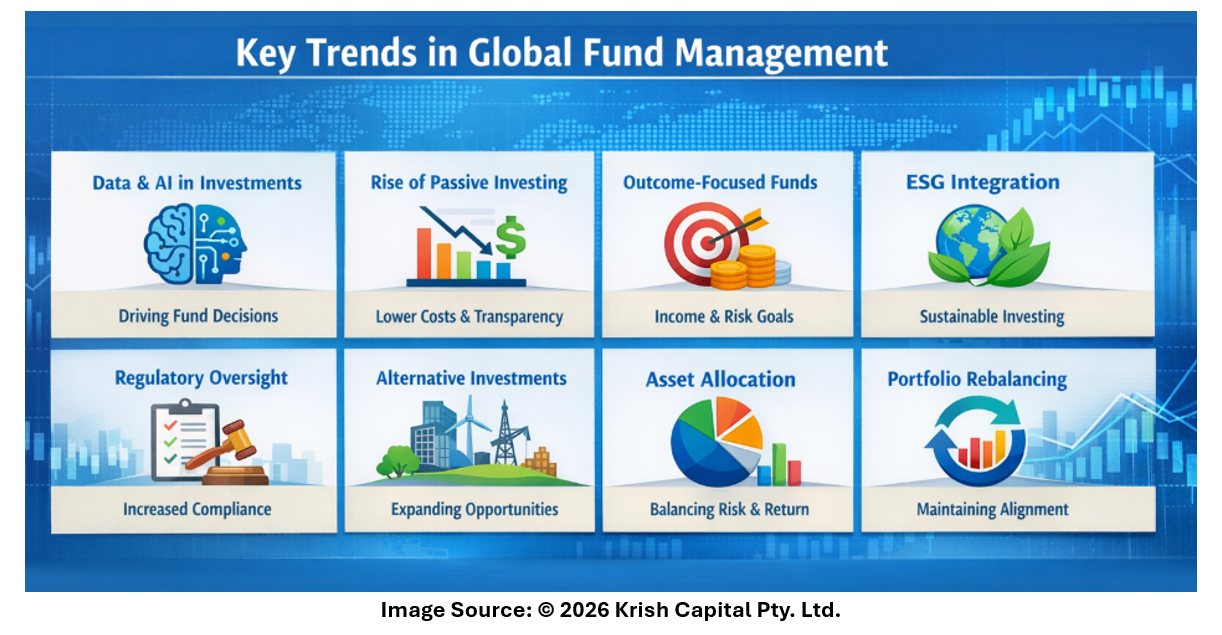
Advances in artificial intelligence, data analytics, and machine learning are playing an increasing role in global fund management. Fund managers are incorporating alternative data sources to supplement traditional financial analysis. Quant funds and model-driven strategies are increasingly used across equity and fixed-income portfolios to enhance portfolio efficiency, improve risk assessment, and support disciplined investment execution.
Continued Shift Toward Passive and Low-Cost Strategies
The shift toward passive investing continues as investors prioritise cost efficiency and benchmark-aligned returns. Index funds and exchange-traded funds are expanding beyond traditional equity benchmarks into fixed income, commodities, factor-based strategies, and thematic exposures. This trend is increasing scrutiny of active management, particularly around fees and performance consistency.
Growth of Outcome-Oriented Fund Solutions
Investor focus is gradually shifting from relative performance to outcome-based objectives such as income generation, capital preservation, inflation protection, and risk-managed growth. Fund managers are developing solutions aligned with specific investor needs, including target-date strategies and income-oriented portfolios.
Integration of ESG and Sustainability Factors
Environmental, social, and governance considerations are becoming embedded in global fund management practices. Green funds and other sustainability-linked strategies are expanding as fund managers integrate ESG metrics into valuation models, risk frameworks, and long-term capital allocation decisions.
Increased Regulatory and Compliance Oversight
Global regulators are placing greater emphasis on disclosure standards, risk controls, and investor protection. Fund managers are required to provide clearer information on fees, portfolio holdings, and risk exposure. As cross-border investment activity grows, firms must also manage compliance requirements across multiple jurisdictions.
Expansion of Alternative Investments
Alternative investments such as private equity, private credit, infrastructure, and real assets are becoming more prominent within diversified portfolios. Fund managers are increasingly incorporating alternatives to enhance diversification and return potential, while managing liquidity and valuation complexities.
Emphasis on Asset Allocation and Rebalancing
Strategic asset allocation remains a cornerstone of fund management, helping balance risk and return across market cycles. Disciplined rebalancing ensures portfolios remain aligned with investment objectives as market conditions change.
Conclusion
The future of global fund management is being shaped by technological adoption, evolving investor preferences, regulatory developments, and structural changes in capital markets. As the industry adapts, greater emphasis is likely to be placed on transparency, cost efficiency, risk management, and clearly defined investment outcomes.
Disclaimer:
This article (“Article”) has been prepared by Kalkine Pty Limited (ABN 34 154 808 312) (Australian financial services licence number 425376) (“Kalkine”) and its related bodies corporate who are authorised to provide general financial product advice. Kalkine.com.au and its associated pages are published by Kalkine.
Any information/advice provided in this article is general in nature and does not take into account your objectives, financial situation or needs. You should therefore consider whether the information is appropriate for your objectives, financial situation and needs before acting upon it.
There may be a Product Disclosure Statement, Information Memorandum or other offer document (“Offer Document”) for the securities or other financial products referred to in Kalkine articles. You should obtain a copy of the Offer Document and consider it before making any decision about whether to acquire the security or financial product.
Kalkine strongly recommends that you seek advice from a financial adviser, stockbroker or other professional (including taxation and legal advice) before acting on any advice/information in this Article or on the Kalkine website. Not all investments are appropriate for all people.
The information in this Article and on Kalkine website has been prepared from a wide variety of sources, which Kalkine, to the best of its knowledge and belief, considers accurate. Kalkine has made every effort to ensure the reliability of the information contained in its articles (including this Article), newsletters and websites. All information represents our views at the date of publication and may change without notice.
The information in this Article does not constitute an offer to sell securities or other financial products or a solicitation of an offer to buy securities or other financial products.
Kalkine does not issue, sell or deal in any financial products.
This Article may contain information on past performance of particular investments. Please note past performance is neither an indicator nor a guarantee of future performance.
To the extent permitted by law, and excluding any dishonesty or gross negligence by Kalkine, Kalkine disclaims and excludes all liability for any direct, indirect, implied, punitive, special, incidental or other consequential loss or damage arising from the use of or reliance on this Article, the Kalkine website and any information published on the Kalkine website without any warranties or representations by Kalkine to you. To the extent the law prohibits or limits this exclusion, Kalkine limits its liability to the resupply of services.
Please also read our Terms & Conditions and Financial Services Guide for further information.
Employees and/or associates of Kalkine and its related entities may hold interests in the securities or other financial products covered in this Article or on the Kalkine website. Any such employees and associates are required to comply with certain safeguards, procedures and disclosures as required by law.
Some of the images/music that may be used in the Article are copyright to their respective owner(s). Kalkine does not claim ownership of any of the pictures displayed/music used in the Article unless stated otherwise. The images/music that may be used in the Article are taken from various sources on the internet, including paid subscriptions or are believed to be in public domain. We have used reasonable efforts to accredit the source wherever it was indicated or was found to be necessary.
Kalkine Media Pty Ltd, an affiliate of Kalkine Pty Ltd, may have received, or be entitled to receive, financial consideration in connection with providing information about certain entity(s) covered on its website.
Copyright 2026 Krish Capital Pty. Ltd. (ABN 61629651510). All Rights Reserved. No part of this Article, or its content, may be reproduced in any form without our prior consent.

 AU
AU CA
CA NZ
NZ UK
UK US
US IND
IND

 Share
Share
 X (Formerly Twitter)
 Whatsapp
 Facebook
 LinkedIn
 Telegram
 Email This Article
 Copy Link
 Summarize with AI
 Chat GPT
 Perplexity


 Mar 06, 2026




 Please wait processing your request...