
 AU
AU CA
CA NZ
NZ UK
UK US
US IND
IND

 Share
Share
 X (Formerly Twitter)
 Whatsapp
 Facebook
 LinkedIn
 Telegram
 Email This Article
 Copy Link
 Summarize with AI
 Chat GPT
 Perplexity
Highlights
- Asset managers leverage AI to automate operations and reduce costs by up to 40%.
- Firms deploy machine learning to enhance alpha generation and portfolio optimisation.
- AI-driven scalability enables asset managers to transform business models and margins.
- Early AI adopters gain competitive edge as technology reshapes investment economics.
The asset-management industry is undergoing a pivotal shift: the tools that once merely supported operations are now poised to reshape the economics of how investment firms compete and scale. With headline cost pressures and margin erosion across the sector, the rise of artificial intelligence (AI) is emerging not just as a tactical enhancement—but as a strategic transformation.
Over the past decade, asset-managers enjoyed tailwinds of low interest rates, calm markets and strong inflows. But those tailwinds have reversed. In this context, AI offers a clear opportunity: not marginal improvements, but step changes in productivity, cost structure and business model flexibility.
How AI is reshaping economics
Here are the main levers through which AI is shifting the economics of asset management:
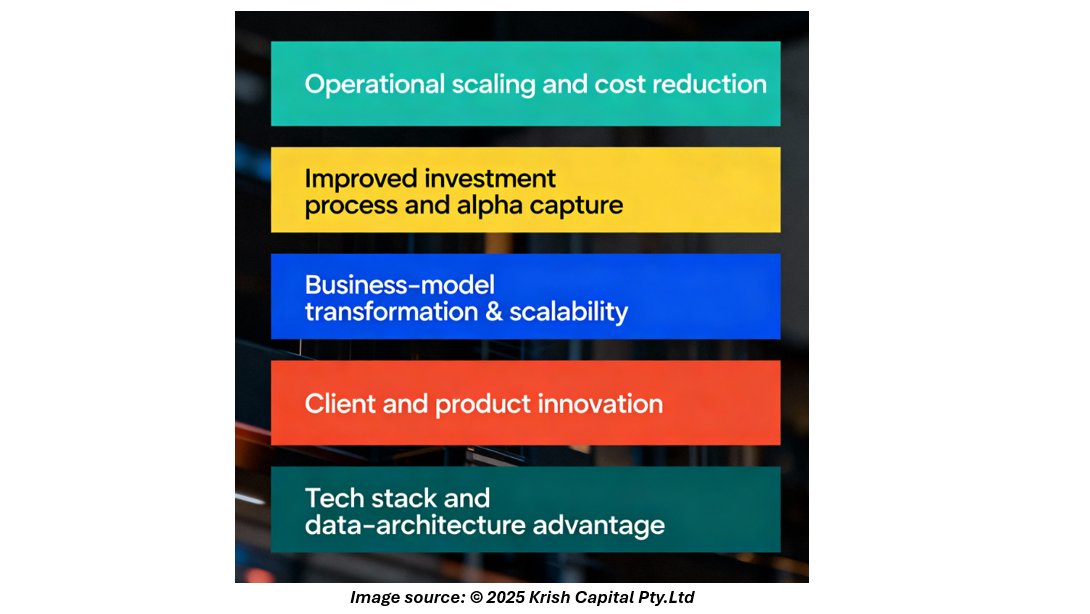
- Operational scaling and cost reduction: AI and machine-learning (ML) systems can automate tasks that previously required extensive human effort—from back-office processing, compliance monitoring, to document review. According to one report, up to 55 % of manual tasks in asset management may be automated within five years. Further, firms using AI report up to 40 % lower processing costs and faster workflow times.
- Improved investment process and alpha capture: Beyond simply lowering costs, AI gives asset managers a chance to improve decision-making, refine models faster, identify signals, and enhance risk-management frameworks. Machine learning is increasingly used for portfolio optimisation, risk modelling, and quantitative signals.
- Business-model transformation & scalability: With AI, firms can start to shift from purely human-driven asset-management models to platforms that embed intelligence, data-engineering and automation. McKinsey estimates that AI (and generative/agentic AI) could affect 25-40 % of a typical asset manager’s cost base. Scaling these capabilities gives first-movers a competitive advantage as costs fall and reinvestment becomes possible.
- Client and product innovation: AI enables more personalised advice, dynamic portfolio construction, and improved client servicing (e.g., chatbot-driven interactions) that can drive revenue growth or at least arrest margin decline. As firms automate operations they can redirect savings into growth initiatives.
- Tech stack and data-architecture advantage: Firms that address legacy systems, data silos and fragmented infrastructure (a common challenge) can reap greater benefit from AI initiatives. As McKinsey points out, many firms still devote the bulk of tech spend to “run” rather than “change” the business—limiting AI’s effect.
Key strategic implications
- Leadership, governance & talent: Embedding AI is not just about tools—it’s about reorganising workflows, talent pipelines, governance and talent priorities (for example shifting from coding to data-engineering, from human-fund-manager focus to human-AI collaboration).
- Scalable architecture, reusable “recipes”: Firms that treat AI as isolated pilot projects will likely not harvest full value. Instead, building reusable AI components (“recipes”) and embedding them at scale gives sustainable advantage.
- Data and tech debt: Many firms are constrained by legacy systems, fragmented data architecture and silos. Those issues must be resolved to unlock AI’s full potential. McKinsey labels it the “complexity tax”.
- Cost re-investment opportunity: As cost bases shrink (via AI), the freed-up capital can be reinvested in growth: product innovation, new markets, alternative strategies or client digital-experience upgrades.
- Competitive bifurcation: Those asset managers who adopt AI early and scale effectively will likely widen the gap with laggards—driving consolidation, fee-pressure intensification and differentiation based on tech/data capabilities.
Risks and challenges
Of course, the transformation is not automatic. Risks include:
- Underestimating integration complexity and governance overhead.
- Failing to scale pilot AI use-cases beyond a unit or asset-class.
- Data-governance, model-risk, regulatory and ethical concerns around AI.
- Vendor dependence and loss of proprietary capability if tech roadmap is outsourced.
- Cost of change management, upskilling and restructuring operations.
Outlook
In summary, AI offers a powerful lever for the asset-management industry to reset its economics—reducing costs, improving decision-making, scaling operations and innovating business models. But unlocking the full potential will require strategic clarity, technical discipline and organisational reinvention. Firms that treat AI as a tactical add-on risk falling behind; those that embed it as a core strategic differentiator stand to gain meaningful advantage in an increasingly commoditised and cost-pressured landscape.


 Mar 06, 2026




 Please wait processing your request...