
 AU
AU CA
CA NZ
NZ UK
UK US
US IND
IND

 Share
Share
 X (Formerly Twitter)
 Whatsapp
 Facebook
 LinkedIn
 Telegram
 Email This Article
 Copy Link
 Summarize with AI
 Chat GPT
 Perplexity
_10_17_2025_03_58_03_638797.jpg)
Highlights
- ETFs are a type of Exchange-Traded Product (ETP), offering exposure to diversified portfolios that track an index or asset class, regulated by ASIC and ASX.
- ETPs cover broader instruments, including ETFs, exchange-traded managed funds (ETMFs), and structured products, varying in complexity and risk profile.
- Understanding distinctions is vital for Australian investors when matching investment goals with risk appetite and regulatory structure.
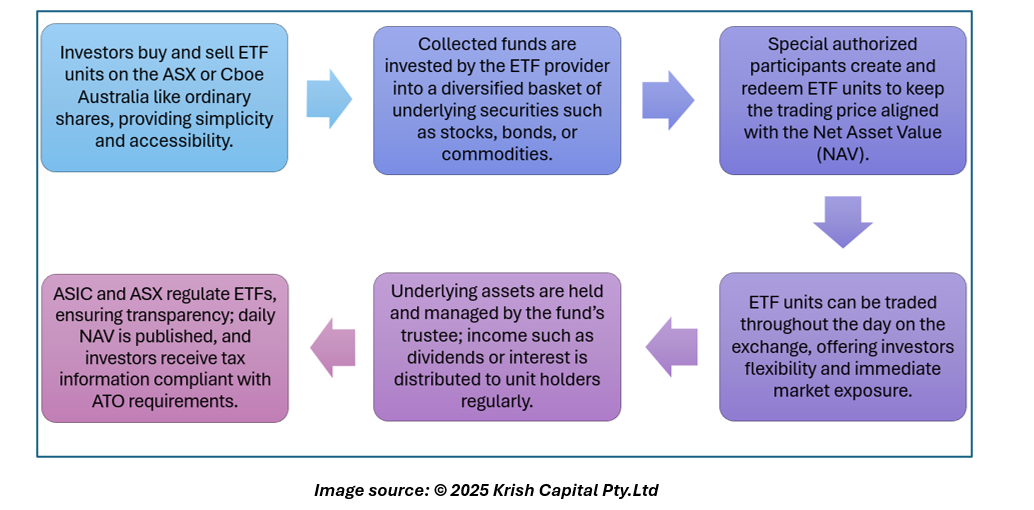
Exchange-Traded Funds (ETFs) are managed investment funds that can be traded on exchanges such as the Australian Securities Exchange (ASX) and Cboe Australia. Investors purchase units in an ETF, which represents a share of the fund that holds underlying assets like equities, bonds, or commodities. The ETF price closely tracks the Net Asset Value (NAV) due to the creation and redemption process by authorised participants, ensuring transparency and liquidity.
Most Australian ETFs are passively managed, replicating the performance of market indices. However, some active ETFs and synthetic ETFs involve professionals actively selecting investments or using derivatives, introducing additional risk layers. ETFs enable diversification across asset classes, including local and global shares, property, fixed income, and commodities.
Role of ETFs in Managed Investment Trusts
ETFs operate through a trust structure, meaning investors own units rather than direct shares in the underlying companies. Income generated from the fund’s investments is distributed to unit holders, forming part of assessable income for tax purposes.
ETFs listed on registered exchanges like the ASX allow self-directed investors or those using licensed brokers to access diversified portfolios without directly purchasing individual securities. Under the Australian taxation system, ETFs may include assets such as shares, property, bonds, precious metals, and digital assets. Each asset class may have distinct taxation outcomes, making it important for investors to review fund statements carefully.
Scope of Exchange-Traded Products in Australia
Exchange-Traded Products (ETPs) encompass a broader range of listed investment vehicles beyond ETFs. According to the Australian Securities and Investments Commission (ASIC), ETPs are open-ended managed investment schemes with units traded on licensed exchanges. Categories include:
- ETFs – passive funds tracking indices or market segments
- Exchange-Traded Managed Funds (ETMFs) – actively managed portfolios
- Structured Products – complex instruments providing exposure through derivatives or other synthetic means
ETPs enable accessibility and liquidity but vary significantly in structure and risk. Regulatory oversight by ASIC ensures that ETP providers comply with disclosure obligations and admission requirements under Information Sheet 230. Investors should identify whether a product is leveraged, synthetic, or managed to gauge risk alignment with investment strategy.
Australian Treasury-Linked Exchange Products
Exchange-Traded Treasury Bonds (eTBs), a subclass of ETPs, grant investors exposure to Australian Government debt securities. eTBs can be traded on the ASX like shares but represent beneficial ownership of Treasury Bonds via CHESS Depositary Interests (CDIs). Each eTB mirrors the coupon payments and face value obligations linked to the underlying Treasury Bond, maintained by the Australian Government.
For risk-averse investors, eTBs offer stable, government-backed returns while retaining liquidity through exchange trading. Unlike typical ETFs or ETMFs, they involve no exposure to market equity risk, making them a conservative inclusion in diversified portfolios.
ETF Structure and Operation
Regulatory Framework and Investor Considerations
ETPs and ETFs listed in Australia function under a robust regulatory system supervised by ASIC and the ASX to maintain transparency and investor protection. The distinction between these instruments lies primarily in how they achieve exposure and manage risk. ETFs generally suit long-term, low-cost investors seeking market-tracking performance, while other ETP variants, such as leveraged or inverse products which carry higher volatility and potential for amplified losses.
Understanding product disclosure statements, taxation reporting through the ATO, and the underlying structure is essential for Australian investors navigating this diverse investment landscape.


 Mar 06, 2026




 Please wait processing your request...