
 AU
AU CA
CA NZ
NZ UK
UK US
US IND
IND

 Share
Share
 X (Formerly Twitter)
 Whatsapp
 Facebook
 LinkedIn
 Telegram
 Email This Article
 Copy Link
 Summarize with AI
 Chat GPT
 Perplexity
Highlights
- Cash provides liquidity and optionality during periods of market uncertainty.
- Rising interest rates have restored cash’s role as a return-generating asset.
- Holding cash can reduce portfolio volatility during market drawdowns.
- Strategic cash allocation supports disciplined entry into risk assets.
Cash is often viewed as an idle asset, associated with low returns and opportunity cost. In long-term market narratives, cash is frequently portrayed as something to deploy rather than hold. However, in certain economic and market environments, cash can function as a deliberate asset class, playing a strategic role in portfolio construction rather than simply waiting on the sidelines.
Understanding Cash Beyond “Dry Powder”
Traditionally, cash has been considered a temporary holding, capital parked while waiting for a better opportunity. Yet cash offers distinct characteristics that differentiate it from equities, bonds, or alternatives. These include capital preservation, immediate liquidity, and low correlation with risk assets. When market conditions become volatile or uncertain, these features can provide stability that other asset classes may not.
Cash also introduces what is often referred to as “optionality.” Holding cash allows market participants to respond quickly to changing conditions, whether that means taking advantage of asset price dislocations or meeting liquidity needs without selling assets at unfavourable prices.
Interest Rates and the Return of Yield
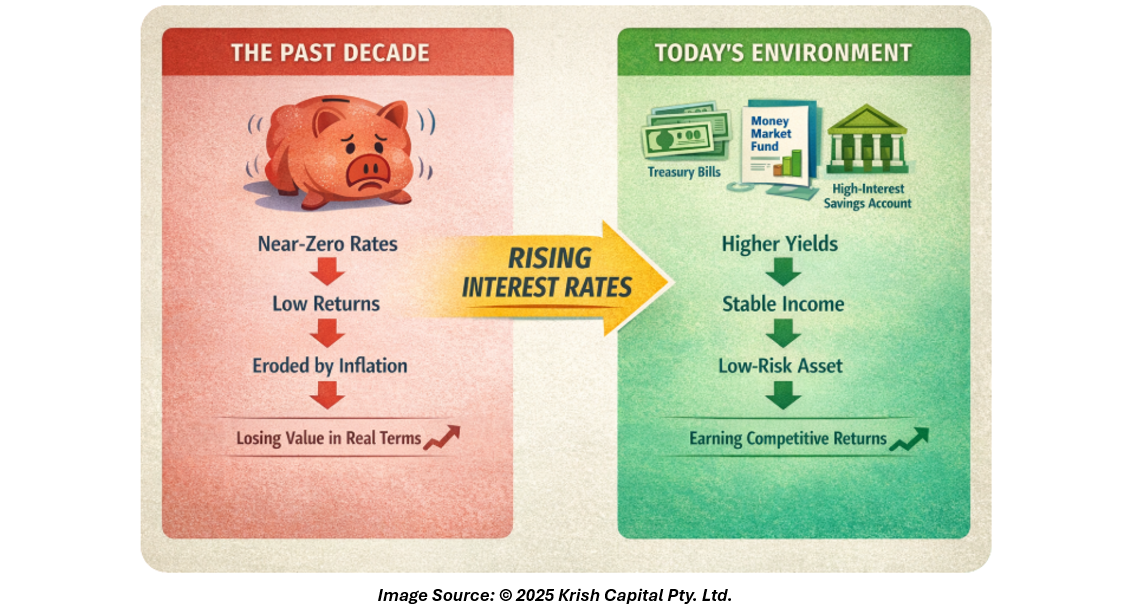
One of the primary criticisms of cash in the past decade was its negligible return. Near-zero interest rate environments meant that holding cash almost guaranteed a loss in real terms after inflation. However, periods of higher interest rates alter this equation. Cash and cash-equivalent instruments such as treasury bills, money market funds, and high-interest savings accounts can generate meaningful nominal yields.
While these returns may still trail equities over long periods, they can compare favourably with fixed income during times of rising rates or when bond prices face pressure. In such contexts, cash begins to resemble a low-risk income asset rather than a return-free placeholder.
Risk Management and Volatility Control
Another strategic role of cash lies in risk management. During market downturns, cash does not experience drawdowns in the same way as risk assets. This defensive quality can reduce overall portfolio volatility and cushion losses during periods of stress.
Maintaining a cash allocation can also help avoid forced selling. In environments where asset prices decline sharply, having readily available liquidity allows portfolios to meet obligations or rebalance without selling depreciated assets. This can be particularly relevant during periods of tightening financial conditions or systemic shocks.
Timing, Discipline, and Behavioural Benefits
Beyond its financial characteristics, cash can influence decision-making discipline. When markets are rising rapidly, being fully invested may feel rewarding, but it can also increase exposure to overvaluation risks. Holding some cash can encourage patience and reduce the pressure to chase momentum-driven rallies.
Conversely, during market corrections, cash enables measured deployment rather than reactive decision-making. This can support more systematic entry into assets when valuations adjust, rather than attempting to time markets perfectly.
The Cost of Holding Too Much Cash
Despite its benefits, cash is not without drawbacks. Over extended periods, excessive cash holdings can lead to underperformance, particularly in growth-oriented portfolios. Inflation remains a key risk, as purchasing power can erode if cash returns fail to keep pace with rising prices.
As a result, cash is most effective when viewed as a tactical or strategic allocation rather than a permanent substitute for productive assets. The appropriate level of cash depends on market conditions, risk tolerance, and broader portfolio objectives.
Cash as a Strategic Choice
Cash does not generate earnings growth, dividends, or capital appreciation in the traditional sense. Yet its role extends beyond returns alone. In certain environments—characterised by elevated uncertainty, shifting monetary policy, or valuation risks—holding cash can be a considered strategy rather than a passive stance.
When used deliberately, cash can provide flexibility, stability, and resilience, reinforcing its place as a functional asset class within diversified portfolios.


 Mar 06, 2026




 Please wait processing your request...