
 AU
AU CA
CA NZ
NZ UK
UK US
US IND
IND

 Share
Share
 X (Formerly Twitter)
 Whatsapp
 Facebook
 LinkedIn
 Telegram
 Email This Article
 Copy Link
 Summarize with AI
 Chat GPT
 Perplexity
Highlights
- Blockchain provides real-time, immutable transparency across fund operations.
- Tokenisation enables fractional ownership, boosting liquidity and market access.
- Smart contracts automate compliance, transfers, and dividend distributions.
- Trade settlements become nearly instantaneous, reducing operational delays.
- Back-office workloads and reconciliation errors are significantly minimised.
- Enhanced security reduces fraud and counterparty risk for all stakeholders.
The funds management industry has historically relied on complex, multi-layered processes that often lack real-time transparency and can be inefficient. From mutual funds to private equity and hedge funds, intermediaries play critical roles in operations such as trade settlement, record-keeping, and compliance. These processes can be slow, costly, and prone to errors. Blockchain technology is being increasingly explored as a transformative solution to these challenges, offering transparency, tokenisation, and operational efficiency that could reshape how investment funds operate.
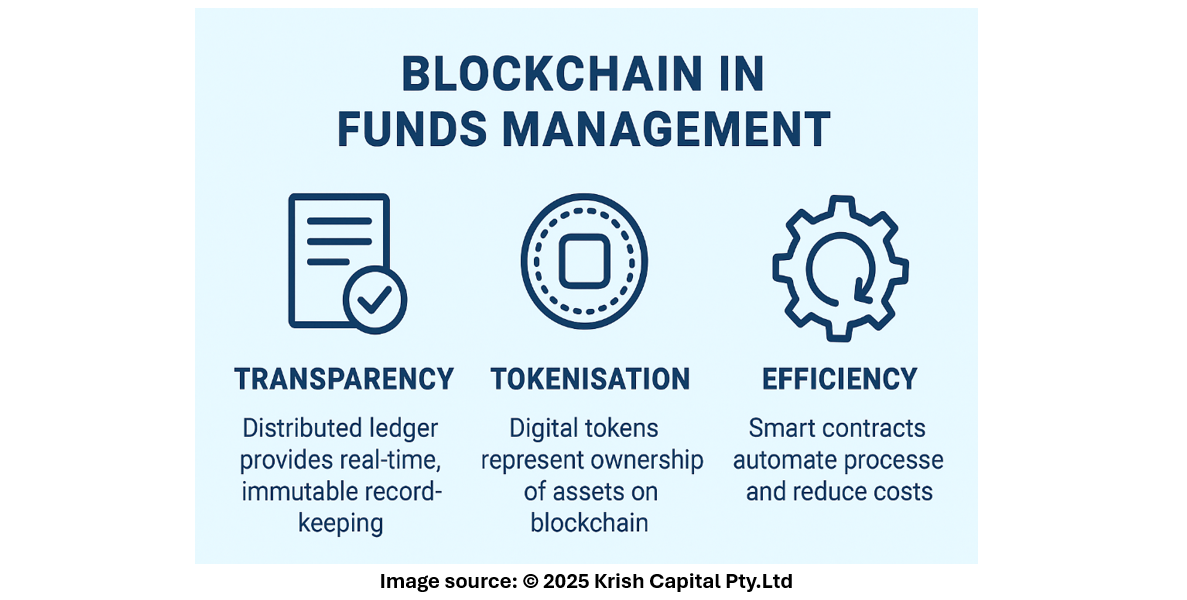
Transparency Through Distributed Ledger Technology
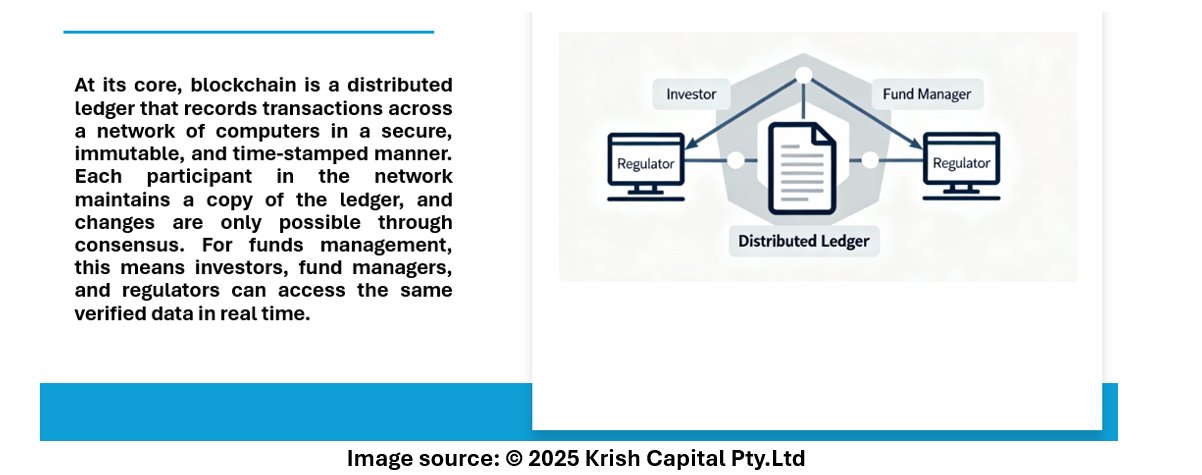
Transparency is particularly critical in areas such as fund reporting, trade settlements, and compliance monitoring. Traditional fund operations involve multiple intermediaries and reconciliations between custodian banks, brokers, fund administrators, and auditors. Blockchain reduces this complexity by providing a single source of truth. Investors can verify the performance of their holdings directly, and regulators can access transaction histories without relying solely on fund-reported data. This increased transparency enhances trust, mitigates the risk of fraud, and strengthens overall governance in the industry.
Tokenisation of Assets
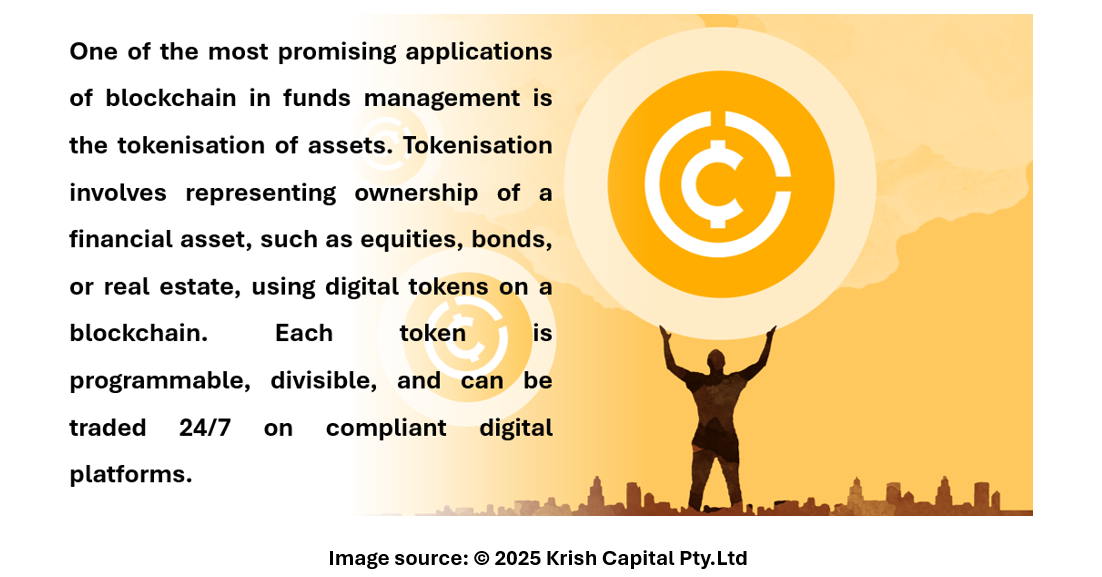
Tokenised assets open up several opportunities for fund managers. Liquidity, traditionally limited for assets like private equity or commercial real estate, can be enhanced as tokens allow fractional ownership and easier secondary trading. Investors with smaller capital can access previously illiquid markets, broadening participation and diversification. Additionally, tokenisation facilitates more automated and precise compliance. Smart contracts—self-executing contracts encoded on the blockchain, can enforce rules for ownership, transfers, dividend distributions, and regulatory obligations without human intervention. This not only reduces operational risk but also lowers administrative costs for fund managers.
Efficiency Gains and Cost Reduction
Operational efficiency is another major advantage of blockchain adoption in funds management. Traditional fund operations often involve manual reconciliations, delayed settlements, and complex record-keeping. Blockchain automates many of these processes, particularly with the integration of smart contracts.
For example, trade settlement—a process that can take two to three days in traditional markets—can be almost instantaneous on a blockchain. Smart contracts can automatically execute transfers of ownership and cash upon meeting predefined conditions. Fund administrators can reduce back-office workload, errors, and the risk of reconciliation mismatches. Similarly, reporting processes for investors and regulators become more efficient, as data can be accessed and verified on-demand.
Moreover, blockchain can reduce counterparty risk. Since every transaction is recorded and verified across the network, the possibility of double-spending, fraud, or unauthorised manipulation is minimised. This provides an additional layer of security and confidence for all stakeholders involved in funds management.
Challenges and Considerations
While blockchain offers compelling benefits, its adoption in funds management is not without challenges. Regulatory clarity remains a key concern. Different jurisdictions have varying rules regarding tokenised securities, digital assets, and blockchain-based fund structures. Fund managers must ensure compliance with anti-money laundering (AML), know-your-customer (KYC), and securities regulations when implementing blockchain solutions.
Technology integration is another hurdle. Legacy systems, operational workflows, and staff expertise may not immediately align with blockchain-based platforms. Transitioning to a blockchain-enabled infrastructure requires careful planning, investment in technology, and training for personnel. Interoperability between different blockchain networks and traditional systems also remains a consideration.
The Road Ahead
Despite these challenges, blockchain’s potential to improve transparency, enable tokenisation, and drive efficiency in funds management is undeniable. Several pilot programs and live deployments have already demonstrated tangible benefits, including faster settlements, reduced costs, and enhanced investor access to previously illiquid assets. As regulators provide more guidance and technology matures, blockchain adoption in funds management is expected to accelerate.
In conclusion, blockchain represents a fundamental shift for the funds management industry. By combining transparency, tokenisation, and efficiency, it has the potential to transform traditional processes, empower investors, and reshape operational paradigms. While challenges remain, the growing interest from asset managers, custodians, and fintech innovators indicates that blockchain could soon become a cornerstone of modern fund management.


 Mar 06, 2026




 Please wait processing your request...