
 AU
AU CA
CA NZ
NZ UK
UK US
US IND
IND

 Share
Share
 X (Formerly Twitter)
 Whatsapp
 Facebook
 LinkedIn
 Telegram
 Email This Article
 Copy Link
 Summarize with AI
 Chat GPT
 Perplexity
_09_29_2025_08_11_25_841647.png)
Image source: © 2025 Krish Capital Pty.Ltd
Highlights
- Gold, private equity, and infrastructure offer diversification beyond traditional stocks and bonds.
- Each asset class provides unique benefits—ranging from safe-haven protection to long-term income streams.
- Alternatives carry risks such as illiquidity, volatility, and regulatory exposure.
Diversification is a core principle of sound investing. While equities and bonds form the backbone of most portfolios, many individuals look to alternative assets for added diversification, potential inflation protection, and uncorrelated returns. Three of the most widely discussed alternatives are gold, private equity, and infrastructure. Each plays a distinct role and carries its own opportunities and risks.
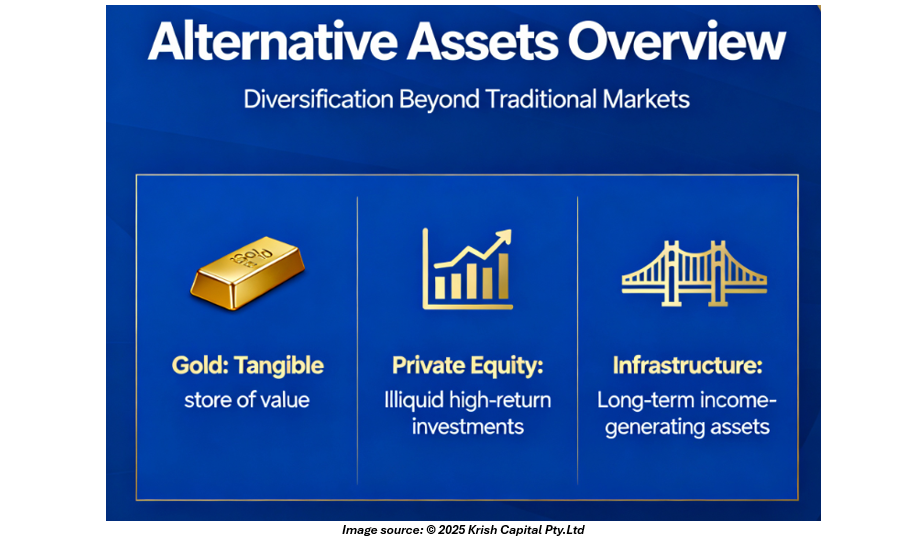
Gold: The Traditional Safe Haven
Gold has been used as a store of value for centuries. Unlike equities, gold does not generate cash flows, but it often shines during periods of economic uncertainty or high inflation.
- Key advantages: Hedge against currency fluctuations and inflation, global demand driven by central banks and jewelry markets.
- Risks: Price volatility, lower dividend or yield, and performance tied heavily to macroeconomic sentiment. Gold is typically accessed through physical bullion, gold-backed ETFs, or mining companies.
Private Equity: Investing Beyond Public Markets
Private equity refers to capital invested directly in private companies or in buyouts of public companies that are then taken private. These investments often target businesses with positive growth potential or underperforming firms that can be restructured.
- Key advantages: Potential for higher returns than public equities, exposure to innovative or early-stage companies.
- Risks: Illiquidity (capital is locked in for years), high fees, and reliance on skilled managers to generate value. Access for individuals is usually through private equity funds, listed investment companies, or exchange-traded vehicles that pool capital from many investors.
Infrastructure: Long-Term, Stable Cash Flows
Infrastructure assets include roads, airports, utilities, and renewable energy projects. These are often essential services with predictable demand, making them attractive for those seeking stability.
- Key advantages: Steady, long-term income streams, often linked to inflation-adjusted contracts.
- Risks: High upfront costs, regulatory changes, and political risks in certain regions.
- One can gain exposure through infrastructure funds, listed infrastructure companies, or direct ownership by large institutional investors.
Why Alternatives Matter
Allocating a portion of a portfolio to alternative assets can help reduce volatility and improve risk-adjusted returns. Gold provides a hedge during crises, private equity offers growth outside public markets, and infrastructure delivers reliable income. However, alternatives are not without trade-offs; higher costs, complexity, and sometimes reduced liquidity mean they should be considered carefully within an overall financial plan.


 Mar 06, 2026




 Please wait processing your request...