
 AU
AU CA
CA NZ
NZ UK
UK US
US IND
IND

 Share
Share
 X (Formerly Twitter)
 Whatsapp
 Facebook
 LinkedIn
 Telegram
 Email This Article
 Copy Link
 Summarize with AI
 Chat GPT
 Perplexity
Highlights
- Benchmarks help investors judge whether a fund is performing well or falling behind.
- The right benchmark depends on the fund’s objective, not market popularity.
- Investors use benchmarks to understand returns, risk, and manager value.
- Global markets rely on different index families, each telling their own story.
Imagine entering a race but never checking a stopwatch. You may feel like you ran well, but you wouldn’t know how you truly performed. Investing works the same way. A fund benchmark is the measuring stick that tells you whether your money is growing in line with the part of the market you intended to invest in. It could be an index tracking U.S. large caps, global bonds, emerging markets, or a specific investing style such as value or ESG.
At its core, a benchmark answers the simplest but most important question in investing:
“Did my fund do better, worse, or about the same as the market it claims to follow?”
Without this reference point, performance becomes guesswork. With it, investors gain clarity and confidence.
Beyond Returns: What Benchmarks Teach Us
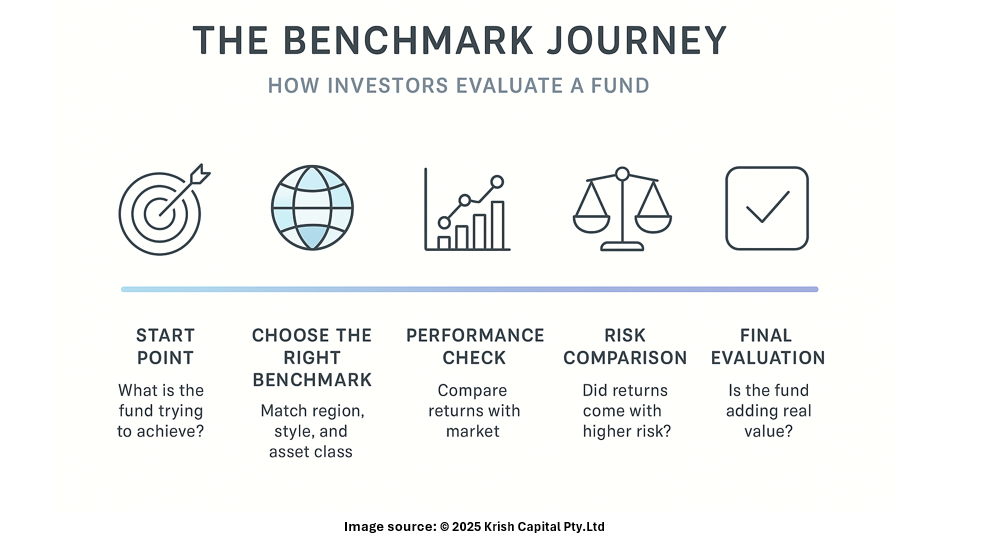
Benchmarks do far more than show whether a fund beats the market. They help investors understand how that return was achieved.
For example, if a fund shows 10% growth, but the benchmark delivered 15% during the same period, the fund actually underperformed — even though headline returns look positive. Conversely, a fund that delivers 8% when the benchmark delivered 4% shows real skill and strategy at work.
This comparison also helps investors identify risk-taking behavior. Sometimes managers outperform by taking larger bets or concentrating in certain sectors. A benchmark comparison reveals whether outperformance came from smart decisions or simply more volatility. Sources frequently emphasize how fundamental this distinction is in evaluating manager skills.
A Global Perspective
In today’s interconnected world, investors aren’t limited to their home markets. That makes benchmarks even more important — and more varied.
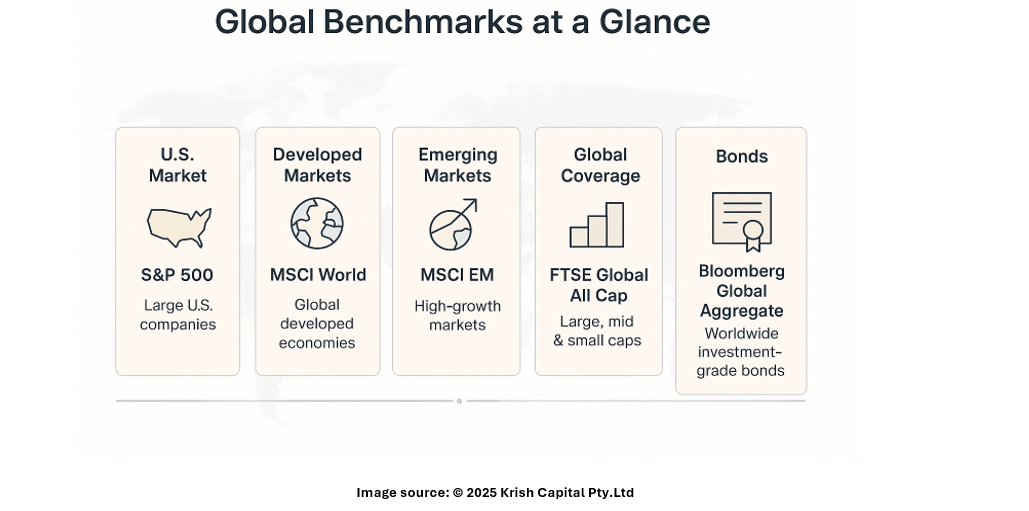
Some of the widely used global and regional benchmarks include:
- S&P 500 Index – Large U.S. companies
- MSCI World Index – Developed markets worldwide
- MSCI Emerging Markets Index – Higher-growth emerging economies
- FTSE Global All Cap Index – Large, mid, and small-cap stocks globally
- Bloomberg Global Aggregate Bond Index – International investment-grade bonds
Each benchmark represents a specific slice of the global market. Comparing a European equity fund to the S&P 500 would be meaningless — the markets behave differently and face different economic pressures.
This is why MSCI’s global benchmark family, widely cited by global institutions, is crucial for investors seeking international exposure. These indices divide the world into clean, comparable segments, making it easier to set realistic expectations and monitor performance.
Benchmarks and Fund Costs: What Investors Often Miss
Benchmarks also influence how investors interpret fees and value.
- Passive funds (like many ETFs) aim to track a benchmark closely. Their value lies in low costs and predictable performance.
- Active funds aim to beat their benchmark. For this higher goal, they often charge higher fees.
This makes comparison essential: if an active fund consistently lags its benchmark, it becomes difficult to justify higher costs. Sources highlight that evaluating a fund relative to its benchmark is one of the most reliable ways to judge whether fees are fair.
How Benchmarks Guide Portfolio Construction
Institutional investors — pension funds, sovereign wealth funds, global asset managers — use benchmarks as building blocks for building diversified portfolios. They often combine multiple benchmarks to reflect a target asset allocation, such as 60% equities and 40% bonds.
Modern investing trends have led to innovations in benchmarks as well:
- ESG indices for sustainability-focused investors
- Factor-based benchmarks capturing value, momentum, or quality
- Multi-asset benchmarks blending global equity and bond exposures
These evolving benchmarks help investors align portfolio design with changing global market realities.
Avoiding the Benchmark Trap
While benchmarks are essential, they should not control every decision. Over-focusing on matching a benchmark can push managers to trade too often, limit creativity, or take positions just to avoid short-term deviations.
A healthier approach is to view the benchmark as a reference point, not a rulebook. It guides evaluation, not day-to-day action. Investors should periodically check whether the benchmark still fits the fund’s strategy — and their own goals.
How to Use Benchmarks Wisely
Here’s a simple, practical checklist:
- Check the benchmark listed in the fund factsheet — it should match the fund’s region, style, and asset class.
- Compare long-term returns — at least 3–5 years of data.
- Look at risk measures relative to the benchmark — this shows whether outperformance came from smart investing or higher risk.
- Review fees — especially for active funds.
- Ensure the benchmark aligns with your personal investment goals — global vs. regional, equity vs. bond, conservative vs. growth.
This approach keeps your investment evaluation grounded, objective, and aligned with real market expectations.
Final Thoughts
Benchmarks may sound like a technical detail, but they shape nearly every meaningful part of investing — performance, expectations, risk, and even fees. For global investors, they serve as a map and a compass, helping navigate a world of diverse markets and shifting opportunities.
Used wisely, benchmarks don’t just measure progress — they make investing clearer, more informed, and much more intentional.


 Mar 06, 2026




 Please wait processing your request...