
 AU
AU CA
CA NZ
NZ UK
UK US
US IND
IND

 Share
Share
 X (Formerly Twitter)
 Whatsapp
 Facebook
 LinkedIn
 Telegram
 Email This Article
 Copy Link
 Summarize with AI
 Chat GPT
 Perplexity
_11_17_2025_17_46_23_442239.png)
Highlights
- Investor psychology often influences fund choices more than actual performance.
- Common Behavioural biases can lead to return-chasing, panic-selling, and under-diversification.
- Awareness of these biases improves long-term decision-making and portfolio discipline.
- Simple guardrails—like automatic investing and predefined rules—help reduce Behavioural mistakes.
Selecting the “right” fund is often framed as a purely analytical process: compare returns, check fees, assess risk levels, and make a rational decision. In reality, fund selection is rarely that logical. Investors—novice and experienced alike—make decisions influenced heavily by psychology, emotions, and cognitive shortcuts. This is where Behavioural finance steps in: to explain why people don’t always behave rationally, especially when money is involved.
Behavioural biases can significantly affect portfolio outcomes, often in ways investors don’t realise. Recognising these patterns is the first step toward building a more resilient, well-constructed investment approach.
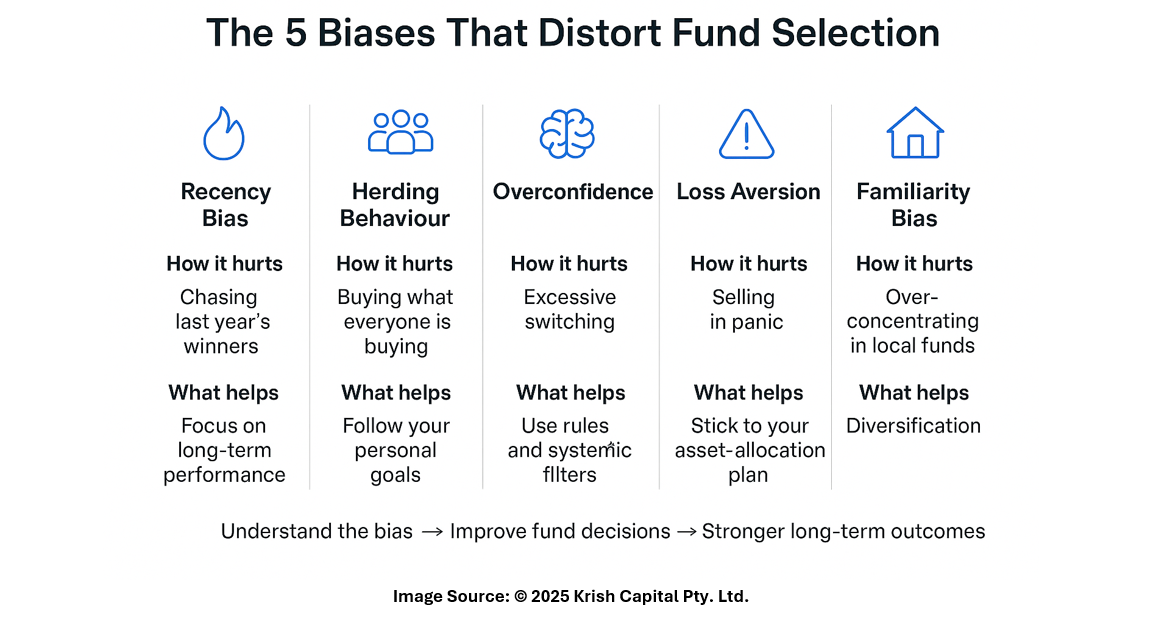
- Recency Bias: Chasing What’s Hot
One of the most common traps in fund selection is recency bias, which occurs when investors give excessive weight to recent performance. If a fund delivered promising returns last year, investors tend to assume it will continue outperforming indefinitely.
This leads to return-chasing, a behavior well-documented in academic research. Studies consistently show that investors who frequently jump in and out of funds based on recent performance often earn significantly less than the funds themselves.
In simple terms: the more an investor chases short-term winners, the more they hurt their long-term results.
What helps:
Looking at long-term, 5-10-year performance and consistency rather than last year’s “hero” numbers.
- Herding Behaviour: Following the Crowd
Humans naturally feel safer when they move with the crowd, and investing is no different. Herding shows up when investors pile into a trending sector fund, a viral ETF, or a suddenly popular theme—simply because “everyone else is buying it.”
This behaviour has been highlighted in multiple fund flow analyses, showing how massive inflows often follow periods of outperformance, and do not precede them. Unfortunately, by the time the crowd rushes in, valuations are often stretched and risks elevated.
Herding creates bubbles on the way up and panic on the way down, leading to poor timing decisions.
What helps:
Setting personal investment objectives and sticking to them—not to the headlines.
- Overconfidence: Overestimating One’s Ability to Pick Winners
Overconfidence bias leads investors to believe they can identify outperforming funds or time in the market better than others. Researchers found that overconfident investors trade more frequently and often achieve lower returns due to mistakes and transaction costs.
In fund selection, overconfidence shows up as:
- Switching funds too frequently
- Believing “this time is different”
- Overestimating one’s ability to read market trends
Fund managers themselves work within complex, data-heavy frameworks; it’s unrealistic for retail investors to outperform consistently with quick judgments.
What helps:
Using systematic selection processes—like predefined screens—to reduce impulsive decision-making.
- Loss Aversion: The Pain of Losing Drives Bad Decisions
Loss aversion explains that humans feel the pain of losses twice as intensely as the pleasure of equivalent gains.
In practical fund selection and investing, this manifests as:
- Selling a fund after temporary underperformance
- Avoiding higher-risk funds even when appropriate for long-term goals
- Holding losing investments too long hoping they “come back”
Loss aversion often leads investors to act defensively in market downturns, even when staying invested might be the better long-term choice.
What helps:
Having an asset-allocation plan that accounts for volatility and sets realistic expectations.
- Familiarity Bias: Choosing What Feels Safe
Many investors prefer domestic funds, blue-chip-heavy portfolios, or asset managers they recognise—regardless of whether they’re the best fit. This is familiarity bias.
While familiarity feels comforting, it can also lead to under-diversification. Research notes that home-country bias is one of the biggest contributors to portfolio concentration risks globally.
What helps:
Embracing diversification across geographies, sectors, and fund styles.
Building Guardrails Against Bias
The good news? Behavioural biases can be managed. Practical steps include:
- Automating investments through SIPs or recurring contributions
- Defining investment rules for when to buy, hold, or exit funds
- Using model portfolios or default asset allocations
- Reviewing portfolios at fixed intervals instead of reacting to market noise
These approaches help remove emotional decision-making and keep an investor focused on long-term goals rather than short-term anxieties.
Mastering Your Mind = Mastering Your Portfolio
Behavioural finance teaches us that fund selection is influenced as much by emotions and instincts as by numbers on a factsheet. Understanding biases—recency, herding, overconfidence, loss aversion, and familiarity—can dramatically improve investment outcomes. By recognising these tendencies and implementing simple guardrails, investors can make smarter, calmer, and more disciplined fund choices that support long-term wealth creation.


 Mar 06, 2026




 Please wait processing your request...