
 CA
 NZ
 UK
 US
 IND

 AU

 Share
 X (Formerly Twitter)
 Whatsapp
 Facebook
 LinkedIn
 Telegram
 Email This Article
 Copy Link
 Summarize with AI
 Chat GPT
 Perplexity

Key Highlights
- Utilities Demonstrate Relative Resilience: Utilities (XUJ) recorded the smallest decline, falling 0.53%, as investors favoured defensive exposure during a broad market sell-off.
- Consumer Staples and Discretionary Follow: Consumer Staples (XSJ) declined 0.84%, while Consumer Discretionary (XDJ) lost 0.92%, limiting losses compared with most other sectors.
- Energy and Healthcare Record Similar Losses: Energy (XEJ) and Healthcare (XHJ) both fell 1.30%, reflecting broad-based weakness rather than a clear defensive-sector rotation.
- Financials and Property Remain Under Pressure: Financials (XFJ) declined 1.32%, while Property (XPJ) fell 1.34%, as investors reduced exposure across a range of domestic industries.
- Technology Leads the Declines: Information Technology (XIJ) plunged 4.70%, as global AI-related uncertainty and a sharp technology sell-off weighed on Australian technology stocks.
- Mining-Related Sectors Also Weaken: Materials (XMJ) and Resources (XJR) declined 2.15% and 1.97%, respectively, amid falling precious and industrial metal prices.
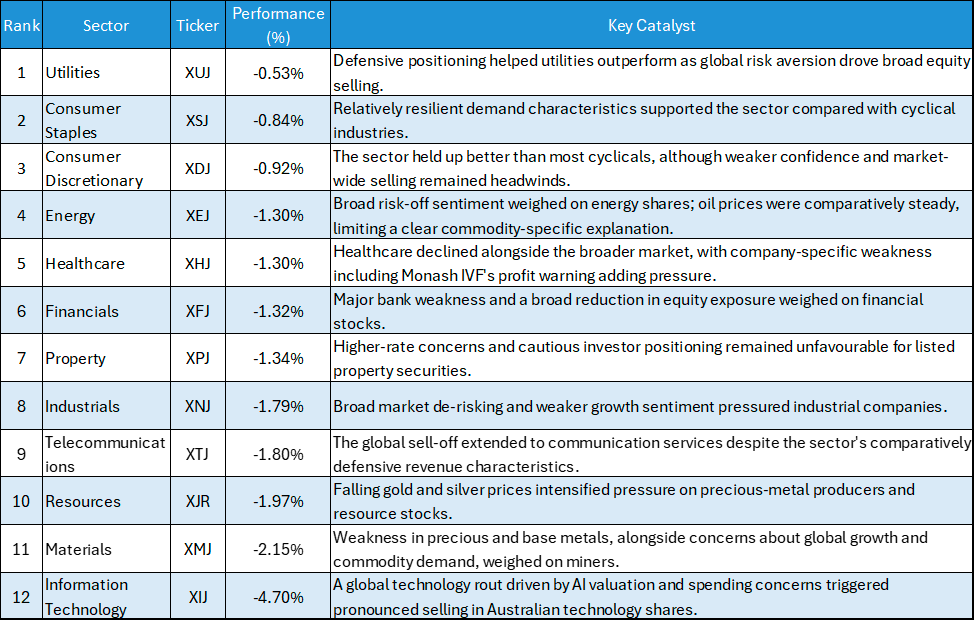
Australian equities experienced broad-based selling pressure on Friday, 20 November 2026, with all 12 supplied sector indices finishing lower. Utilities (XUJ) was the most resilient, declining 0.53%, followed by Consumer Staples (XSJ), which lost 0.84%. At the other end of the ranking, Information Technology (XIJ) fell 4.70%, substantially underperforming the rest of the market. Materials (XMJ) and Resources (XJR) also recorded sizeable declines as weakness in precious and industrial metals added to investor concerns. The session reflected a defensive, risk-averse environment, with global technology weakness and softer domestic labour-market data weighing on sentiment.
Daily ASX Sector Performance Summary
Defensive Sectors Lead Relative Performance
Utilities (XUJ) recorded the smallest decline, falling 0.53%, while Consumer Staples (XSJ) lost 0.84%. Their relative resilience was consistent with investors seeking businesses perceived to have more predictable Demand and cash flows during a period of heightened uncertainty. Consumer Discretionary (XDJ) also outperformed most sectors, declining 0.92%, although the Negative return showed that defensive characteristics did not insulate the broader market from selling pressure. The pattern was consistent with a preference for comparatively stable Earnings rather than an outright move into positive-performing sectors.
Broad Weakness Extends Across Domestic Sectors
Energy (XEJ) and Healthcare (XHJ) both declined 1.30%, while Financials (XFJ) and Property (XPJ) fell 1.32% and 1.34%, respectively. The healthcare sector faced additional company-specific pressure after Monash IVF warned of lower profits amid weaker demand and rising costs, with its shares falling sharply. Financial stocks were also affected by losses among major banks as investors reduced exposure across the market. Industrials (XNJ) and Telecommunications (XTJ) recorded steeper declines of 1.79% and 1.80%, suggesting that the session's risk aversion extended beyond technology and commodity-related companies.
Technology and Mining Stocks Bear the Brunt
Information Technology (XIJ) was the weakest sector, plunging 4.70%. The decline followed a sharp overnight sell-off in global technology shares, driven by renewed uncertainty over artificial intelligence valuations, spending and the potential returns from substantial investment. Australian technology stocks including Megaport, Life360, Xero and WiseTech Global came under heavy pressure, reinforcing the sector's underperformance. The scale of the decline highlighted the sensitivity of growth-oriented technology companies to changes in global risk appetite.
Materials (XMJ) and Resources (XJR) also recorded notable losses of 2.15% and 1.97%, respectively. Falling precious-metal prices weighed on gold and silver producers, while weakness in base metals added pressure to diversified miners. Market reports also pointed to a sharp decline in gold and silver prices, with copper weaker during the session. Although oil prices were comparatively steady and Newcastle coal moved higher, the broader reduction in exposure to cyclical and commodity-linked equities continued to weigh on materials and resource stocks.
Bottom Line
Utilities (XUJ) led the ASX sector ranking on 20 November 2026, declining 0.53%, followed by Consumer Staples (XSJ) and Consumer Discretionary (XDJ), which fell 0.84% and 0.92%, respectively. However, all 12 supplied sector indices finished in negative territory, highlighting the breadth of the market sell-off. Information Technology (XIJ) was the weakest performer, falling 4.70%, while Materials (XMJ) and Resources (XJR) also faced considerable pressure amid weakness in Commodity prices. The session reflected a clear risk-off environment, with global AI-related uncertainty, softer Australian employment data and falling metals prices undermining investor confidence.


 Nov 24, 2026





 Please wait processing your request...