
 CA
 NZ
 UK
 US
 IND

 AU

 Share
 X (Formerly Twitter)
 Whatsapp
 Facebook
 LinkedIn
 Telegram
 Email This Article
 Copy Link
 Summarize with AI
 Chat GPT
 Perplexity

Key Highlights
- Telecommunications Leads the Market: Telecommunications (XTJ) advanced 1.05%, recording the strongest performance among the 12 supplied sector indices.
- Technology and Healthcare Also Advance: Information Technology (XIJ) gained 0.96%, while Healthcare (XHJ) increased 0.83%, demonstrating resilience despite broader market weakness.
- Defensive Sectors Show Mixed Performance: Telecommunications and Healthcare attracted buying interest, while Consumer Staples (XSJ) and Utilities (XUJ) recorded modest declines.
- Financials and Industrials Remain Relatively Resilient: Financials (XFJ) declined 0.32%, while Industrials (XNJ) lost 0.33%, limiting their losses compared with more cyclical sectors.
- Energy Faces Selling Pressure: Energy (XEJ) dropped 2.08%, reflecting weakness in international oil and coal prices.
- Mining Sectors Record the Largest Declines: Resources (XJR) and Materials (XMJ) fell 3.66% and 3.68%, respectively, as declining Commodity prices intensified selling pressure across Mining stocks.
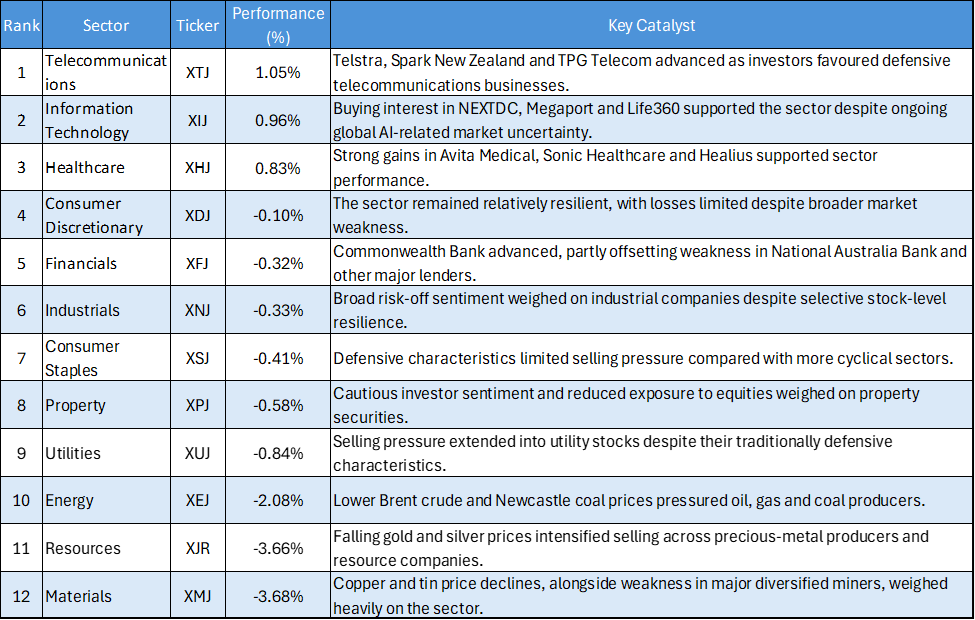
Australian equities experienced considerable divergence across sectors on Thursday, 19 November 2026. Telecommunications (XTJ) was the strongest-performing sector, gaining 1.05%, followed by Information Technology (XIJ), which advanced 0.96%. Healthcare (XHJ) also recorded a positive return of 0.83%, reflecting selective buying interest in defensive and growth-oriented businesses. However, selling pressure remained pronounced across commodity-related sectors, with Materials (XMJ) and Resources (XJR) recording the largest declines. Energy (XEJ) also experienced significant weakness, falling 2.08% as lower oil and coal prices weighed on energy producers. Overall, the session highlighted a rotation towards selected technology, healthcare and telecommunications stocks, while investors reduced exposure to mining and energy companies.
Daily ASX Sector Performance Summary
Telecommunications, Technology and Healthcare Lead Sector Gains
Telecommunications (XTJ) was the strongest-performing sector, advancing 1.05%. Telstra Group, Spark New Zealand and TPG Telecom recorded positive performances, demonstrating the relative attractiveness of telecommunications businesses during a period of heightened market uncertainty. Telstra gained 1.6%, while Spark New Zealand and TPG Telecom advanced 1.1% and 0.7%, respectively. Their relatively predictable Revenue streams and defensive characteristics helped attract investor interest.
Information Technology (XIJ) followed with a gain of 0.96%. Interestingly, local technology shares demonstrated resilience despite continued uncertainty surrounding global artificial intelligence valuations. NEXTDC and Megaport advanced 4.3% and 3.5%, respectively, while Life360 gained 4.0%. The recovery in selected technology companies suggested that investors were identifying potential value opportunities following previous declines, although Volatility across the broader technology sector remains elevated.
Healthcare (XHJ) also performed strongly, gaining 0.83%. Avita Medical advanced 8.1%, while Sonic Healthcare and Healius increased 6.3% and 4.3%, respectively. Sonic Healthcare's positive trading update, which reaffirmed its FY27 Earnings guidance and highlighted continued momentum across its diagnostic services, provided additional support for investor confidence.
Financials, Industrials and Consumer Sectors Demonstrate Relative Resilience
Financials (XFJ) declined 0.32%, with mixed performances among Australia's major banking institutions. Commonwealth Bank advanced 0.4%, outperforming its major peers, while National Australia Bank fell 0.9%. Westpac and ANZ also recorded modest declines. Despite the weakness, the sector demonstrated relative resilience compared with commodity-sensitive industries.
Industrials (XNJ) lost 0.33%, while Consumer Staples (XSJ) declined 0.41%. Both sectors experienced relatively limited selling pressure, suggesting that investors remained selective in reducing exposure to equities.
Consumer Discretionary (XDJ) recorded the smallest decline among the negatively performing sectors, falling just 0.10%. Property (XPJ) and Utilities (XUJ), however, declined 0.58% and 0.84%, respectively, indicating that defensive characteristics alone were insufficient to prevent selling pressure across all traditionally defensive market segments.
Energy and Mining Sectors Face Significant Selling Pressure
Energy (XEJ) declined 2.08%, reflecting weakness across international energy markets. Brent Crude prices fell 2.5% overnight before stabilising during Asian trading. Oil and gas producers experienced considerable selling pressure, with Karoon Energy declining 4.7%, while Beach Energy, Woodside Energy and Santos also recorded losses. Newcastle coal futures dropped 3.0% to approximately US$141.65 per tonne, adding further pressure to coal producers.
Resources (XJR) and Materials (XMJ) were the weakest-performing sectors, declining 3.66% and 3.68%, respectively. Precious-metal prices experienced substantial declines, with COMEX gold futures falling 3.2% overnight and silver futures losing 4.9%. Gold producers including Emerald Resources, Ramelius Resources and Northern Star Resources recorded significant losses.
Materials stocks also experienced considerable weakness as copper futures plunged 5.3% overnight, while London Metal Exchange tin prices declined 9.9%. Major diversified miners were heavily affected, with South32 falling 5.9%, Rio Tinto declining 4.1% and BHP losing 3.7%. The simultaneous weakness across industrial metals and precious metals highlighted growing concerns surrounding commodity Demand and global economic growth.
Bottom Line
Telecommunications (XTJ) led ASX sector performance on 19 November 2026, advancing 1.05%, followed by Information Technology (XIJ) and Healthcare (XHJ), which gained 0.96% and 0.83%, respectively. Financials, Industrials and Consumer Discretionary demonstrated relative resilience, recording comparatively modest declines. However, Energy experienced significant selling pressure, while Resources and Materials were the weakest-performing sectors, declining 3.66% and 3.68%, respectively. The weakness reflected substantial declines in gold, silver, copper and coal prices, alongside continued uncertainty surrounding global commodity demand. Overall, the session highlighted a clear divergence between selected technology and defensive businesses and commodity-dependent companies, suggesting that investors remained cautious towards resource-related exposures while selectively accumulating shares in telecommunications, technology and healthcare.


 Nov 24, 2026





 Please wait processing your request...