
 CA
 NZ
 UK
 US
 IND

 AU

 Share
 X (Formerly Twitter)
 Whatsapp
 Facebook
 LinkedIn
 Telegram
 Email This Article
 Copy Link
 Summarize with AI
 Chat GPT
 Perplexity

Key Highlights
- Consumer and service-oriented ASX penny stocks offer relatively more stable revenue profiles compared to mining explorers and clinical-stage biotechs, making them an increasingly relevant option for investors seeking small capital exposure with lower binary risk.
- The 2026 reporting season has highlighted that while revenue growth is achievable, scaling efficiently and managing cost structures remain the defining challenges for companies in this segment.
- Murray Cod Australia (ASX: MCA) represents an emerging niche in premium aquaculture, a sector with structural long-term demand tailwinds but high capital and operational requirements.
- Starpharma Holdings (ASX: SPL) sits at the intersection of pharmaceutical technology and commercial licensing, offering a more diversified risk profile than early-stage biotech peers.
- Profitability — not merely revenue — is now the metric investors are scrutinising most intensely across this segment.
Sector Overview
In a market frequently dominated by the drama of resource discoveries and clinical trial announcements, consumer and services penny stocks offer a quieter but increasingly compelling investment story. These are companies operating in the real economy — producing food, developing pharmaceutical delivery platforms, and building commercial businesses that generate recurring revenues. They are not immune to risk, but their risk profile is typically more linear than the binary, event-driven volatility that characterises mining and biotech peers.
The 2026 investment environment has, in many ways, become more favourable to this segment by default. As speculative excess in the mining and technology spaces corrects, patient capital is gravitating toward businesses with tangible revenues, identifiable customers, and comprehensible operating models. Consumer and services penny stocks — often overlooked in bull markets — are gaining renewed attention.
However, scrutiny has sharpened too. The reporting season has reinforced that revenue growth without credible margin improvement is insufficient to attract sustained institutional interest. For ASX-listed small caps in this space, the challenge is not proving that a market exists for their products and services — it is demonstrating that they can scale toward profitability in a cost-effective and capital-efficient manner.
This article examines two of the most noteworthy ASX consumer and services penny stocks as of April 2026 in depth: Murray Cod Australia and Starpharma Holdings.
Company Profiles
Murray Cod Australia (ASX: MCA)
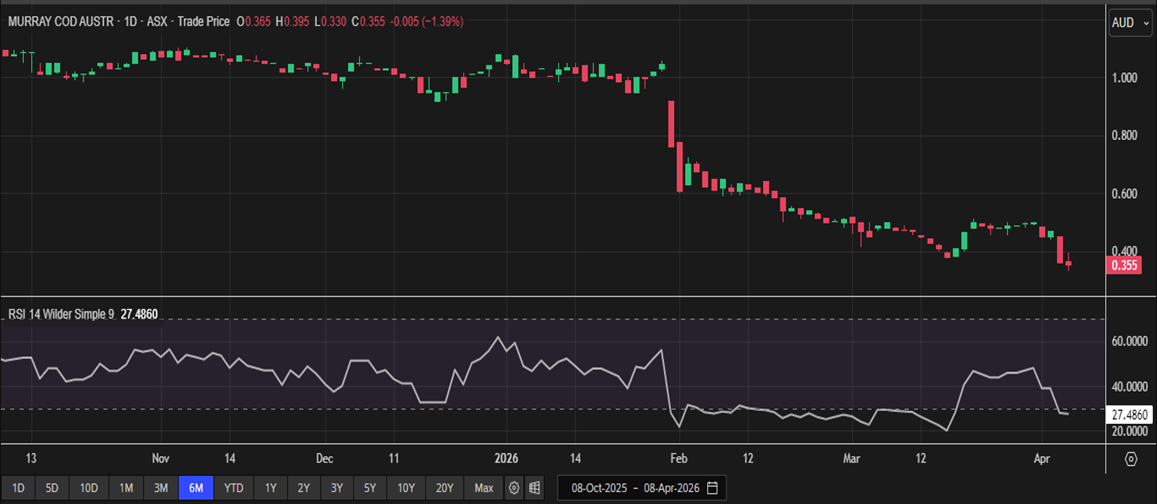
Price: ~A$0.38 | Market Cap: ~A$46 million
Company Overview
Murray Cod Australia is a vertically integrated aquaculture company producing premium Murray cod — Australia's largest native freshwater fish and a species with deep cultural significance and growing commercial appeal. The company operates land-based recirculating aquaculture systems (RAS), which allow year-round fish production in controlled environments, independent of seasonal and environmental variables that affect traditional fishing.
Murray cod has historically been a boutique, restaurant-quality product, but MCA is working to scale production to reach a broader consumer audience while maintaining the premium positioning that commands higher price points. The company supplies into Australian food service and retail channels, with growing interest from export markets, particularly in Asia, where demand for sustainably sourced premium seafood is expanding.
The aquaculture industry globally is being reshaped by sustainability imperatives, food security concerns, and the declining productivity of wild fisheries. Land-based RAS operations — while capital intensive — are increasingly viewed as part of the long-term solution to global protein supply challenges. Murray Cod Australia's technology-forward approach positions it favourably within this structural trend.
Financial Insights
MCA's financial profile reflects a company in active growth mode, investing ahead of its current revenue base:
- Growing revenue base — sales volumes are increasing as production capacity expands and distribution relationships deepen
- High operating costs — land-based aquaculture is energy and labour intensive; feed costs, electricity, and facility maintenance represent significant fixed and variable cost components
- Capital investment cycle — the company continues to invest in production infrastructure, compressing short-term earnings but building future capacity
- Market capitalisation of ~A$46 million — a relatively modest valuation that may understate the long-term asset value if production scaling is achieved
The critical financial ratio for investors to monitor is the cost per kilogram of fish produced relative to the average selling price per kilogram. As production volumes increase, fixed cost dilution should improve unit economics — but this depends on management's ability to scale efficiently without compromising fish health, product quality, or yield rates.
Inventory management is also a distinctive financial consideration for aquaculture businesses. Fish in various growth stages represent a biological asset on the balance sheet, and their value is subject to mortality risk, disease risk, and market price fluctuations — factors that add a layer of complexity to financial analysis not present in most small-cap businesses.
Management Outlook
MCA's management team has articulated a clear long-term vision: build Australia's leading premium freshwater fish brand, scaled to serve both domestic and export markets. Near-term strategic priorities for 2026 include:
- Production volume growth — increasing biomass under management to improve revenue and cost efficiency
- Export market development — building distribution channels into Asian markets, where premium Australian seafood commands significant price premiums
- Operational efficiency initiatives — identifying and implementing improvements in feed conversion ratios, energy management, and facility utilisation
- Brand development — investing in consumer marketing to strengthen the Murray Cod Australia brand in the premium food segment
Management has acknowledged that the path to profitability is a medium-term exercise, dependent on sustained execution across production, sales, and cost management simultaneously. The aquaculture industry's inherent biological and operational complexity makes this a genuinely challenging management task.
Price Performance
MCA trades at approximately A$0.38, a level that reflects both the company's early commercial progress and investor caution about the timeline and cost of scaling. The stock has been relatively range-bound, consistent with a business where progress is steady but not spectacular enough to trigger sharp re-ratings. A meaningful acceleration in revenue growth — supported by evidence of improving unit economics — would likely be the catalyst for a sustained move higher.
For patient investors with an understanding of agricultural and food production dynamics, MCA offers an interesting combination of structural tailwinds, genuine product differentiation, and modest current valuation. The key risk is execution: scaling land-based aquaculture profitably is technically demanding and capital intensive, and the company is still proving its model at commercial scale.
Starpharma Holdings (ASX: SPL)
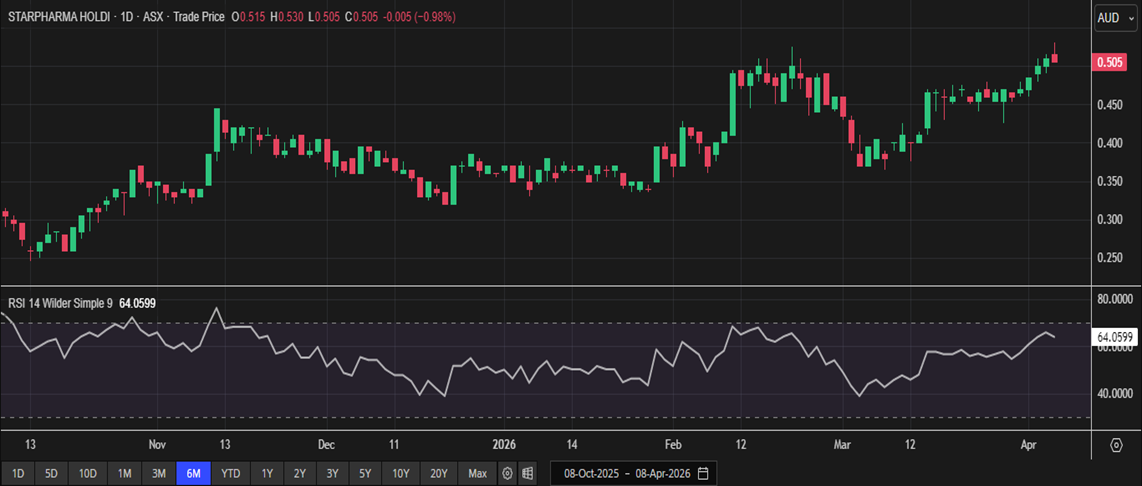
Price: ~A$0.51 | Market Cap: ~A$214 million
Company Overview
Starpharma Holdings is an Australian biopharmaceutical company with a differentiated business model — one that blends pharmaceutical technology development with active commercialisation, making it more operationally mature than most of its ASX small-cap biotech peers.
The company's core technology platform is built around dendrimers — highly branched, nanoscale molecular structures that can be engineered to improve the delivery and performance of drug molecules. Starpharma has applied this technology across two primary business segments:
- VivaGel® and Women's Health — Starpharma's lead commercial product, VivaGel BV, is an FDA- and TGA-approved treatment for bacterial vaginosis with commercial distribution partnerships in multiple markets.
- DEP® Drug Delivery Technology — a platform technology that enhances the efficacy and tolerability of existing oncology drugs by enabling more targeted delivery. Starpharma has licensing partnerships with major global pharmaceutical companies leveraging the DEP® platform.
This dual commercial and development model is relatively unusual among ASX penny stocks and gives Starpharma a more complex — but potentially more resilient — financial profile than single-asset, pre-revenue biotech peers.
Financial Insights
Starpharma's financials reflect its hybrid commercial-development status:
- Revenue from licensing and product sales — providing a meaningful if variable income stream that partially funds operations
- Ongoing R&D expenditure — the DEP® platform pipeline requires sustained investment to generate the clinical data that underpins partnership and licensing value
- Mixed earnings performance — the company is not consistently profitable, as R&D investment and partnership timing create variability in reported earnings
- Market capitalisation of ~A$214 million — pricing in a meaningful premium for the DEP® platform's potential alongside the existing commercial business
The licensing revenue model is worth understanding in detail. Starpharma receives milestone payments and royalties from pharmaceutical partners as DEP® formulations advance through development and, eventually, commercial launch. This creates a financial profile where revenues can be lumpy — significant in periods when milestones are achieved, and quieter in periods between them. For analysts, this makes annual earnings a less reliable metric than multi-year cash generation and the value of the licensing pipeline.
Management Outlook
Starpharma's management team is focused on progressing the DEP® platform through clinical development in partnership with global pharmaceutical companies, while simultaneously growing the commercial footprint of its women's health products.
Key strategic priorities for 2026 include:
- Advancing DEP® oncology partnerships — driving development milestones with existing partners to unlock milestone payments and build the clinical evidence base for the platform
- Expanding VivaGel BV commercial reach — extending distribution into additional international markets to grow product revenue
- New licensing discussions — the DEP® platform's versatility makes it applicable to a wide range of drug molecules, and management is actively pursuing additional partnership discussions
- Cost discipline — managing R&D expenditure relative to near-term revenue to maintain a sustainable cash position
The company's management team carries significant experience across pharmaceutical development, regulatory affairs, and commercial partnerships — a depth of expertise that is a genuine competitive advantage at Starpharma's stage of development.
Price Performance
SPL trades at approximately A$0.51 — the highest nominal price among the consumer and services penny stocks discussed in this article. The stock has historically exhibited lower volatility than pure-play clinical-stage biotechs, reflecting the stabilising effect of existing commercial revenues. However, it is not immune to sector-wide biotech sentiment swings, and any adverse developments in the DEP® clinical pipeline could trigger a material de-rating.
For investors seeking biotech exposure with somewhat less binary risk than a single-asset, pre-revenue company, Starpharma offers a differentiated option. The combination of existing revenues, a versatile technology platform, and established
pharmaceutical partnerships gives it a more balanced risk-reward profile than most of its ASX peers trading at similar price points.
Cross-Sector Insight: The Profitability Imperative
Both Murray Cod Australia and Starpharma Holdings illustrate a broader theme defining consumer and services penny stocks in 2026: the market is no longer willing to grant indefinite benefit of the doubt to companies that generate revenue without a credible path to profitability.
MCA faces the operational challenge of scaling a biologically complex production system efficiently. Starpharma faces the commercial challenge of converting a sophisticated technology platform into consistent, growing licensing income. Both companies are navigating their respective challenges competently — but neither has yet delivered the profitability inflection that would unlock a new investor audience and compress their risk premiums.
This creates both opportunity and risk. Investors with the patience and conviction to hold through the current execution phase may be rewarded with significant re-ratings as profitability milestones are achieved. Those expecting near-term earnings may be disappointed.


 Nov 11, 2026





 Please wait processing your request...