
 AU
AU CA
CA NZ
NZ UK
UK US
US IND
IND

 Share
Share
 X (Formerly Twitter)
 Whatsapp
 Facebook
 LinkedIn
 Telegram
 Email This Article
 Copy Link
 Summarize with AI
 Chat GPT
 Perplexity
Key Market Data
1. Company Overview
Insurance Australia Group Limited (ASX:IAG) is the largest general insurance company in Australia and New Zealand. IAG provides insurance products under leading brands including NRMA, CGU, SGIO, SGIC, Swann, and WFI in Australia, and NZI, State, and AMI in New Zealand. The company insures over 9 million customers across its markets.
2. Business Model and Operations
IAG operates through two segments: Australia and New Zealand. The Australia division provides personal lines insurance (home, motor, and personal) and commercial insurance (business packages, professional indemnity, and workers compensation). The New Zealand division provides similar products in the NZ market. IAG uses a multi-brand strategy to target different customer segments. The company also has significant reinsurance arrangements to manage catastrophe exposure.
3. Recent Market Performance
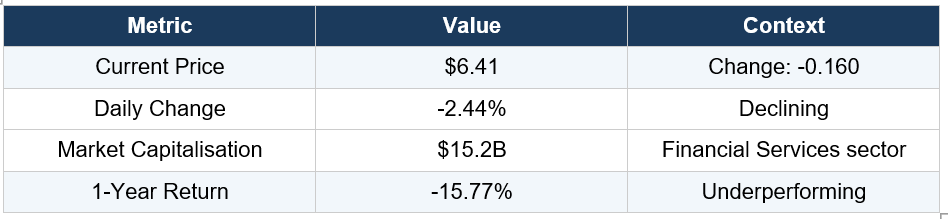
As of 9 March 2026, Insurance Australia Group is trading at $6.41, representing a daily decline of 2.44% with a change of $-0.16. The company commands a market capitalisation of $15.2B, placing it firmly among Australia's largest listed companies within the Financial Services sector.
Over the trailing twelve-month period, IAG has delivered a total return of -15.77%, underperforming the broader S&P/ASX 50 index which returned 6.47% over the same period. This underperformance relative to the benchmark reflects headwinds specific to the company or its sector that have weighed on investor sentiment. The broader market context is one of heightened volatility, with the ASX 50 experiencing a 3.64% decline on this particular trading session, suggesting macroeconomic or geopolitical factors contributing to broad-based selling pressure.
4. Sector Analysis and Competitive Positioning
Insurance Australia Group operates within the Financial Services sector of the S&P/ASX 50 index. The Financial Services sector is the largest component of the ASX 50, representing approximately 40.5% of the index by market capitalisation. This sector has been shaped by interest rate dynamics, regulatory evolution, and ongoing digital transformation. Major Australian banks have benefited from strong net interest margins during the rate hiking cycle, though the outlook faces potential headwinds as monetary policy potentially shifts toward easing.
Within this competitive landscape, Insurance Australia Group has established a challenged but strategically positioned market position. The company's market capitalisation of $15.2B reflects its scale and significance within the sector. Competitive advantages include the depth of operational expertise, established customer relationships, brand recognition, and strategic asset positions that collectively create barriers to entry and support long-term value creation. The company's ability to adapt to evolving market conditions and regulatory requirements will be critical to maintaining and enhancing its competitive standing.
5. Outlook and Investment Considerations
IAG has declined 15.77% over the past year, impacted by concerns about elevated natural catastrophe claims costs and competitive pressures in premium pricing. The Australian insurance market has experienced significant premium increases over recent years, which may face resistance as affordability becomes a growing concern. However, IAG's dominant market position, strong brand portfolio, and improving underlying margins provide a foundation for recovery. Climate change-related catastrophe frequency remains the most significant ongoing risk to the business.
6. Risk Assessment
Investors considering Insurance Australia Group should be aware of several key risk factors that could impact future performance and returns. Macroeconomic risks include the potential for a global economic slowdown, particularly given the interconnected nature of Australian markets with global trade and commodity cycles. The ongoing recalibration of monetary policy by the Reserve Bank of Australia introduces interest rate risk that affects borrowing costs, asset valuations, and consumer spending patterns across the economy.
Company-specific risks include operational execution challenges, competitive pressures from both domestic and international players, and the need for continued investment in technology, infrastructure, and human capital to maintain competitive advantages. Regulatory and compliance risks are an ever-present consideration, particularly as government policy evolves in areas such as environmental standards, taxation, foreign investment rules, and sector-specific regulation. Currency risk is also relevant given Australia's trade exposure and the impact of AUD movements on companies with international operations or commodity-linked revenues.
Additionally, environmental, social, and governance considerations are increasingly material for investors evaluating Insurance Australia Group. Climate-related transition risks, social licence to operate, workforce dynamics, and board governance quality all factor into the comprehensive risk assessment. The company's approach to these ESG factors will likely influence its long-term sustainability and attractiveness to a growing cohort of responsible investors. Geopolitical tensions, supply chain vulnerabilities, and cybersecurity threats represent further risks in the current operating environment.
7. Conclusion
Insurance Australia Group (ASX: IAG) represents a turnaround candidate within the S&P/ASX 50 index. With a market capitalisation of $15.2B and a one-year return of -15.77%, the stock has lagged the broader index, reflecting specific headwinds that warrant careful assessment. Investors should weigh the company's competitive positioning, growth prospects, and risk factors against current valuation levels when making investment decisions. As always, diversification, thorough due diligence, and alignment with individual risk tolerance and investment objectives remain paramount considerations.


 Mar 10, 2026




 Please wait processing your request...