
 CA
 NZ
 UK
 US
 IND

 AU

 Share
 X (Formerly Twitter)
 Whatsapp
 Facebook
 LinkedIn
 Telegram
 Email This Article
 Copy Link
 Summarize with AI
 Chat GPT
 Perplexity

If you had invested $10,000 in Bannerman Energy Ltd (ASX:BMN) just year ago, you would be sitting on approximately $18,201 today — a gain of nearly 82.01%.That kind of outperformance turns heads, attracts attention, and — crucially — prompts the all-important question every investor eventually asks: is the best of this run already behind us, or is there still significant upside left?
Based on analysis from Fairmont Equities analyst Michael Gable, who currently holds a buy recommendation on the stock, the answer appears to lean firmly toward the latter. The confluence of structural forces driving uranium demand, the development trajectory of Bannerman's flagship Etango project in Namibia, and the broader renaissance of nuclear energy as a clean baseload power solution all point toward a company that may still have considerable room to run.
In this comprehensive guide, we take an in-depth look at Bannerman Energy — what the company does, why the uranium market is experiencing such extraordinary tailwinds, what the Etango project means for the company's future, and what investors need to understand before making any decisions about this high-momentum ASX uranium stock.
Disclaimer: This article is for informational purposes only and does not constitute financial advice. Always conduct your own research and consider speaking with a licensed financial adviser before making investment decisions.
What Is Bannerman Energy? A Company Overview
The Core Business
Bannerman Energy Ltd is an Australian-listed uranium development company focused on advancing its flagship Etango Uranium Project in Namibia, one of Africa's most mining-friendly jurisdictions. The company is classified within the S&P/ASX 300 Index (ASX: XKO), which tracks the 300 largest companies by market capitalisation listed on the Australian Securities Exchange.
Unlike uranium producers such as Cameco or Paladin Energy who are actively extracting and selling uranium today, Bannerman is a development-stage company. Its primary mission is to advance the Etango project from its current state through to construction-ready status and eventually into production. This development-stage positioning means the company carries both higher risk and higher potential reward than an established producer — a profile that suits growth-oriented and resource investors who are willing to tolerate volatility in exchange for potentially outsized returns.
Bannerman Energy has been listed on the ASX for a number of years, and its journey reflects the cyclical nature of the uranium market. Like most uranium developers, the company experienced years of lean conditions following the Fukushima nuclear disaster in 2011, which triggered a dramatic downturn in uranium prices and investor sentiment. The resurgence of nuclear energy as a credible, emissions-free power source — particularly in the context of the global energy transition — has breathed new life into uranium developers across the board, with Bannerman among the key beneficiaries.
Key Management and Governance
Strong leadership is critical for any development-stage mining company, and Bannerman has assembled an experienced team with deep expertise in uranium development, African mining operations, and capital markets. The team's experience in navigating the complex regulatory environment in Namibia, managing relationships with local stakeholders, and progressing the technical work required to de-risk the Etango project represents a meaningful competitive advantage.
The company's board brings together directors with backgrounds spanning mining engineering, geology, corporate finance, and legal affairs — the multidisciplinary expertise needed to guide a complex resource project from development through to production.
The Etango Uranium Project: Bannerman's Crown Jewel
Location and Jurisdiction
The Etango Uranium Project is located in Namibia, a country widely regarded as one of the most politically stable and mining-friendly jurisdictions in Africa. Namibia has a long and successful history of uranium mining — it is home to two of the world's largest uranium mines, Rössing and Husab — and the government has consistently demonstrated a commitment to attracting responsible mining investment.
This jurisdictional context matters enormously for investors. Political risk is one of the most significant concerns for any company operating in Africa, and Namibia's track record of honouring mining contracts, maintaining macroeconomic stability, and supporting the mining sector provides a degree of comfort that is not available in many other African nations. For uranium specifically, Namibia's established regulatory framework for nuclear materials adds another layer of confidence.
Scale and Resource Base
Etango is a large-scale uranium deposit with substantial resources. The project is designed around an open-pit mining operation with conventional acid heap leach processing — a well-understood, commercially proven processing method that is particularly suited to the type of uranium mineralisation found at Etango.
The scale of the resource base at Etango is one of its most compelling features. Large uranium deposits are relatively rare globally, and the ability to potentially produce uranium at meaningful scale over a multi-decade mine life positions Etango as a genuinely significant asset in the global uranium supply landscape. This scale is a key reason why analysts and investors view the project as having the potential to become a major contributor to global uranium supply during a period of growing demand.
The Etango-8 Development Pathway
Bannerman has adopted a strategic approach to developing Etango that acknowledges current market conditions and the capital requirements of large-scale mining projects. The company has outlined an initial development stage — referred to as Etango-8 — which involves a smaller-footprint operation designed to generate cash flow and de-risk the project before any potential expansion to full scale.
This phased approach is considered by many analysts to be a prudent and investor-friendly strategy. Rather than requiring the enormous upfront capital commitment of a full-scale development, Etango-8 allows the company to demonstrate the project's viability, establish operational credibility, and potentially fund future expansion from internal cash flows or on more favourable financing terms once the project is de-risked.
The Etango-8 strategy represents a capital-efficient pathway to uranium production — a key consideration for a development-stage company operating in the current environment of elevated interest rates and cautious project financing.
Pre-Feasibility and Feasibility Studies
Bannerman has invested significantly in technical studies to advance the Etango project. The company has completed comprehensive pre-feasibility and feasibility-level work that provides detailed engineering, environmental, and financial assessments of the project. This work underpins the company's understanding of the project's economics, including estimates of capital costs, operating costs, and potential production rates.
The results of these studies have consistently supported the project's viability at uranium prices well below current spot levels, suggesting a meaningful margin of safety for investors. As uranium prices have risen, the economic case for Etango has only strengthened, improving projected returns and making the project's financing more achievable.
The Global Uranium Market: Understanding the Bull Case
Nuclear Energy's Remarkable Comeback
To understand why Bannerman Energy shares have performed so strongly, you need to understand what is happening in the global uranium market — and the story is genuinely compelling. After more than a decade in the wilderness following Fukushima, nuclear energy is experiencing a remarkable renaissance driven by the intersection of climate policy, energy security concerns, and the growing recognition that intermittent renewables alone cannot reliably power a modern industrial economy.
Governments around the world, from the United States and the United Kingdom to France, Japan, South Korea, and China, are all either recommitting to existing nuclear capacity, planning new builds, or actively extending the operational lives of reactors that were previously scheduled for retirement. This shift in policy direction has profound implications for uranium demand, because nuclear reactors require a continuous and substantial supply of uranium to operate.
The Supply Deficit Problem
The uranium market faces a significant structural supply challenge. Years of depressed prices following Fukushima led to the curtailment or closure of numerous uranium mines globally, with producers unwilling to invest in new capacity at prices that did not justify development. Meanwhile, demand from operating reactors continued, with utilities drawing down secondary supply sources including government stockpiles and enrichment tails.
Those secondary supply sources are now largely depleted, and the industry faces a situation where primary mine supply is insufficient to meet the projected demand from existing and new reactors. This supply deficit underpins the long-term bull case for uranium prices — and for the companies, like Bannerman, that are positioned to bring new supply to market.
The supply constraints are compounded by geopolitical factors. Russia has historically been a major supplier of uranium enrichment services to Western utilities, and the conflict in Ukraine and subsequent sanctions have prompted utilities in the United States, Europe, and elsewhere to urgently reassess their supply chains and prioritise sourcing from stable, friendly jurisdictions. This shift — which analysts describe as 'de-Russification' of the nuclear fuel cycle — is a structural tailwind for uranium developers in jurisdictions like Namibia.
The AI and Data Centre Demand Driver
One of the most exciting recent developments in the uranium demand story is the emergence of artificial intelligence and data centres as a significant new source of electricity demand — and, by extension, nuclear power demand. The extraordinary computational requirements of large language models, machine learning workloads, and the data centres that support them are creating a step-change in electricity consumption that is forcing utility companies, technology firms, and governments to urgently consider where the additional power will come from.
Nuclear energy — with its ability to provide large quantities of 24/7, carbon-free baseload power — is increasingly seen as an ideal solution for powering the AI economy. Major technology companies including Microsoft, Google, and Amazon have all made significant announcements related to nuclear energy procurement, including agreements to restart previously closed reactors and support the development of advanced nuclear technologies. These announcements have been a powerful signal to financial markets about the long-term demand trajectory for uranium.
Small Modular Reactors: A New Demand Frontier
Beyond conventional large-scale nuclear plants, the emerging technology of small modular reactors (SMRs) represents a potential additional source of uranium demand that is not fully captured in current market projections. SMRs are factory-built, modular nuclear reactors that can be deployed more quickly and at lower capital cost than traditional large reactors. Multiple countries and companies are advancing SMR programmes, with the first commercial deployments expected later this decade.
If SMR technology achieves commercial scale — and the investment and policy support it is attracting suggests this is increasingly likely — it could add meaningfully to uranium demand forecasts and provide additional upside for uranium producers and developers beyond what is currently priced into the market.
Uranium Price Dynamics
The spot price of uranium has reflected these supply and demand dynamics, recovering strongly from multi-decade lows to trade at levels that are economically compelling for a new generation of uranium projects. Long-term contract prices, which are more relevant to the economics of new mine development, have also risen significantly as utilities have begun to lock in supply at prices that reflect the tighter market conditions.
Critically for Bannerman and other uranium developers, the economics of new uranium projects — including Etango — look substantially more attractive at current and projected price levels than they did just a few years ago. This improvement in project economics is one of the key drivers of investor interest in uranium development companies and helps explain the extraordinary share price performance that stocks like Bannerman have delivered.
Analysing Bannerman Energy's Share Price Performance
From $2.24 to $3.91: Breaking Down the Rally
The numbers that have attracted attention to Bannerman Energy are striking. year ago, shares in the company traded at just $2.24. At their most recent close, those same shares were changing hands at $3.91— a gain of 82.01% that puts the stock's performance in a completely different league to the broader ASX 300 index.
To contextualise that return, an investor who allocated $50,000 to Bannerman Energy a year ago would now be sitting on a position worth approximately $91,005. By comparison, the same $50,000 invested in an ASX 300 index fund, assuming a 6.64% annual gain, would have grown to around $53,320. The difference — roughly $37,700 — highlights the substantial premium that active investors can capture by correctly identifying high-momentum opportunities in the resources sector.
Of course, the same volatility that enables such gains can also work in reverse, and uranium stocks are among the most volatile in the market. This is an important consideration for investors assessing whether Bannerman is appropriate for their portfolio.
Technical Analysis Perspective
From a technical analysis standpoint, Bannerman Energy's share price chart tells an interesting story. The sustained uptrend over the past twelve months — underpinned by fundamental drivers rather than speculative excess — is the kind of trend that technical analysts look for as evidence of genuine buying conviction. The stock has demonstrated an ability to absorb selling pressure and continue its upward trajectory, which analysts like Fairmont Equities' Michael Gable point to as evidence of underlying strength.
Key technical levels — including support zones that have held during pullbacks and resistance levels that have been broken and converted to support — provide a framework for understanding the risk-reward profile of the stock at current prices. Gable's ongoing buy recommendation suggests he sees the technical picture as favourable for continued outperformance.
Relative Performance Against Uranium Peers
Bannerman Energy's performance should also be assessed in the context of its peer group. The uranium sector has broadly performed well over the past year, with most ASX-listed uranium stocks participating in the rally. However, not all uranium companies have performed equally well. Bannerman's nearly 82.01% gain suggests the company has been a leader within the sector, reflecting both the quality of its project and the market's growing appreciation of the Etango development story.
This relative outperformance is meaningful because it suggests that Bannerman is not simply rising on the tide of a rising uranium price, but that the market is specifically recognising and rewarding the company's progress and the quality of its flagship asset. Companies that outperform their peer group in rising markets often continue to do so as the sector matures and capital flows more selectively toward the highest-quality assets.
Fairmont Equities' Buy Recommendation: What the Analysts Are Saying
Michael Gable's View
Fairmont Equities analyst Michael Gable has publicly stated his buy recommendation on Bannerman Energy, expressing the view that the stars are aligning for continued outperformance from the stock. In his commentary sourced through The Bull, Gable describes Bannerman as a uranium development company with its flagship Etango project based in Namibia — a characterisation that emphasises both the development-stage nature of the company and the quality of the jurisdiction.
Gable's recommendation appears to be based on a combination of fundamental analysis — the quality of the Etango asset, the company's development trajectory, and the uranium market backdrop — and technical analysis, which is Fairmont Equities' speciality. The firm uses proprietary technical analysis methodologies to identify stocks with favourable chart patterns and momentum characteristics, and the fact that Bannerman screens well on these metrics alongside its strong fundamentals makes for a compelling combination.
Key Investment Thesis Points
Based on available analysis and the company's own disclosures, the investment thesis for Bannerman Energy rests on several key pillars:
- The Etango project is a large, technically understood, and economically viable uranium deposit in a stable mining jurisdiction.
- The phased Etango-8 development approach reduces execution risk and capital requirements compared to a full-scale development.
- Uranium prices have recovered strongly and the supply-demand outlook supports further price support or upside.
- Global nuclear energy policy is becoming increasingly favourable, with multiple major economies recommitting to nuclear power.
- New demand drivers — including AI, data centres, and SMRs — provide additional upside to uranium demand forecasts.
- Bannerman's management team has the experience and relationships needed to advance a complex African mining project.
- The stock's technical setup, according to analysts like Gable, supports a positive outlook for continued share price appreciation.
Risks to Consider: What Could Go Wrong?
Development Risk
Bannerman Energy is a development-stage company, which means it has not yet produced a single kilogram of uranium. Like all development-stage miners, the company faces the risk that its project may experience delays, cost overruns, technical challenges, or financing difficulties that prevent it from reaching production on the timeline or at the cost assumed in current valuations. Investors should be aware that the path from development to production is rarely smooth, and that setbacks are common in the mining industry.
Uranium Price Risk
While the current uranium price environment is favourable, commodity prices are inherently cyclical and unpredictable. A sustained decline in uranium prices — which could be triggered by factors including an unexpected increase in mine supply, changes in nuclear energy policy, or a global economic downturn that reduces electricity demand — would materially affect the economics of the Etango project and the value of Bannerman shares. Investors need to be comfortable with the uncertainty inherent in uranium price forecasting.
Financing Risk
Developing a uranium mine requires substantial capital and raising that capital in the current environment — where project finance for mining has become more challenging and expensive — is a significant operational challenge. Bannerman will need to secure debt and equity financing for the Etango-8 development, and the terms on which that financing is secured will have a material impact on the project's returns to shareholders. Dilution through equity raisings is a persistent risk for development-stage companies.
Geopolitical and Regulatory Risk
While Namibia is widely regarded as a stable and mining-friendly jurisdiction, no jurisdiction is entirely free of political or regulatory risk. Changes in government, shifts in mining policy, new environmental regulations, or community opposition could all create challenges for the Etango development. Investors should monitor developments in Namibia's political and regulatory environment as part of their ongoing assessment of the investment case.
ESG and Environmental Considerations
Uranium mining, like all forms of mineral extraction, carries environmental risks that require careful management. The Etango project's heap leach processing method involves the use of sulphuric acid, which requires careful containment and management to prevent environmental contamination. Investors with ESG (environmental, social, and governance) mandates should carefully review Bannerman's environmental management practices and disclosures before investing.
Bannerman Energy vs. the ASX Uranium Sector
The ASX Uranium Landscape
Australia has a rich uranium resource base — the country holds approximately 28% of the world's known uranium resources — and the ASX is home to a diverse range of uranium-focused companies, from early-stage explorers to development companies like Bannerman and established producers. This diversity provides investors with a range of options depending on their risk appetite, investment horizon, and portfolio objectives.
Within the development-stage segment of the ASX uranium sector, Bannerman competes for investor capital with other companies advancing uranium projects in Australia and internationally. The quality of the Etango project — in terms of its scale, technical maturity, and jurisdictional advantages — positions Bannerman toward the higher-quality end of the development company spectrum.
Why Namibia Is a Strategic Advantage
One of Bannerman's most significant competitive advantages relative to many ASX uranium peers is the location of its flagship project in Namibia rather than Australia. While Australian uranium resources are large, the regulatory environment for uranium mining in Australia has historically been complex, with some states banning uranium mining entirely. Namibia, by contrast, has a proven, streamlined approval process for uranium projects, demonstrated by the successful development of the Rössing and Husab mines.
The presence of established uranium mining infrastructure, experienced local contractors, a skilled workforce with uranium mining experience, and a regulatory framework that understands the industry all represent meaningful advantages for Bannerman as it advances the Etango project.
The Investment Decision: Should You Buy Bannerman Energy Shares Today?
Factors Supporting the Bull Case
For investors who are constructive on uranium and nuclear energy, Bannerman Energy offers a compelling way to gain exposure to the sector. The company has a high-quality project in a good jurisdiction, a credible development strategy, positive analyst coverage, and a share price chart that reflects genuine buying conviction. The macro environment — with growing nuclear energy commitments from major economies and a tight uranium supply-demand balance — is arguably as favourable as it has been since the pre-Fukushima era.
The fact that the stock has already more than doubled in a year might give some investors pause, but experienced resource investors understand that development-stage companies can continue to rerate significantly as they de-risk their projects and approach production. The re-rating story for Bannerman is far from over if the company continues to execute on its Etango-8 development plan.
Factors Warranting Caution
Investors should also consider the factors that could challenge the investment thesis. Development-stage mining companies are inherently high-risk investments. The company has not yet generated revenue, and its path to production depends on securing financing, receiving regulatory approvals, and successfully constructing and commissioning a mine and processing facility — each of which carries execution risk.
Additionally, after an 82.01% gain in one year, the stock's valuation is not as conservative as it once was. Investors buying today are paying a higher price for the same asset, which means the margin of safety is thinner. Any negative development — a financing setback, a uranium price pullback, or a technical problem with the project — could trigger a significant share price correction.
Portfolio Sizing and Risk Management
For investors who decide to include Bannerman Energy in their portfolio, careful position sizing is essential. Development-stage uranium stocks are volatile and can experience sharp drawdowns even within broader bull markets. A prudent approach involves allocating only a portion of one's resource or speculative portfolio to any single name, maintaining diversification across multiple companies and sectors, and being prepared to hold through periods of volatility.
Given the company's development-stage status and the inherent volatility of uranium stocks, Bannerman Energy is likely most appropriate for investors with a higher risk tolerance, a multi-year investment horizon, and existing familiarity with the uranium sector. Always consult a financial adviser before investing.
The Bigger Picture: Nuclear Energy and the Energy Transition
Nuclear's Role in a Net-Zero World
The investment case for Bannerman Energy is ultimately embedded in a much larger story: the role of nuclear energy in the global transition to a net-zero economy. For decades, the debate about nuclear energy was dominated by concerns about safety, waste, cost, and public perception. Those concerns have not disappeared, but they are increasingly being weighed against an even more pressing concern: the need to rapidly decarbonise the global energy system while maintaining reliable, affordable electricity supplies for billions of people.
The mathematics of decarbonisation are challenging. Wind and solar power have made tremendous strides in cost reduction and deployment, but they are intermittent — they produce power only when the wind blows or the sun shines. Meeting electricity demand around the clock, in all weather conditions, across all seasons, requires either massive investments in energy storage (which remains expensive and technically limited at grid scale) or dispatchable, low-carbon generation capacity.
Nuclear energy is uniquely positioned to fill this role. It provides large quantities of 24/7, carbon-free, baseload electricity from a small physical footprint, with high energy density and proven technology. For countries serious about reaching net-zero emissions while maintaining energy security, nuclear energy is increasingly seen not as an optional extra but as a necessary component of the energy mix.
Policy Tailwinds: From COP to Congressional Acts
The policy landscape for nuclear energy has shifted dramatically over the past few years. At COP28, more than 20 countries signed a declaration committing to triple global nuclear energy capacity by 2050. The United States has passed legislation providing substantial financial support for both existing and new nuclear plants. The European Union has recognised nuclear energy as a green investment under its taxonomy framework. The United Kingdom, France, Japan, South Korea, and multiple other countries have announced significant nuclear expansion plans.
These policy commitments translate directly into uranium demand. Each nuclear reactor requires a continuous supply of uranium, and the aggregate demand from planned new builds and life extensions represents a significant and growing call on uranium production that the market will need to supply. Development-stage companies like Bannerman, with projects that are technically mature and in good jurisdictions, are well-positioned to participate in meeting this demand.
The Long-Term View
Investors who take a long-term view on the energy transition have reason to be optimistic about the outlook for nuclear energy and, by extension, uranium. The structural forces driving nuclear's revival — decarbonisation imperatives, energy security concerns, AI and data centre power demands, and the limitations of intermittent renewables — are durable, multi-decade trends that are unlikely to reverse.
For a development company like Bannerman Energy, reaching production during a period of sustained high uranium demand and prices would represent a fundamental rerating catalyst that could drive the share price to levels well above current trading prices. The question, as always with development-stage companies, is whether they can successfully navigate the path from where they are today to where investors need them to be.
Conclusion: Bannerman Energy's Investment Case in Summary
Bannerman Energy Ltd (ASX: BMN) has delivered extraordinary returns for investors over the past twelve months, rising nearly 82.01% to significantly outperform the broader ASX 300. But the question that matters for prospective investors today is not what the stock has done — it is what it might do next.
The evidence, at least from the perspective of analysts like Fairmont Equities' Michael Gable, is encouraging. The stars appear to be aligning for Bannerman, with the Etango project in a technically and financially stronger position than it has ever been, the uranium market providing a powerful macro tailwind, and nuclear energy enjoying unprecedented policy and commercial support from governments and technology companies alike.
At the same time, investors should approach this opportunity with clear eyes. Bannerman is a development-stage company that has not yet produced uranium, faces real execution and financing risks, and is trading at a valuation that already reflects significant optimism about its future. The shares are appropriate for investors who understand and can tolerate development-stage mining company risk, have a multi-year investment horizon, and view uranium and nuclear energy as compelling structural investment themes.
For those who fit that profile, Bannerman Energy offers one of the more compelling stories in the ASX uranium sector — a high-quality project in a good jurisdiction, a credible development pathway, positive expert coverage, and exposure to a commodity whose long-term demand outlook is more exciting than it has been in over a decade.
Past performance is not a reliable indicator of future results. This article does not constitute financial advice. Investors should seek professional advice tailored to their individual circumstances before making any investment decisions.
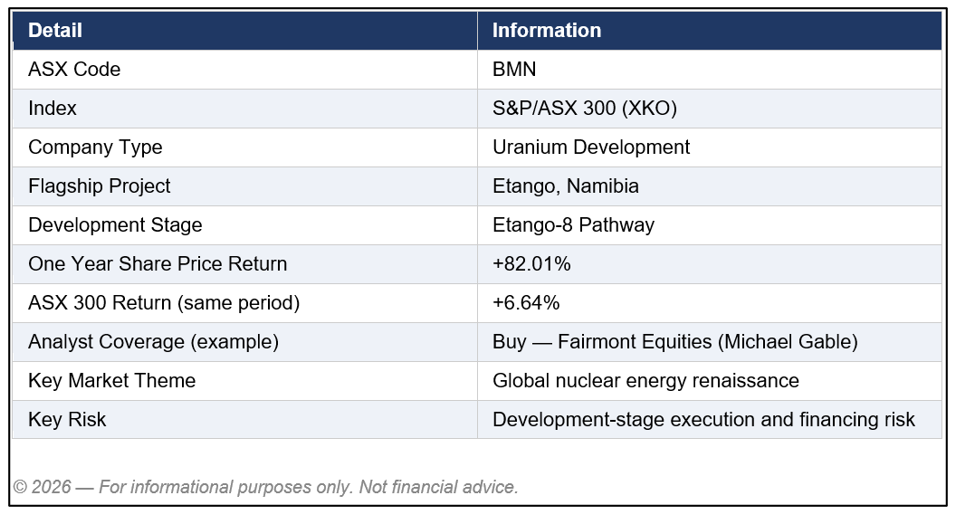
Quick Reference: Bannerman Energy (ASX: BMN) Key Facts
FAQs
- What does Bannerman Energy Ltd do?
Bannerman Energy Ltd is an Australian uranium development company focused on advancing the Etango Uranium Project in Namibia. Unlike uranium producers, Bannerman is still in the development stage and is working toward bringing the Etango project into production through a phased development strategy known as Etango-8.
- Why has Bannerman Energy's share price risen so strongly?
Bannerman Energy shares have surged due to several factors including rising global uranium prices, increasing demand for nuclear energy, supply shortages in the uranium market, and growing investor confidence in the company's flagship Etango project. Strong sector momentum and positive analyst outlooks have also contributed to the rally.
- What is the Etango-8 project and why is it important?
Etango-8 is the initial development phase of Bannerman’s Etango uranium project. It is designed as a smaller, capital-efficient operation that can generate early cash flow while reducing financial and operational risk before any potential expansion to full-scale production.
- Is Bannerman Energy considered a high-risk investment?
Yes. Bannerman Energy is a development-stage mining company, which means it has not yet started producing uranium. Investors face risks such as project delays, financing challenges, uranium price volatility, and regulatory factors. However, if the Etango project progresses successfully, the company could benefit significantly from rising uranium demand.


 Nov 12, 2026





 Please wait processing your request...