
 CA
 NZ
 UK
 US
 IND

 AU

 Share
 X (Formerly Twitter)
 Whatsapp
 Facebook
 LinkedIn
 Telegram
 Email This Article
 Copy Link
 Summarize with AI
 Chat GPT
 Perplexity

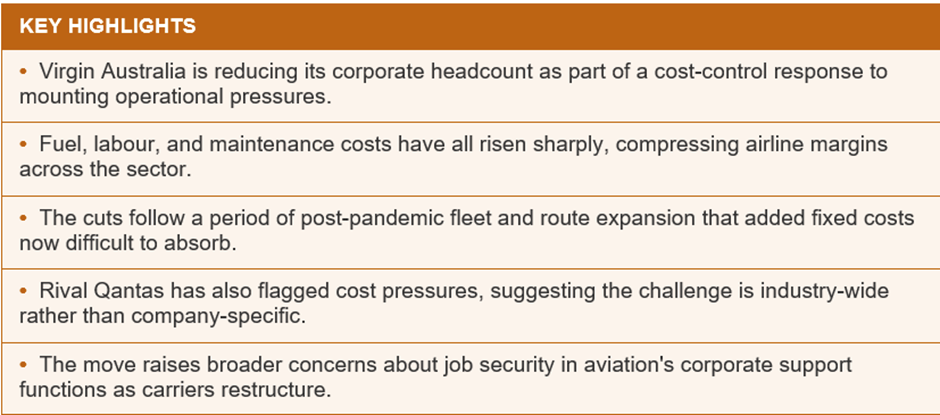
Virgin Australia is cutting corporate staff as surging operational costs squeeze airline margins across the industry, raising fresh questions about the carrier's long-term competitive position and the financial resilience of Australian aviation as a whole.
The Cost Spiral Facing Australian Airlines

The airline industry has never been known for its comfortable margins, but 2026 has delivered an unusually severe combination of cost pressures that is forcing carriers around the world — and now explicitly in Australia — to reassess the size of their corporate operations.
For Virgin Australia, the decision to cut head office and corporate staff reflects a fundamental tension at the heart of the Business. The carrier emerged from administration in 2020 under Bain Capital's ownership with a mandate to operate leaner than its previous incarnation, focussing on the business traveller market and profitable domestic routes rather than the sprawling full-service network that had weighed it down before collapse. For several years, that strategy appeared to be working. The post-Pandemic rebound in domestic travel drove strong passenger numbers, and the airline re-established itself as a credible competitor to Qantas on key city-pair routes.
But the environment in which airlines operate has shifted dramatically. Fuel remains the single largest Variable Cost for any carrier, and oil prices have surged in recent months — driven by persistent Middle East tensions and Supply constraints from OPEC+ producers — to levels that strip meaningful Margin from virtually every flight. The Australian Bureau of Statistics' March 2026 household spending data captured this shift in consumer terms, reporting a 5.1 per cent monthly surge in transport costs as petrol prices climbed. For airlines, the equivalent pressure on jet fuel is even more pronounced.
Labour costs represent a second front. The tight labour markets of the post-COVID period have pushed wages across aviation — pilots, cabin crew, ground staff and now corporate roles — to levels that airlines locked into pre-pandemic employment agreements did not anticipate. The negotiation of new enterprise agreements has in many cases produced significant wage increases, reflecting both genuine skills shortages in specialised aviation roles and the broader cost-of-living pressures facing workers across the economy.
Maintenance and aircraft leasing costs round out the picture. The global aviation supply chain, still recovering from pandemic-era disruption, has kept aircraft parts and servicing costs elevated. Lessors, who hold significant Leverage over carriers in the current environment, have renegotiated Lease terms in ways that add to Fixed Cost bases.
What the Job Cuts Tell Us
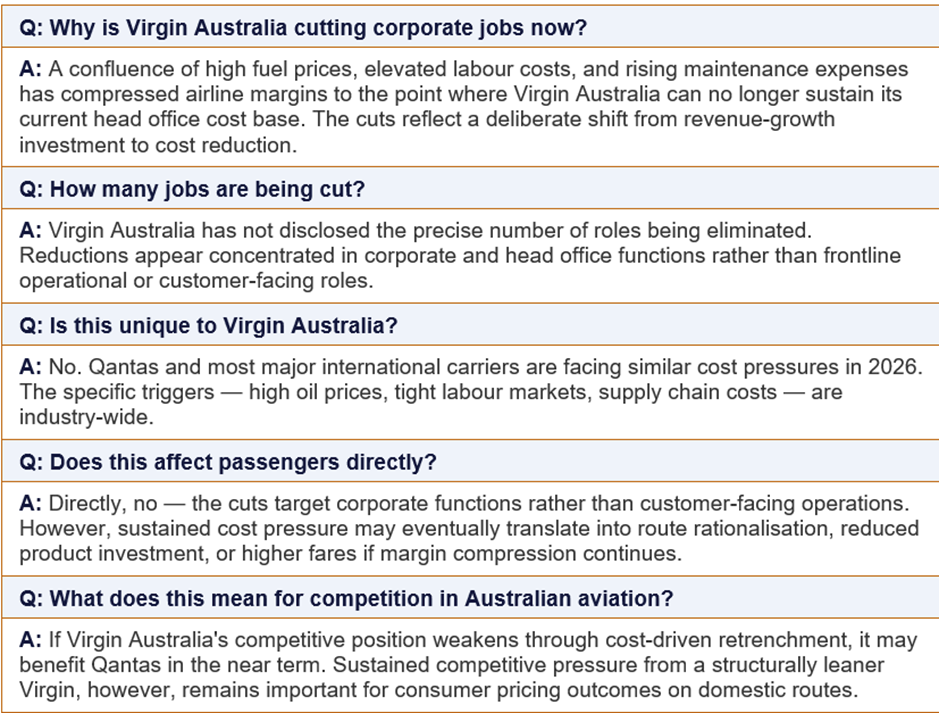
Corporate job cuts are a specific and revealing signal. Unlike operational reductions — fewer routes, smaller fleets, reduced frequencies — cutting head office staff signals that an airline believes its current Revenue trajectory cannot support its existing overhead structure. It is an acknowledgement that cost-out, rather than revenue growth, must now do the heavy lifting.
Virgin Australia has been careful not to specify the exact number of roles being eliminated, which is itself a common practice designed to limit the reputational damage of large-scale redundancy announcements. But the direction is clear. Functions that expanded during the post-pandemic growth phase — strategy, Marketing, corporate affairs, business development — are likely bearing the brunt.
The timing matters. These cuts are coming at a moment when Virgin Australia had been investing in its product, adding new routes and upgrading its frequent flyer offering in an effort to close the loyalty gap with Qantas. A retrenchment in corporate capability risks slowing that programme and sending a signal to corporate travel buyers that the airline's competitive momentum may be wavering.
For employees, the message is confronting. Aviation's corporate sector has historically offered relatively stable white-collar employment for professionals in finance, revenue management, digital, and operations. The current round of cuts suggests that stability is being reassessed at the top of the industry.
Industry-Wide or Virgin-Specific?
It would be a mistake to read Virgin Australia's cuts as a company-specific failure. The pressures driving this decision — fuel, labour, maintenance — are structural headwinds faced by every carrier operating in today's environment. Qantas has also flagged cost pressures in its recent communications with investors, and international carriers from British Airways to Singapore Airlines have each described a challenging cost environment in their most recent reporting periods.
What differentiates airlines is their ability to pass costs through to consumers via ticket pricing, and the composition of their route networks and customer mix. Full-service carriers with a heavy reliance on high-Yield business and premium leisure travellers have more pricing power than budget operators competing primarily on fare. Virgin Australia sits in a middle position — targeting business travellers on domestic routes while remaining price-competitive enough to attract leisure customers — that makes margin management particularly delicate.
The broader question for Australian aviation is whether the competitive Duopoly between Qantas and Virgin can remain stable if one party is forced to structurally downsize while the other retains deeper capital reserves and a more established loyalty program. History suggests that cost-driven retreats in airline competition tend to benefit the dominant carrier, at least in the short term.
Frequently Asked Questions


 Nov 12, 2026





 Please wait processing your request...