
 CA
 NZ
 UK
 US
 IND

 AU

 Share
 X (Formerly Twitter)
 Whatsapp
 Facebook
 LinkedIn
 Telegram
 Email This Article
 Copy Link
 Summarize with AI
 Chat GPT
 Perplexity
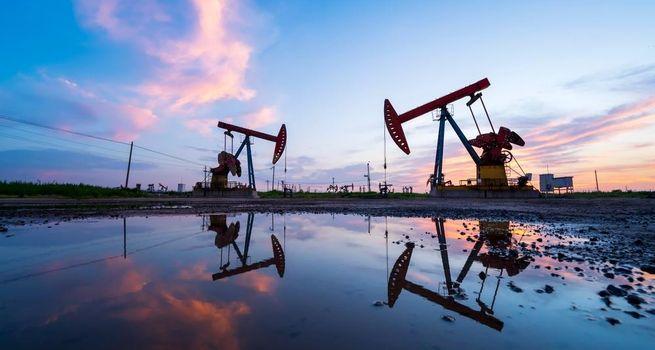
Five weeks into the most disruptive energy shock since the 1970s, the Iran war has exposed the fragility of an interconnected global economy — and the limits of central banks, finance ministers, and investors to contain it
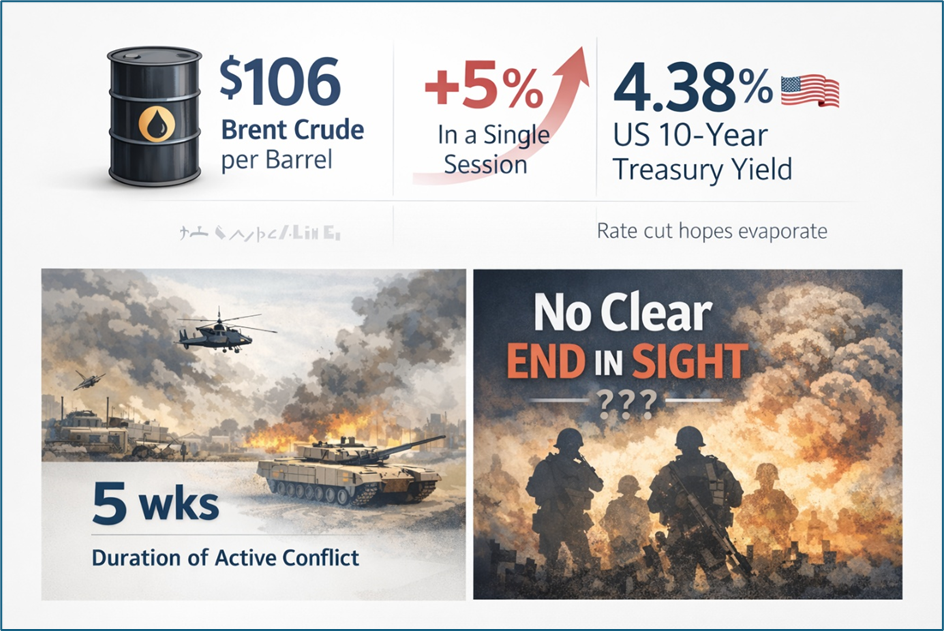
Source: EODHD/Others, Analysis by Kalkine
There is a particular cruelty to the way financial markets punish false hope. For two days this week, investors had allowed themselves a rare moment of optimism — buying stocks, selling dollars, pricing in the possibility that the war in Iran might be nearing an end. On Thursday, that optimism was methodically dismantled by a presidential address that offered nothing of the kind.
Donald Trump confirmed that American bombing campaigns would continue for at least another two to three weeks. He offered no timeline for reopening the Strait of Hormuz. He gave no indication that Iran's capacity to choke off global energy supplies — the single most consequential act of economic warfare since the Arab oil embargo of 1973 — would be neutralised any time soon. Markets drew their own conclusions.
Brent crude surged 5 per cent to $106.16 per barrel. The US dollar reversed two days of losses. Equity markets around the world fell. Government bond yields climbed as traders abandoned any remaining expectation of imminent interest rate cuts. In the space of a single speech, the brief calm that had descended over global markets evaporated entirely.
The chokepoint at the centre of everything
To understand why financial markets have become so acutely sensitive to every word from Washington, Tehran, and Jerusalem, one must understand the Strait of Hormuz — a narrow ribbon of water between the Iranian coast and the Omani peninsula, through which roughly 20 per cent of the world's seaborne oil flows every day.
Iran's closure of the strait, which Tehran retains the capacity to enforce through a combination of mines, naval assets, and missile batteries, has created what analysts are now calling the worst global energy shock in recorded history. The arithmetic is unforgiving: remove one-fifth of global oil supply from a market that has spent years running lean on spare capacity, and prices do not rise gradually — they lurch.
The Strait of Hormuz is not merely a shipping lane. It is the jugular vein of the global economy — and right now, a hand is pressed firmly against it.
What makes this shock particularly dangerous is its open-ended nature. Previous supply disruptions — the Gulf War, the Libyan civil war, the Russian invasion of Ukraine — had relatively legible timelines. Markets could price in an eventual resolution. This conflict offers no such comfort. Trump's statement on Thursday confirmed what many investors had privately feared: that there is no imminent off-ramp, and that the duration of the disruption is measured not in days but in months.
How the war has moved key markets — 5-week shift
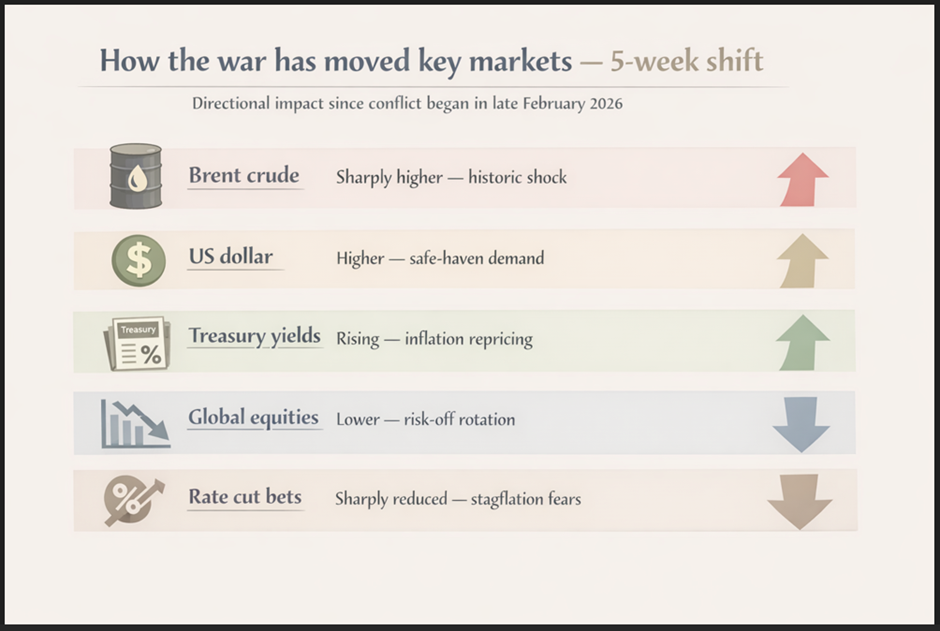
Analysis based on market moves since conflict began late February 2026. Bars are indicative of direction and relative magnitude.
The stagflation trap springs shut
For decades, the word "stagflation" existed primarily in economics textbooks — a relic of the 1970s that modern central banking was supposed to have rendered obsolete. The Iran war has returned it to the front pages with a vengeance.
The mechanism is straightforward. Energy is not merely a commodity — it is an input into virtually every good and service in the modern economy. When oil prices surge, transport costs rise, manufacturing costs rise, food prices rise. Inflation follows. But the same energy shock that drives prices higher also compresses consumer spending power and corporate margins, weakening growth simultaneously. The result is the central banker's nightmare: rising inflation that demands tighter monetary policy at precisely the moment when a faltering economy demands the opposite.
The Bank of Japan's incoming board member Toichiro Asada articulated the bind with unusual candour on Wednesday, warning that Japan faces stagflation risks from the conflict that would be "challenging to deal with using monetary policy." It is a problem that no major central bank has a clean answer to.
The stagflation arithmetic
When oil rises 30–40%, historical models suggest a 1.5–2.5 percentage point addition to headline inflation in advanced economies within 6–9 months, while simultaneously trimming GDP growth by 0.5–1.0 points. The Federal Reserve's preferred inflation measure, the PCE deflator, was already running above target before the conflict began. A sustained energy shock of this magnitude makes the path back to 2% near-impossible without a recession.
For emerging market economies with limited currency buffers and dollar-denominated energy import bills, the arithmetic is considerably worse.
The resolution problem
What distinguishes this crisis from previous oil shocks — and what makes it so structurally difficult for markets to price — is its political complexity. The Strait of Hormuz will not reopen because Washington decides it should. It will reopen when Iran chooses to allow it, or when Iran's capacity to prevent it is destroyed. Neither outcome is imminent.
As Carol Kong, currency strategist at Commonwealth Bank of Australia, observed with forensic precision: "It's hard to feel optimistic about the end of the war for sure, because ultimately Israel and Iran are the two other parties to the war — it's not just the US." Washington's military operations exist within a broader conflict that has its own logic, its own grievances, and its own timeline. The Strait will remain closed until those deeper dynamics resolve — and there is no sign of that yet.
"We are looking at a situation now where we are getting into a stagflation situation with lower growth and higher inflation expectations."— Russel Chesler, VanEck, Sydney
This is the essential difference between a supply shock that markets can trade around and one that causes structural repricing. Traders can hedge a disruption with a foreseeable end. They cannot easily hedge an open-ended geopolitical reconfiguration of the world's most important energy corridor.
What investors do now
In the near term, the consensus trade is well-established: long oil, long dollars, short risk. The US dollar, which has benefited consistently from safe-haven flows since the conflict began, has further to run if the war extends into June as many analysts now expect. Ten-year Treasury yields, paradoxically, face upward pressure even as economic growth forecasts are revised down — a classic stagflationary dynamic in which inflation expectations dominate.
For equity investors, the calculus is harder. Energy producers benefit from sustained high oil prices. But the sectors that built the bull market of the past decade — consumer discretionary, technology, industrials — are all exposed, either through compressed margins or through the demand destruction that $100-plus oil inevitably produces over time.
The deeper question is one that no analyst can answer with confidence: at what price does oil tip the global economy from slowdown into recession? The answer lies somewhere between $110 and $130 per barrel on a sustained basis, according to most historical models. At $106 and rising, markets are approaching that threshold.
Thursday's market moves were, in a sense, a correction — not of prices, but of expectations. Investors had briefly convinced themselves that resolution was near. It is not. The war is five weeks old, the Strait of Hormuz remains closed, and the president of the United States has confirmed that bombing will continue for weeks more. Whatever comes next, the era of cheap, stable, predictable energy that underpinned the global economy for a generation is, for now, over.


 Nov 12, 2026





 Please wait processing your request...