
 CA
 NZ
 UK
 US
 IND

 AU

 Share
 X (Formerly Twitter)
 Whatsapp
 Facebook
 LinkedIn
 Telegram
 Email This Article
 Copy Link
 Summarize with AI
 Chat GPT
 Perplexity


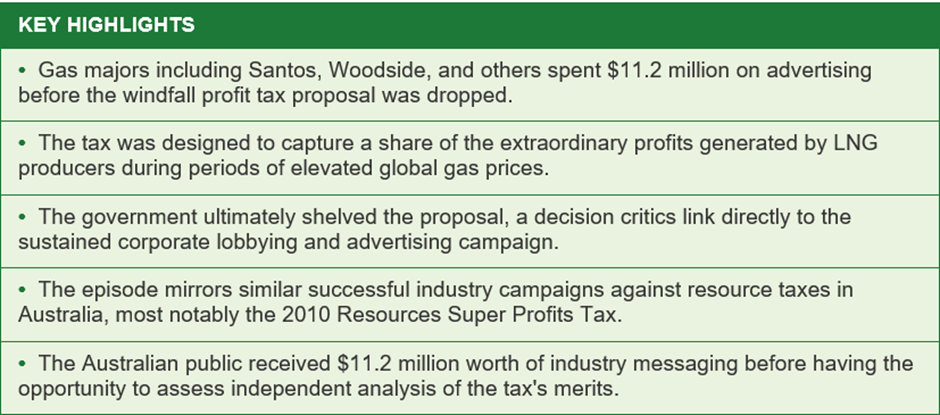
Australia's largest LNG producers mounted an $11.2 million Advertising campaign ahead of the federal government's decision to abandon a proposed windfall profit tax on the gas sector — a revelation that has reignited the debate about corporate lobbying, the power of resource companies in Australian policy-making, and whether the country is adequately capturing its fair share of returns from its Natural Gas endowment.
The Tax That Never Was
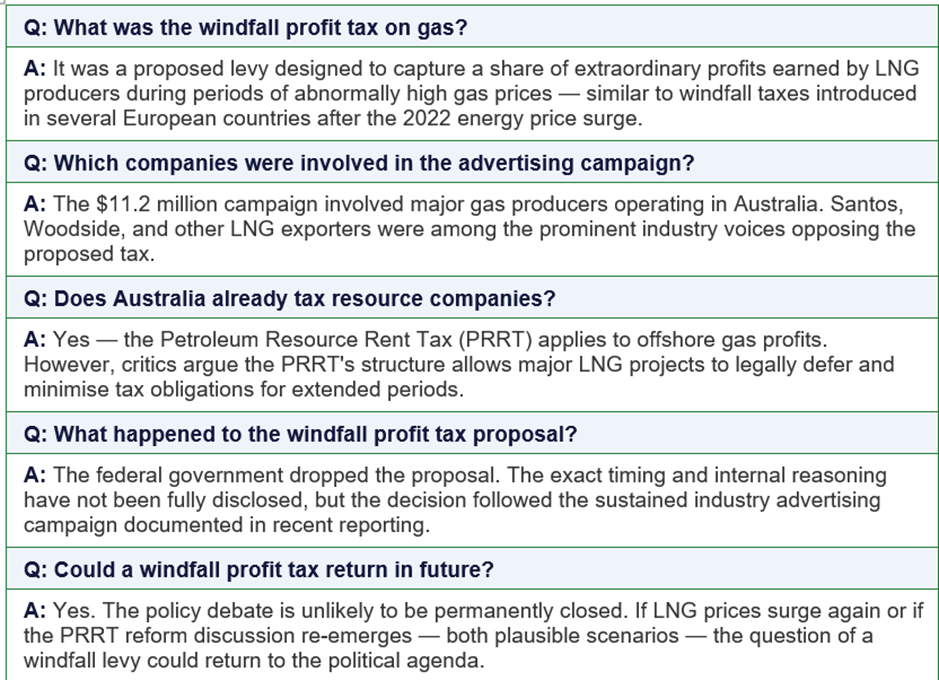
The windfall profit tax idea emerged from a straightforward observation: LNG prices surged to historic highs in the aftermath of Russia's invasion of Ukraine in 2022, generating extraordinary profits for Australia's gas exporters at a time when ordinary Australians were paying record prices for household energy. The argument for a windfall levy was, at its core, that companies producing a publicly owned natural resource should share a portion of the exceptional returns generated by geopolitical circumstances beyond their control.
It was not a fringe proposal. Windfall profit taxes on energy companies were enacted across multiple European jurisdictions following the 2022 price surge, and the policy debate in Australia drew on similar reasoning. The Petroleum Resource Rent Tax (PRRT), which is supposed to capture a share of offshore gas profits for the Australian public, had by that point attracted sustained criticism from economists and policy analysts who argued its structure allowed major LNG projects to legally minimise their tax obligations for extended periods.
Into this environment, Australia's gas majors launched what the data now confirms was a co-ordinated and substantial public communications campaign. The $11.2 million figure, spread across television, digital, print, and outdoor advertising, was not incidental or routine. It was a deliberate effort to shape public opinion and, through it, political calculus, before any legislation could be drafted or debated.
The $11.2 Million Campaign: What It Bought
Advertising campaigns of this scale, directed at a specific piece of proposed legislation, operate on multiple levels simultaneously. At the most visible level, they communicate directly with the public — in this case, with messages emphasising the contribution of the gas sector to the Australian economy, jobs, and export Revenue, and warning of the Investment consequences of increased taxation.
But the more consequential audience is political. A sustained, well-funded advertising campaign signals to government members — particularly those in seats with resource sector employment — that the industry is prepared to invest heavily in defending its interests. It creates the implicit threat of continued spending in an election cycle if the policy proceeds, and the implicit promise of reduced political heat if it does not.
The 2010 Resources Super Profits Tax, proposed by the Rudd government, is the canonical Australian example. The Mining industry's response — featuring a campaign estimated at around $22 million — is widely credited with contributing to Kevin Rudd's removal from the prime ministership and the subsequent dilution of the tax under Julia Gillard. The outcome created a lasting template: mobilise early, spend heavily, and shape the political environment before the legislative process begins.
The gas industry's 2026 campaign appears to have followed that template closely. Santos, as one of Australia's largest domestic gas suppliers with a Market Capitalisation of around $25 billion, would have had both the financial capacity and the strategic motivation to participate in any such campaign. The sector's combined advertising spend of $11.2 million is significant but, relative to the tax revenues at stake from a well-designed windfall levy, economically rational from the industry's perspective.
The Policy Outcome and Its Implications
The government's decision to drop the windfall profit tax proposal will be interpreted differently depending on where one stands on resource taxation policy. Proponents of the tax will see the outcome as evidence that the political economy of resource extraction in Australia remains systematically skewed toward industry, and that public interest considerations — including the adequacy of PRRT revenues, the affordability of domestic gas, and the energy transition — are too easily displaced by well-resourced industry advocacy.
Industry and its supporters will argue that the campaign was a legitimate exercise in democratic participation, that the tax would have deterred future investment and harmed the competitiveness of Australian LNG in global markets, and that the government reached an independent judgement on policy merits.
What is harder to dispute is the asymmetry of the public debate. When one side of a policy argument spends $11.2 million on advertising before the other side has had the opportunity to develop and publicise its case, the outcome of any public consultation is shaped before it begins. This is a structural feature of policy debates involving large resource companies, and it applies regardless of whether the underlying policy is good or bad.
For Santos and the broader gas sector, the outcome is a near-term win. The Petroleum Resource Rent Tax remains in its current form, and the political appetite for a new resource levy appears diminished for the foreseeable future. Whether that outcome serves the long-term interests of an industry that ultimately depends on a social licence to operate in Australia is a more open question.
Frequently Asked Questions


 Nov 12, 2026





 Please wait processing your request...