
 CA
 NZ
 UK
 US
 IND

 AU

 Share
 X (Formerly Twitter)
 Whatsapp
 Facebook
 LinkedIn
 Telegram
 Email This Article
 Copy Link
 Summarize with AI
 Chat GPT
 Perplexity

Highlights
- Global trade growth has slowed to ~2.8–3%, signaling a shift from hyper-globalisation to deglobalisation.
- Supply chain restructuring toward resilience is driving persistent inflation via higher production and logistics costs.
- Capital flows are increasingly redirected to strategically aligned emerging markets like India, Vietnam, and Mexico.
- Deglobalisation favors domestic-oriented sectors—manufacturing, infrastructure, and logistics—while export-reliant industries face margin pressures.
- India emerges as a key beneficiary of “China+1” strategies, attracting rising FDI and industrial investment.
The global economy is undergoing a profound structural transformation, marked by a gradual but decisive shift away from the hyper-globalisation that defined the late 20th and early 21st centuries. For decades, globalisation functioned as a powerful disinflationary force, enabling firms to optimise production across borders, minimise costs, and benefit from comparative advantage. Today, that model is being systematically reconfigured. The emerging paradigm prioritises resilience over efficiency, security over cost minimisation, and regionalisation over global integration. This shift—commonly described as deglobalisation—is not merely a cyclical adjustment but a structural realignment with far-reaching implications for inflation, growth, and financial markets.
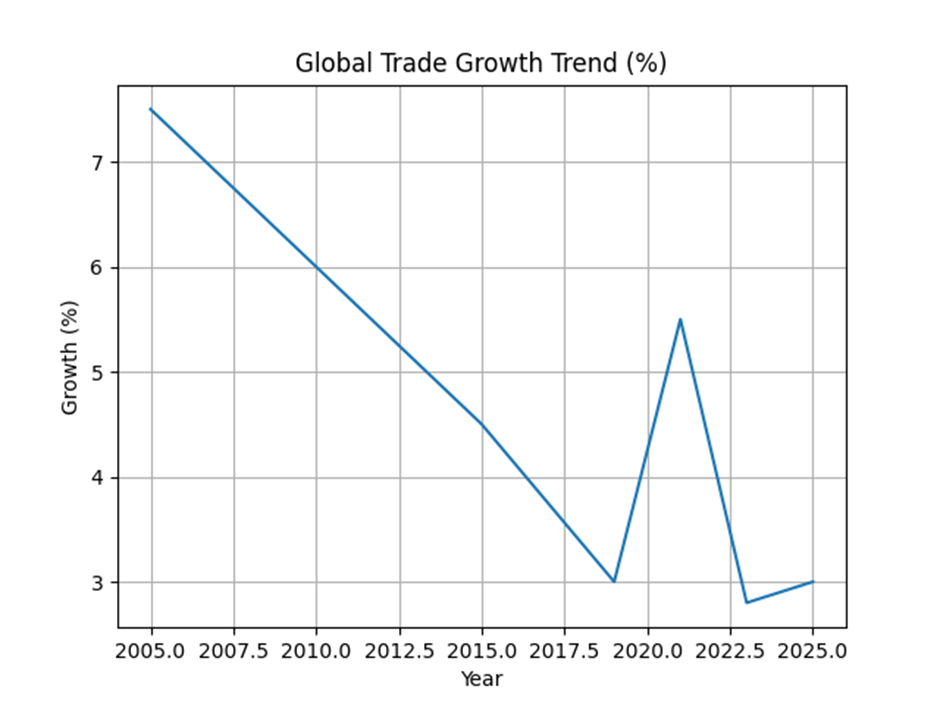
The slowdown in global trade growth provides one of the clearest indicators of this transition.
Source: World Bank, WTO
As the chart illustrates, global trade growth has declined significantly from the high single-digit levels observed in the early 2000s to approximately 2.8–3% in recent years. While trade experienced a temporary rebound following the pandemic, the underlying trend remains subdued. This reflects a combination of factors, including geopolitical tensions, protectionist policies, and structural shifts in supply chains.
The roots of deglobalisation can be traced to multiple overlapping developments. The global financial crisis of 2008 marked the first inflection point, exposing vulnerabilities in interconnected financial systems and prompting a reassessment of global integration. However, the more recent acceleration of deglobalisation has been driven by geopolitical dynamics, particularly the strategic rivalry between major economic powers such as the United States and China. Trade disputes, tariffs, and restrictions on technology transfer have fragmented global trade flows, reducing the efficiency of cross-border production networks.
The COVID-19 pandemic further accelerated this trend by exposing the fragility of global supply chains. Lockdowns and disruptions in key manufacturing hubs led to shortages of critical goods, including semiconductors, medical equipment, and consumer products. Firms that had optimised their operations for cost efficiency found themselves vulnerable to supply shocks. In response, companies began to reassess their supply chain strategies, shifting from “just-in-time” to “just-in-case” models. This transition involves maintaining higher inventory levels, diversifying suppliers, and relocating production closer to end markets.
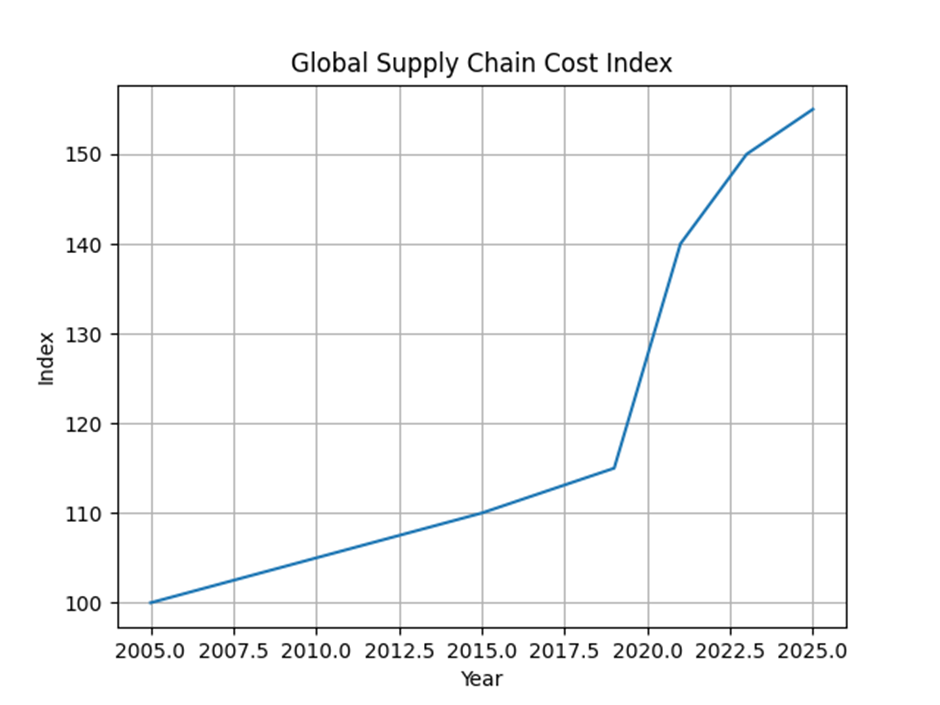
While these changes enhance resilience, they come at a cost. The increase in redundancy and the loss of scale efficiencies contribute to higher production costs, which are ultimately passed on to consumers in the form of higher prices. This dynamic is reflected in the rising cost of global supply chains.
Source: IMF, Bloomberg, Proxy indices
The upward trajectory of supply chain costs since 2020 highlights the inflationary impact of deglobalisation. Shipping costs, logistics expenses, and input prices have all increased, contributing to broader inflationary pressures. Unlike the cyclical spikes observed during the pandemic, these cost increases are more persistent, reflecting structural changes in production and distribution networks.
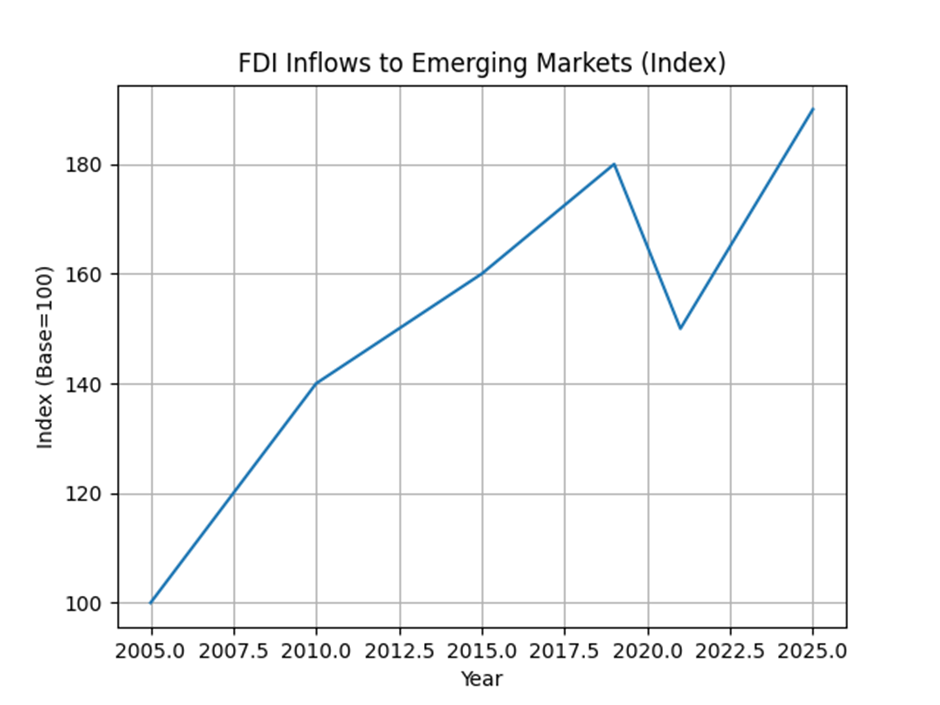
Another critical dimension of deglobalisation is the reconfiguration of capital flows. Foreign direct investment (FDI), which has historically played a key role in facilitating global integration, is being redirected toward strategically aligned regions. Emerging markets that are positioned as alternatives to traditional manufacturing hubs are benefiting from this shift.
Source: UNCTAD, World Bank
The chart illustrates the evolving pattern of FDI inflows to emerging markets, with a noticeable shift toward countries such as India, Vietnam, and Mexico. This reflects the adoption of “China+1” strategies by multinational corporations seeking to diversify their production bases. Governments in these countries have also implemented policies to attract investment, including incentives, infrastructure development, and regulatory reforms.
However, the redistribution of FDI is not uniform. Countries that lack the necessary infrastructure, policy stability, or strategic positioning may be excluded from these new investment flows. This creates a divergence within the emerging market landscape, with some economies benefiting from deglobalisation while others face marginalisation.
The macroeconomic implications of deglobalisation are significant. One of the most important is its impact on inflation. Globalisation contributed to low inflation by enabling firms to source inputs from low-cost regions, thereby reducing production costs. Deglobalisation reverses this dynamic, leading to higher input costs and reduced efficiency. As a result, inflation becomes more structurally embedded in the economy.
This has important implications for monetary policy. Central banks are now required to manage inflation that is not solely driven by demand but also by structural supply-side factors. Traditional policy tools, such as interest rate adjustments, may be less effective in addressing these types of inflationary pressures. This increases the complexity of policy decisions and raises the risk of policy errors.
Growth dynamics are also affected. While deglobalisation may support domestic industries and reduce dependence on external supply chains, it can also lead to lower overall efficiency and slower global growth. The fragmentation of trade reduces the benefits of specialisation and economies of scale, which have historically been key drivers of productivity growth. As a result, the global economy may experience a period of slower but more regionally balanced growth.
From a valuation perspective, deglobalisation introduces new dynamics that reshape market behaviour. One of the most direct effects is the re-rating of sectors linked to domestic production and infrastructure. Increased investment in manufacturing, logistics, and supply chain resilience supports earnings growth in these sectors, leading to higher valuations. Infrastructure spending, in particular, becomes a critical driver of economic activity, benefiting companies involved in construction, engineering, and capital goods.
Conversely, sectors that rely heavily on global integration may face challenges. Export-oriented industries that depend on low-cost production and global demand may experience margin pressure as costs rise and trade barriers increase. Multinational corporations with complex global supply chains may also face higher operational risks and reduced profitability.
The shift in valuation dynamics is closely linked to capital expenditure cycles. Deglobalisation necessitates increased investment in domestic production capabilities, including factories, warehouses, and transportation networks. This leads to a rise in capital expenditure, which in turn supports earnings growth in related sectors. The multiplier effects of such investment can be substantial, contributing to broader economic growth.
India’s position within this evolving landscape is particularly noteworthy. As global supply chains are reconfigured, India has emerged as a key beneficiary of the “China+1” strategy. The country’s large domestic market, demographic advantage, and policy initiatives such as the Production Linked Incentive schemes make it an attractive destination for manufacturing investment. This shift is already reflected in increased FDI inflows and expanding industrial capacity.
However, the benefits of deglobalisation are not automatic. To fully capitalise on these opportunities, India must continue to address structural challenges, including infrastructure bottlenecks, regulatory complexity, and labour market rigidities. Successful execution of reforms will determine the extent to which India can sustain its competitive advantage.
Financial markets are increasingly incorporating these structural shifts into asset pricing. The reallocation of capital toward sectors aligned with deglobalisation trends is evident in market performance. Infrastructure, manufacturing, and logistics companies have outperformed in many markets, reflecting expectations of sustained investment and earnings growth. At the same time, sectors sensitive to global trade cycles have experienced greater volatility.
Another important consideration is the impact on currency markets. Deglobalisation can lead to increased currency volatility, as trade imbalances and capital flows become more fragmented. Countries with strong macroeconomic fundamentals and stable policy frameworks are better positioned to manage these risks, while others may face increased pressure on their currencies.
In conclusion, deglobalisation represents a fundamental shift in the structure of the global economy. The transition from efficiency to resilience is reshaping trade patterns, cost structures, and investment flows. While this shift introduces new risks, it also creates opportunities for economies and sectors that can adapt to the changing landscape.
Analyst Insights:
Deglobalisation is driving a structural reallocation of capital, favouring economies and sectors aligned with supply chain diversification and domestic production. The inflationary impact of rising supply chain costs is likely to persist, reinforcing the “higher-for-longer” macro environment. Investors should focus on infrastructure, manufacturing, and logistics sectors that benefit from increased capital expenditure, while exercising caution in export-dependent industries vulnerable to trade fragmentation. The long-term winners will be those positioned at the intersection of policy support, capital flows, and structural demand shifts.
FAQs
Q1: What is deglobalisation, and why is it happening?
A: Deglobalisation is the structural shift from global integration toward regionalisation, prioritizing supply chain resilience, security, and domestic production. It’s driven by geopolitical tensions, trade disputes, and pandemic-induced supply chain fragility.
Q2: How does deglobalisation affect inflation and economic growth?
A: By increasing supply chain costs and reducing efficiency, deglobalisation embeds structural inflation and slows global growth, while benefiting domestic industries through localized production.
Q3: Which sectors and countries benefit the most from deglobalisation?
A: Sectors linked to domestic production—manufacturing, infrastructure, logistics—see growth and higher valuations. Countries with strategic positioning and supportive policies, like India, Vietnam, and Mexico, attract increased foreign investment.


 Nov 12, 2026





 Please wait processing your request...