
 CA
 NZ
 UK
 US
 IND

 AU

 Share
 X (Formerly Twitter)
 Whatsapp
 Facebook
 LinkedIn
 Telegram
 Email This Article
 Copy Link
 Summarize with AI
 Chat GPT
 Perplexity

ANZ-Roy Morgan Consumer Confidence collapses to historic low of 58.8. ASX 200 rebounds 0.25%. Fair Work Commission abolishes junior pay rates for 500,000 workers.
Key Highlights
- ANZ-Roy Morgan Consumer Confidence fell to 58.8 points, the lowest reading since the index began tracking in 1973.
- The index has declined for five consecutive weeks, breaching the 60-point threshold for the first time in its history.
- The S&P/ASX 200 recovered from an early session loss to close 0.25% higher on March 31, supported by diplomatic signals from Washington on the Middle East conflict.
- The Fair Work Commission abolished discounted junior pay rates for approximately 500,000 workers aged 18 to 20 in retail, fast food, and pharmacy.
- Inflation expectations among Australian households reached a record high of 7.3%, complicating the Reserve Bank of Australia's monetary policy
A Confidence Crisis of Historic Proportions
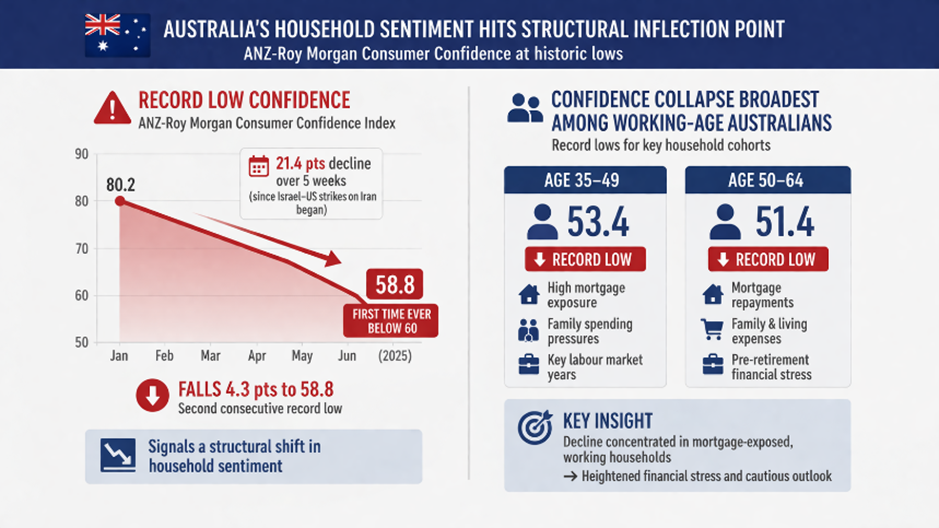
Australia's household sentiment has reached a structural inflection point. The ANZ-Roy Morgan Consumer Confidence index fell a further 4.3 points to 58.8, marking a second consecutive record low and the first time the index has ever dropped below 60. Confidence has declined 21.4 points over five weeks, beginning when Israel and the United States initiated military operations against Iran.
The damage is not evenly distributed. Working-age Australians aged 35 to 49 registered a confidence reading of just 53.4, while those aged 50 to 64 fell to 51.4, both at record lows for their respective cohorts. These are the households most exposed to mortgage repayments, family expenditure, and labour market pressures.
Analysis: Kalkine Group
Monetary policy has compounded the deterioration. This decline is attributed to the effects of the Middle East conflict on oil prices, the economic outlook, and the Reserve Bank's decision to lift the cash rate to 4.10%. The upside inflation risks and the need to anchor inflation expectations are likely to support a final 25 basis point rate hike in May, taking the cash rate to 4.35%.
Inflation Expectations: A Compounding Risk
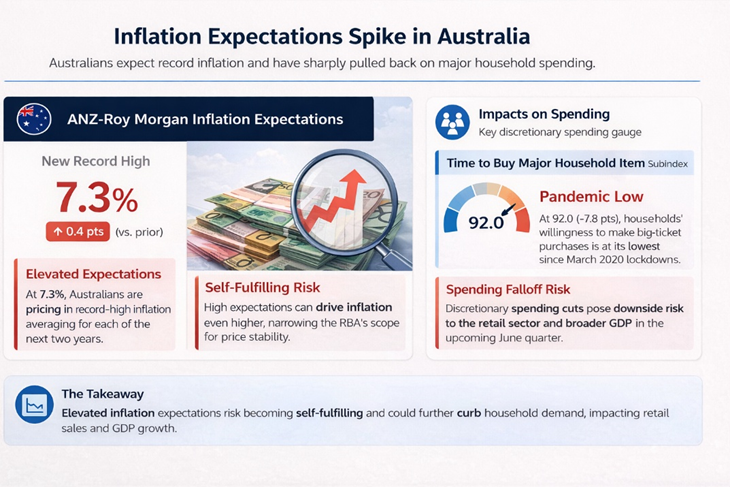
ANZ-Roy Morgan Inflation Expectations climbed 0.4 percentage points to 7.3%, a new record high, meaning Australians are pricing in annual inflation of that magnitude for each of the next two years. Elevated expectations risk becoming self-fulfilling, narrowing the RBA's scope to restore price stability without triggering a sharper contraction in household demand.
The transmission into spending behaviour is already visible. The 'time to buy a major household item' subindex dropped to its lowest point since pandemic lockdowns were announced in March 2020. Discretionary spending, a key driver of retail sector revenue and broader GDP, faces material downside risk heading into the June quarter.
Analysis: Kalkine Group
ASX 200: A Fragile Rebound
Against this backdrop, the equity market staged a measured recovery. The S&P/ASX 200 rose approximately 21 points, or 0.3%, to close at 8,482 on March 31, ending a three-session decline after reports emerged that President Trump was prepared to wind down the US military campaign against Iran. Sentiment was further supported by PMI data from China showing the manufacturing sector posting its strongest monthly gain in a year.
The recovery was selective. The four major banks gained between 0.7% and 1.6%, while Xero, REA Group, and Northern Star Resources led broader movers higher. The monthly picture remains sobering. For March, the ASX 200 fell 7.8%, its worst monthly performance since January 2022, pressured by inflation concerns tied to the widening Middle East conflict.
Technically, the index faces meaningful resistance. The ASX 200 must reclaim the 200-day moving average, currently at 8,775, on a sustained basis to confirm that a medium-term low is in place. Until that level is recovered, the structural downtrend remains intact.
Junior Pay Reform: Labour Market Implications
The Fair Work Commission abolished junior pay rates for young adults aged 18 to 20 in retail, fast food, and pharmacy, affecting approximately 500,000 workers over a four-year phase-in period beginning December 2026. Under the current system, 18-year-olds receive 70% of the full adult award rate, rising to 80% at age 19 and 90% at 20.
The ruling followed an application by the Shop, Distributive and Allied Employees' Association under its "Adult Age = Adult Wage" campaign, with the commission ruling to phase out junior rates for workers aged 18 to 20 with six months of service.
The Australian Retail Council acknowledged the decision but warned it would represent a financial blow for shop owners, particularly small businesses that have historically used junior wage structures to lower barriers to youth employment.
Phased implementation limits the immediate labour cost shock, but the cumulative impact across sectors with high concentrations of young workers will weigh on operating margins over the medium term. Whether that translates into reduced headcount, accelerated automation, or modest price pass-through remains an open question for investors in consumer-facing equities.
Structural Outlook: Risks Accumulating
The convergence of record-low household confidence, elevated inflation expectations, a challenged equity benchmark, and a structural wage uplift for labour-intensive sectors presents a complex picture for Australia's near-term economic trajectory. The RBA faces a narrowing policy corridor: tighten further to contain inflation expectations and risk a sharper consumer contraction or hold and risk expectations becoming entrenched. Neither path is without consequence for capital markets.


 Nov 12, 2026





 Please wait processing your request...