
 CA
 NZ
 UK
 US
 IND

 AU

 Share
 X (Formerly Twitter)
 Whatsapp
 Facebook
 LinkedIn
 Telegram
 Email This Article
 Copy Link
 Summarize with AI
 Chat GPT
 Perplexity

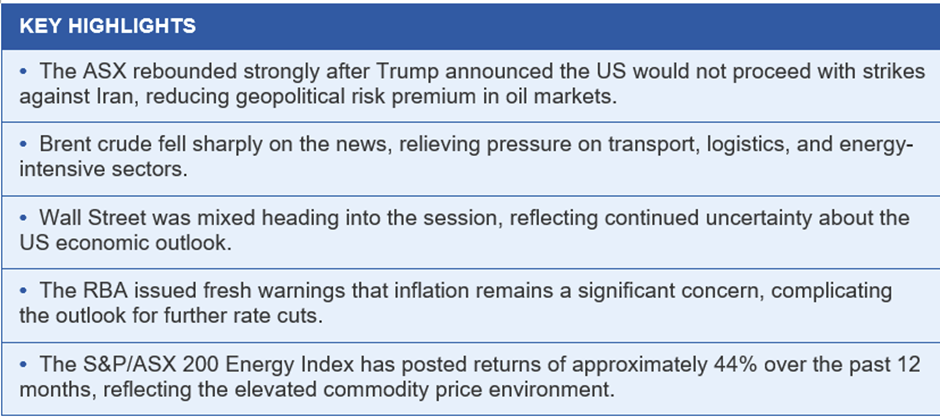
Australian shares rebounded sharply on Tuesday after US President Donald Trump announced he had called off threatened military strikes against Iran, sending oil prices lower and triggering a broad relief rally across risk assets. But the optimism was tempered almost immediately by fresh warnings from the Reserve Bank of Australia that Inflation risks remain elevated — a reminder that the path back to stable, low-cost growth is far from assured.
The Iran Factor and Oil's Sharp Move

The geopolitical backdrop to global oil markets has been extraordinarily active in 2026. The Middle East has remained a persistent source of Supply risk and price Volatility, with markets pricing in a meaningful probability of a broader regional conflict at various points over the past six months. Iran, as the third-largest OPEC producer, sits at the centre of that risk calculus: any military action involving Iranian oil infrastructure or the Strait of Hormuz — through which approximately 20 per cent of global oil supply transits — would represent a supply shock of the first order.
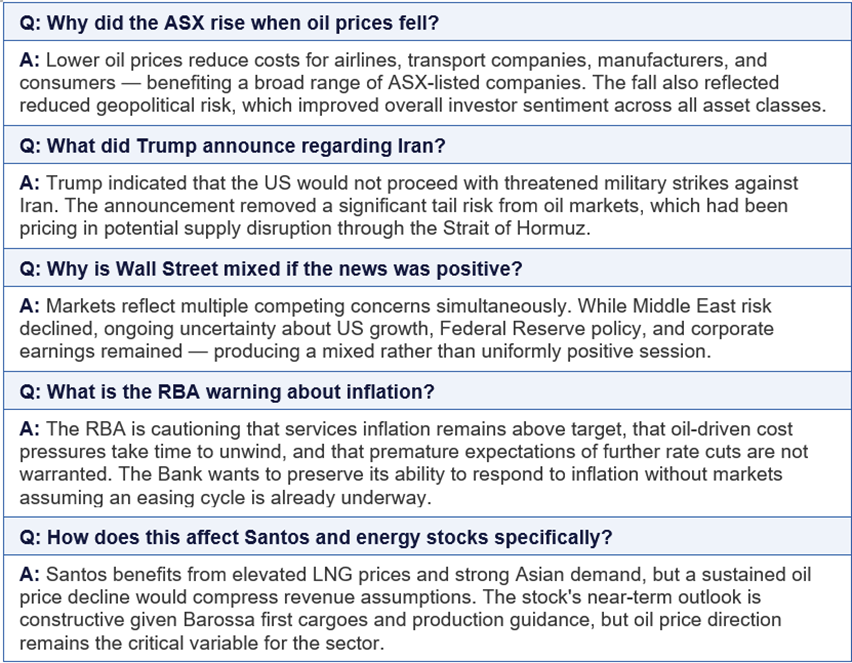
When Trump announced that the US had stepped back from the brink of strikes, the market reaction was immediate and logical. The risk premium embedded in oil prices — estimated by analysts at between $5 and $10 per barrel at the peak — began to unwind. Brent Crude fell sharply in the session, and the knock-on effects were visible across financial markets globally. Airlines, transport companies, consumer discretionary stocks, and any sector with significant fuel cost exposure rallied as the implied operating cost outlook improved.
For the ASX, the rebound was broad-based but particularly pronounced in energy-adjacent sectors. Energy stocks pulled back as oil fell, but the overall index moved higher as the broader relief from reduced geopolitical tension outweighed sector-specific losses. The S&Amp;P/ASX 200 Energy Index, which had already posted extraordinary returns of approximately 44 per cent over the preceding twelve months, saw some of those gains give back as the premium associated with supply risk deflated.
Santos, as one of Australia's largest LNG producers with operations spanning the Cooper Basin, PNG LNG, Darwin LNG and Western Australia, sits at the intersection of these dynamics. The company had guided for FY26 production volumes of between 101 and 111 million barrels of oil equivalent, and the LNG price environment — elevated by sustained Asian Demand from China and India — had been broadly supportive. But oil price volatility introduces genuine uncertainty into that Revenue outlook, particularly given Santos' Upstream exposure across multiple jurisdictions.
Wall Street's Mixed Signal
While Australian markets rebounded cleanly, Wall Street's response was more equivocal. US equities moved in mixed directions, reflecting competing impulses: relief at the reduction in Middle East risk on one side, and persistent concern about the domestic economic outlook, Federal Reserve policy, and corporate Earnings trajectories on the other.
The divergence matters for Australian investors because the ASX typically takes directional cues from US markets in the hours before domestic trading opens. A mixed Wall Street session, even against a positive geopolitical backdrop, creates genuine uncertainty about conviction — whether the relief rally is the beginning of a sustained recovery or a technical bounce in a market that remains fundamentally anxious about the economic outlook.
US economic data released in recent weeks has been similarly ambiguous. Consumer spending has held up better than many economists expected, but Business Investment and Manufacturing activity have shown signs of softening. The Federal Reserve, wrestling with its own version of the inflation-versus-growth dilemma, has held rates steady while markets debate the timing of any pivot toward easing. That uncertainty ripples through global risk appetite in ways that affect Australian asset prices regardless of local conditions.
The RBA's Inflation Warning: A Complicating Signal
Into this environment of cautious optimism, the Reserve Bank of Australia chose Tuesday to reaffirm that it views inflation as a significant and ongoing concern. The timing was not accidental — with oil prices falling and markets beginning to price a more benign near-term outlook, the RBA wanted to signal that it would not be premature in easing monetary conditions further.
This matters because the RBA cut the official cash rate by 25 basis points to 3.85 per cent earlier this month — the kind of move that might ordinarily be interpreted as the beginning of an easing cycle. The Bank's Tuesday messaging was designed to complicate that interpretation. Yes, a cut was delivered. No, it should not be taken as evidence that the inflation battle is won or that further cuts are imminent.
The inflation concerns are specific and credible. Services inflation — covering rents, insurance, healthcare, and other non-tradeable items — has proven stickier than goods inflation throughout the post-Pandemic cycle and remains above the RBA's 2-3 per cent target band. The oil price surge of recent months, even partially unwound by Tuesday's news, has fed into transport costs and consumer price expectations in ways that take time to reverse. And wage growth, while moderating, continues to run ahead of the productivity improvements needed to make it non-inflationary.
For markets, the RBA's stance creates a delicate balancing act. Investors want to price in easing; the Central Bank keeps reminding them not to run too far ahead. The result is an environment in which any positive macro data point — lower oil, better consumer sentiment, a steadier global backdrop — risks being countered by tighter-than-expected Monetary Policy communication. That push-and-pull is likely to characterise Australian financial markets for the remainder of 2026.
The Bigger Picture for Australian Investors
What Tuesday's session illustrated, in compressed form, is the multi-directional complexity facing Australian investors in the current environment. A single piece of geopolitical news — Trump's Iran decision — was sufficient to swing sentiment meaningfully. That sensitivity is itself informative: it tells us that markets are priced for a relatively benign base case, and that any negative deviation from that case has the potential to produce sharp downside moves.
The energy sector, which has delivered outstanding returns over the past year, illustrates this tension acutely. Santos, at a recommended price of AUD 7.655 with a target of AUD 8.905, offers exposure to ongoing LNG demand from Asian markets, the Barossa ramp-up, and the structural argument for Natural Gas as a transition fuel. But the same exposure means that a sustained fall in oil and LNG prices — triggered by geopolitical de-escalation or demand softness from China — would affect the investment case materially.
Frequently Asked Questions


 Nov 12, 2026





 Please wait processing your request...