
 CA
 NZ
 UK
 US
 IND

 AU

 Share
 X (Formerly Twitter)
 Whatsapp
 Facebook
 LinkedIn
 Telegram
 Email This Article
 Copy Link
 Summarize with AI
 Chat GPT
 Perplexity

As February 2026 unfolds, income-focused investors are scanning the market for reliable dividend opportunities beyond the traditional bank heavyweights. From energy and infrastructure to transport, property and travel, several ASX-listed companies are offering projected yields between roughly 5% and 6.5%, with many delivering fully franked payouts. This list of six dividend stocks spans defensive cash-flow businesses and cyclical earners tied to global demand, providing a mix of income potential and sector diversification for portfolios seeking steady distributions in the year ahead.
- Woodside Energy Group Ltd (ASX:WDS) – High Yield Energy Producer
Woodside is a major Australian energy company with large LNG and oil assets. Recent yields have hovered around ~6.5% fully franked, making it one of the highest yielding stocks outside the big banks.
Why It’s Attractive:
- Cash flow supports sustainable dividends.
- Fully franked dividends offer tax advantages for Australian investors.
- Commodity cycles and energy demand can help underpin earnings.
Risks:
- Energy prices can fluctuate with global supply/demand dynamics.
- ESG pressures could affect long-term investment sentiment.
- Dicker Data Ltd (ASX:DDR) – Profitable IT Distributor
Dicker Data supplies hardware, cloud, and software solutions across Australia and New Zealand. Dividend yield has been attractive (around ~4.5%) with quarterly, fully franked payouts.
Why Investors Like It:
- Consistent profitability even during slower tech spending.
- Recurring customer base and diversified product lines.
- Favourable balance sheet with limited debt.
Risks:
- Tech spending downturns could impact revenue cycles.
- Competition from global distributors.
- APA Group (ASX:APA) – Energy Infrastructure
APA owns and operates a large portfolio of gas pipelines, storage, and energy infrastructure across Australia — assets with long-term contracts that underpin visibility of cash flows. The company currently has yields of around 6.3% for 2026.
Why Good for Income:
- Stable contracts and regulated assets support reliable distributions.
- Earnings visibility from long-term agreements.
- Infrastructure assets with inflation-linked revenues.
Risks:
- Commodity price shifts indirectly affect utilisation.
- Regulatory changes in energy policy.
- Aurizon Holdings Ltd (ASX:AZJ) – Rail Freight & Transport
Overview:
Aurizon operates Australia’s largest rail freight network transporting bulk commodities (e.g., coal) under long take-or-pay contracts. This company has dividend yield of ~4.9% .
Why It Matters:
- Infrastructure backbone with steady contracted cash flows.
- Exposure to commodity export demand.
- Consistent dividend history with reasonable coverage.
Risks:
- Volume downturn in freight demand can weaken earnings.
- Competition from road freight or alternative logistics.
- Charter Hall Long WALE REIT (ASX:CLW) – REIT With Defensive Income
Charter Hall Long WALE REIT holds a diversified portfolio of commercial property assets (data centres, logistics, retail, etc.) with long lease terms that generate predictable rental income. It’s has a ~6.6% distribution yield.
Why It’s Popular:
- Long weighted average lease expiry (WALE) supports income stability.
- Diversification across property sectors improves risk profile.
- Rental growth visible through annual escalations.
Risks:
- Property valuations and cap rates shifting with interest rates.
- Occupancy fluctuations in softer markets.
- Qantas Airways Ltd (ASX:QAN) – Travel Sector Dividend Play
Qantas continues to offer an attractive dividend yield of around ~5% including franking credits — supported by favourable travel demand, improved earnings, and a recovering international travel segment.
Why to Consider It:
- Operational momentum with robust travel demand post-pandemic.
- Dividend yield combined with growth potential from expansion.
- A resilient brand with diversified revenue streams (frequent flyer, cargo, loyalty).
Risks:
- Travel and fuel cost volatility can impact margins.
- Competitive pressures in aviation markets.
How to Think About ASX Dividend Stocks in Feb 2026
Key Dividend Themes Right Now
- Higher yields than bank term deposits: Many of these stocks offer yields above what you’d get in savings or term deposits, especially when fully franked.
- Steady cash flows: Infrastructure, transport, energy, and REITs with long contracts tend to deliver more predictable dividends.
- Special dividends: Some companies (e.g., industrials) have recently boosted payouts via special dividends — like BlueScope Steel returned A$1/share in Jan 2026.
Dividend Strategy Tips for 2026
- Prioritise Coverage:
Look for companies with dividend payout ratios paid from sustainable earnings and free cash flows. - Consider Franking Credits:
Fully franked dividends are especially valuable for Australian investors at tax time. - Monitor Ex-Dividend Dates:
Buying before ex-dividend dates ensures you collect upcoming payouts — e.g., several ASX shares paid dividends in Feb/March 2026. - Diversify Across Sectors:
Dividend income doesn’t have to come only from banks — transport, energy, REITs, and industrials can all contribute to a balanced income portfolio.
Risks to Keep in Mind
- Dividend cuts can happen if earnings weaken.
- Interest rate changes influence valuations and REIT cap rates.
- Commodity swings disproportionately impact energy/transport stocks.
- Macro factors (inflation, economic slowdown) can influence dividend sustainability.
🧾 Summary Table: Top 6 ASX Dividend Stocks (Feb 2026)
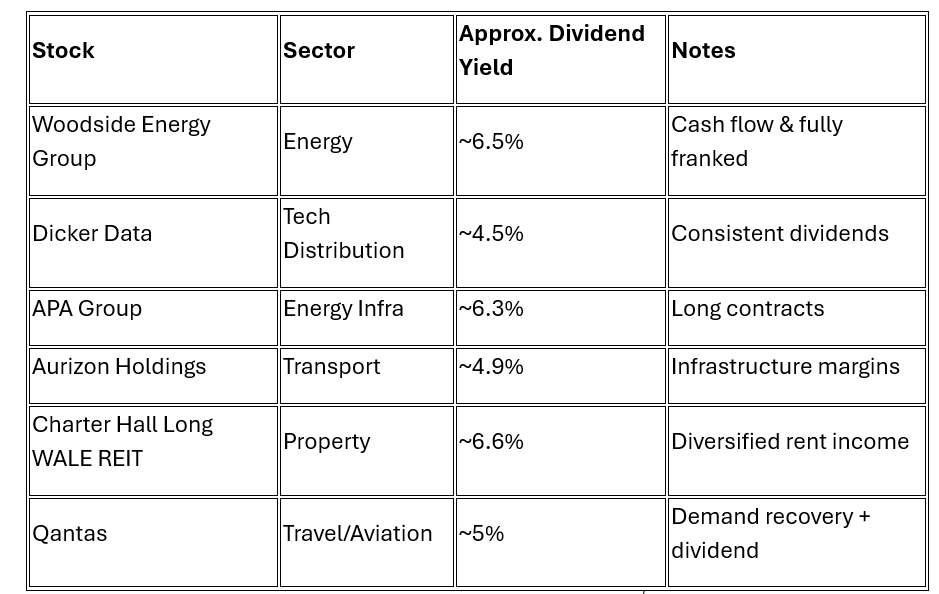
(Yields are approximate and subject to market movements.)


 Nov 12, 2026





 Please wait processing your request...