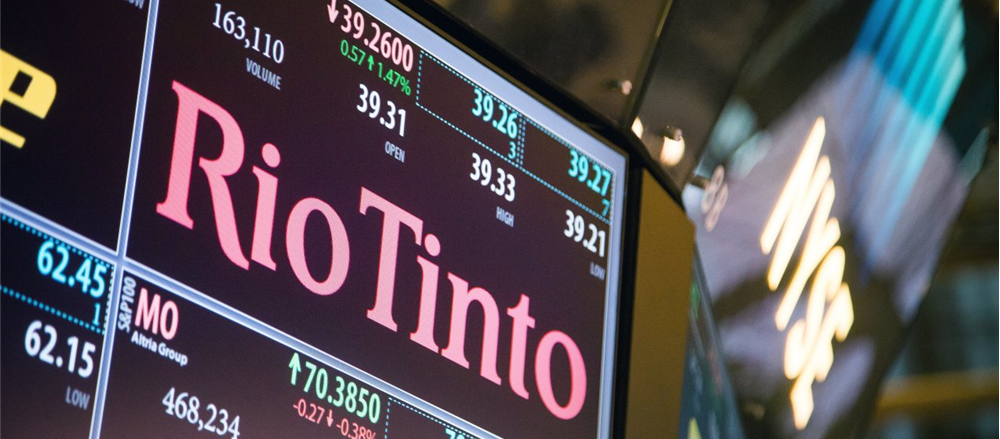
Rio Tinto Ltd
Decent Returns to Shareholders: Rio Tinto (ASX: RIO) had reported for total returns to shareholders amounting to about US$9.7 Bn in 2017 at the back of a decent set of results for the year with operating cash flow of US$13.9 Bn and full-year dividend of US$5.2 Bn with an additional US$2.1 Bn through share buy-back. Underlying EBITDA was recorded at US$18.58 Bn in FY17 as compared to US$13.51 Bn of prior year, marking a growth of 38% on a year on year basis (YoY). Net earnings were US$8.8 Bn in 2017 as compared to US$4.6 Bn in 2016. RIO continued to realise considerable savings from its cost reduction programme and delivered US$0.6 Bn of pre-tax improvements. The company has reduced net debt to US$3.8 Bn in FY17 from US$9.58 Bn in FY16 on the back of disciplined capital allocation.
In view of uncertainties in timing of development and variations to project scope under future project ownership, the project Ore Reserves have been written back to Mineral Resources. There were some significant changes in the estimates of Ore Reserves and Mineral Resources at Rio Tinto’s Argyle Diamond mine in the East Kimberley, Western Australia, wherein Rio’s interest is 100%. During 2017, estimate of Argyle Ore Reserves decreased by 13MT from 29MT to 16MT and this decrease includes depletion of almost 5Mt which is due to production activities in 2017. There were few changes in the estimates of Ore Reserves and Mineral Resources for four Pilbara iron ore deposits in Western Australia, wherein estimated iron Ore Reserves increased by 165 Mt after depletion from mining while estimated Mineral Resources increased by 508 Mt. The group now aims to provide US$1.1 Bn in cumulative post tax free cash flow from mine-to-market productivity initiatives over 2017 and 2018 with cumulative free cash flow of US$5.0 billion expected through 2017 to 2021.
Meanwhile, the stock price has increased by 6.9% in the past three months followed by a drop of 5.4% in last one month as on March 14, 2018. Given the backdrop of impact from macro-economic factors including foreign-exchange, US tax changes, iron ore scenario and slowdown in China, the stock bears some risks, and looks “Expensive” at the current market price of $76.06
.png)
Pre-tax Operating Cash Cost Improvement (Source: Company Reports)
Mirvac Group
Reaffirmed FY18 EPS post a soft half year result: Mirvac Group (ASX: MGR) is a leading integrated real estate group, which has maintained a strong capital position and flexible balance sheet, while the half year result for period ended December 2017 was a mixed one. The company has reported the statutory profit of $465 Mn compared to the $508 Mn in the corresponding period last year. The profit was down due to the lower property revaluation gains in the investment portfolio compared to the prior corresponding period, as well as the timing of residential lot settlements, which has been otherwise in line with the company’s expectations. However, for FY18, MGR has reaffirmed operating EPS guidance of between 15.3 cents and 15.6 cents per stapled security, which represents a growth in the range of 6% to 8%. Recently, the company announced for a buy-back program in open market for up to 2.6% of total outstanding of share, as a part of its disciplined capital allocation strategy. The buy-back started from February 2018 and will be completed in 12 months or earlier. However, the stock has declined by 11.5% in three months as on March 14, 2018. The group is expected to face challenges from retail sector headwinds while office and industrial segment is performing well. Given the mix of updates along with adverse macro-economic scenario, we believe that the stock is “Expensive” at the current price of $2.17
.png)
Reaffirmed FY18 Guidance (Source: Company Reports)
Disclaimer
The advice given by Kalkine Pty Ltd and provided on this website is general information only and it does not take into account your investment objectives, financial situation or needs. You should therefore consider whether the advice is appropriate to your investment objectives, financial situation and needs before acting upon it. You should seek advice from a financial adviser, stockbroker or other professional (including taxation and legal advice) as necessary before acting on any advice. Not all investments are appropriate for all people. Kalkine.com.au and associated pages are published by Kalkine Pty Ltd ABN 34 154 808 312 (Australian Financial Services License Number 425376). The information on this website has been prepared from a wide variety of sources, which Kalkine Pty Ltd, to the best of its knowledge and belief, considers accurate. You should make your own enquiries about any investments and we strongly suggest you seek advice before acting upon any recommendation. Kalkine Pty Ltd has made every effort to ensure the reliability of information contained in its newsletters and websites. All information represents our views at the date of publication and may change without notice. To the extent permitted by law, Kalkine Pty Ltd excludes all liability for any loss or damage arising from the use of this website and any information published (including any indirect or consequential loss, any data loss or data corruption). If the law prohibits this exclusion, Kalkine Pty Ltd hereby limits its liability, to the extent permitted by law to the resupply of services. There may be a product disclosure statement or other offer document for the securities and financial products we write about in Kalkine Reports. You should obtain a copy of the product disclosure statement or offer document before making any decision about whether to acquire the security or product. The link to our Terms & Conditions has been provided please go through them and also have a read of the Financial Services Guide. On the date of publishing this report (mentioned on the website), employees and/or associates of Kalkine Pty Ltd do not hold positions in any of the stocks covered on the website. These stocks can change any time and readers of the reports should not consider these stocks as advice or recommendations.

 AU
AU
 CA
CA NZ
NZ UK
UK US
US IND
IND
 Please wait processing your request...