The Offer

Company Overview
Cerebras Systems Inc. is an advanced artificial intelligence infrastructure company headquartered in Sunnyvale, California, focused on designing, manufacturing, and deploying the world's fastest AI computing systems. The company is centered on three integrated technology platforms: its flagship Wafer-Scale Engine (WSE) processor, the CS-3 data center system, and comprehensive software stack enabling training and inference for frontier-scale AI models. The WSE-3 processor measures 46,225 square millimeters (58 times larger than NVIDIA's B200 chip), integrates 900,000 compute cores with 44 gigabytes of on-chip SRAM memory, and delivers 21 petabytes per second of memory bandwidth (2,625 times more than NVIDIA's B200 package). This architecture enables inference speeds up to 15 times faster than leading GPU-based solutions and training time reductions exceeding 10 times compared to same-generation GPU systems, positioning Cerebras as the performance leader in AI compute infrastructure.
Key Highlights
Primary Offering:
Cerebras Systems Inc. is offering 28,000,000 shares of Class A Common Stock at an indicative price range of USD 115.00 to USD 125.00 per share, with an additional over-allotment option for up to 4,200,000 shares (15% greenshoe). The company has reserved up to 5% of shares offered for a directed share program for certain persons identified by management and long-tenured employees. Following the offering, the company will operate with a three-class common stock structure: Class A shares (1 vote per share, economic rights), Class B shares (20 votes per share, economic rights, convertible to Class A), and Class N shares (non-voting, convertible to Class A). Existing Class B shareholders will retain approximately 99.2% of total voting power immediately post-IPO despite representing roughly 89% of economic ownership, creating significant founder and early investor control.
Use of proceeds:
- Capital Deployment and Infrastructure Investment: Cerebras estimates net proceeds of approximately USD 3.36 billion from the base offering at an assumed offering price of USD 120.00 per share (midpoint of indicated range) after underwriting discounts and estimated expenses. Management intends to deploy proceeds for multiple strategic priorities including substantial data center infrastructure buildout to fulfill the OpenAI Master Revenue Agreement (MRA) committed capacity obligations and support growing inference demand from strategic customers.
- Cloud Infrastructure Scaling and OpenAI Commitment: A significant portion of proceeds will address capital-intensive cloud infrastructure requirements. The filing explicitly states cloud offerings require "significant data center capacity and capital investments for which we expect to require significant additional capital." The recently executed MRA with OpenAI commits Cerebras to delivering specified compute capacity over a defined period, creating substantial near-term capital deployment obligations. Management expects cloud and other services revenue to constitute significantly higher percentages of total revenue in future periods as this agreement ramps.
- Research and Development Investment: With R&D spending consuming 48% of 2025 revenue ($243 million), proceeds will fund next-generation wafer-scale engine development, software stack enhancements, and continued innovation maintaining technology leadership. The wafer-scale integration roadmap builds on architectural advantages through increased on-chip memory, improved interconnect density, and process node migration (16nm → 7nm → 5nm completed; future nodes planned).
- Working Capital and Manufacturing Scale: Proceeds will address working capital requirements including wafer procurement from TSMC and foundry partners requiring advance commitments, manufacturing scale-up supporting hardware delivery obligations, and general corporate purposes. The combination of cloud infrastructure capex, sustained R&D investment, and working capital absorption creates ongoing cash requirements despite reported accounting profitability driven by non-recurring gains.
- Future Capital Requirements: Management acknowledges the current raise may prove insufficient if cloud business scales as projected. The filing language suggests potential need for future equity or debt financing to fully execute long-term strategy, particularly for international data center expansion and capacity ahead of contracted demand.
Dividend Policy:
Cerebras Systems Inc. does not expect to declare or pay any cash dividends on its common stock for the foreseeable future. Management intends to retain all available capital and future earnings to fund ongoing research and development, support wafer-scale processor technology advancement, invest in cloud infrastructure capacity, execute strategic customer commitments including the OpenAI MRA, and address general corporate needs. Any future dividend decisions will remain subject to Board of Directors discretion. Accordingly, prospective investor returns are expected to be driven principally by capital appreciation rather than recurring dividend income.
Cerebras Systems Inc. – Business Model, Technology Platform and Strategic Positioning
- Integrated AI Infrastructure Platform with Hardware-Software Co-Design: Cerebras operates a full-stack AI infrastructure business model centered on three core technology pillars: the Wafer-Scale Engine processor, CS-3 system integration, and comprehensive software platform (Cerebras Compiler, Inference Serving Stack, Cluster Manager orchestration). Revenue is generated through hardware sales for on-premises deployments ($358 million or 70% of 2025 revenue) and cloud-based offerings including dedicated capacity contracts and consumption-based inference services ($152 million or 30% of 2025 revenue, growing 94% year-over-year). The hardware-software co-design approach enables customers to train and deploy frontier-scale models without distributed programming complexity or code modifications across training and inference workloads.
- Wafer-Scale Integration as Foundational Competitive Moat: Cerebras solved the 75-year semiconductor industry challenge of building commercially viable processors from entire silicon wafers. The WSE-3 integrates 900,000 compute cores, 44GB on-chip SRAM, and 21 petabytes/second memory bandwidth on a single 46,225mm² die (58x larger than NVIDIA B200). This architectural breakthrough required inventing multi-die interconnect technology linking separate die regions at wafer fabrication and fault-tolerant architecture routing around manufacturing defects using redundant compute blocks. These foundational innovations enable performance advantages stemming from eliminating off-chip data movement bottlenecks that dominate GPU latency and power consumption.
- Speed as Strategic Differentiation and Market Entry Wedge: Cerebras delivers inference responses up to 15 times faster than leading GPU-based solutions on benchmarked open-source models, with training customers reporting 10x+ faster time-to-solution. Speed improvements stem from 2,625x memory bandwidth advantage enabling memory-bound workloads to execute without constant data shuttling between compute, memory, and networking. Management positions speed as fundamental competitive differentiator that changes user experience, expands product capabilities, enables new applications (conversational AI, code generation, multi-step reasoning), and creates customer lock-in as engineering teams optimize for fast inference rather than latency management.
- Strategic Customer Validation with OpenAI and AWS: OpenAI, the world's leading foundation model lab, selected Cerebras for fast inference powering Codex-Spark code generation, enabling developers to turn ideas into working software in seconds. Amazon Web Services signed binding term sheet to become first hyperscaler deploying Cerebras in its data centers, providing massive enterprise customer distribution. The OpenAI Master Revenue Agreement commits Cerebras to delivering specified compute capacity (deployable as dedicated hardware or cloud services per OpenAI election), creating significant near-term revenue visibility but also substantial capital and operational obligations. Failure to meet MRA commitments would materially harm business prospects.
- Emerging Cloud Revenue Model with Recurring Economics: The strategic pivot toward consumption-based cloud models reflects management's recognition that recurring revenue streams command higher valuations than hardware sales. Dedicated Capacity contracts structured as take-or-pay commitments provide revenue recognition over service terms regardless of utilization. On-Demand offerings enable pay-as-you-go consumption for inference and training workloads. Cloud gross margins deteriorated to 30% in 2025 from 61% in 2024 as the company invested in data center infrastructure ahead of revenue realization, reflecting startup costs supporting OpenAI commitments and broader inference demand.
- Customer Concentration as Opportunity and Risk: Strategic partnerships with G42, MBZUAI (Mohamed bin Zayed University of Artificial Intelligence), OpenAI, and AWS drove 2025 revenue growth but create material concentration risk. The filing warns substantial revenue derives from limited customers and reduction in demand from these entities would materially harm financial performance. Hardware revenue concentration with Abu Dhabi-based Sovereign AI initiatives (G42, MBZUAI) for on-premises supercomputer deployments provided 2025 growth but lacks diversification across broader enterprise and cloud customer base.
Cerebras Systems Inc. – Industry Landscape, Structural Growth Drivers and Competitive Positioning
- AI Infrastructure Market Scaling Exponentially with Model Complexity: Global AI compute infrastructure represents one of fastest-growing technology markets as foundation model training and inference demands increase exponentially. Training workloads require massive parallel processing for months-long model development while inference workloads demand low-latency responses for production deployments serving billions of user interactions. NVIDIA commands estimated 90% market share through CUDA software ecosystem lock-in and superior performance on transformer architectures. However, GPU architecture faces fundamental bottlenecks including memory bandwidth limitations, power-hungry interconnects for data movement between chips, and distributed programming complexity managing thousands of networked processors.
- Inference Speed as Critical Competitive Dimension: The inference market particularly rewards speed given user experience sensitivity to latency. Applications requiring real-time responses cannot tolerate multi-second delays that batch-oriented GPU inference sometimes produces. Speed enables new use cases including conversational AI with natural interaction patterns, code generation with instant feedback loops, and multi-step reasoning workflows compounding latency across multiple model calls. Cloud providers and enterprises increasingly prioritize inference optimization as deployment costs scale linearly with token volumes and model size. This market dynamic creates receptivity for solutions delivering material speed advantages even at cost premiums, provided performance gains justify incremental expenditure.
- Competitive Positioning Against NVIDIA's Entrenched Ecosystem: NVIDIA possesses vastly superior scale, established CUDA developer ecosystem creating switching costs, continuous innovation across hardware (Blackwell, Hopper architectures) and software (TensorRT, Triton inference server), and customer relationships spanning every major AI lab and hyperscaler. Cerebras must continuously demonstrate performance advantages justifying premium pricing and operational complexity customers incur deviating from standard GPU infrastructure. Technology advantages can erode through competitor innovation (NVIDIA Grace Hopper integrating CPU-GPU, NVLink improvements reducing interconnect bottlenecks) or workload evolution where compute constraints rather than memory bandwidth become primary bottleneck.
- Emerging Competition from Hyperscalers and Custom Silicon: Beyond NVIDIA, competitive threats include Google's TPUs optimized for TensorFlow workloads and available exclusively through Google Cloud, Amazon's Trainium and Inferentia chips targeting training and inference with tight AWS integration, and numerous startups (Groq, SambaNova, Graphcore) attacking specific AI workloads with novel architectures. Each competitor fragments addressable market and creates customer optionality reducing Cerebras pricing power. Success requires not only technology leadership but also ecosystem development, software maturity, and customer success demonstrating ROI justifying infrastructure transformation.
- Data Center and Hyperscaler Demand as Near-Term Growth Catalyst: Explosive growth of AI workloads from cloud providers, technology companies, and enterprises creates substantial near-term demand for specialized AI infrastructure. The AWS partnership represents critical validation and distribution channel accessing enterprise customers through established procurement relationships. However, hyperscalers also develop competing internal silicon (AWS Trainium/Inferentia, Google TPU) creating long-term strategic tension where Cerebras enables near-term capacity while hyperscalers build substitutes. Sustained competitive advantage requires maintaining sufficient performance delta that hyperscalers continue purchasing Cerebras despite internal alternatives.
- Supply Chain Dependencies and Manufacturing Risk: Cerebras relies on TSMC for wafer fabrication and specialized vendors for packaging and assembly. Manufacturing services and components are procured on purchase order basis without capacity or volume commitments, meaning Cerebras competes for foundry allocation against much larger customers (Apple, NVIDIA, AMD) during industry capacity constraints. The 46,225mm² wafer size creates unique manufacturing challenges around yield, testing, and packaging that few vendors can address. Supply chain disruptions or inability to secure sufficient TSMC capacity could delay product deliveries, harm customer relationships, and enable competitors to capture market share.
- Regulatory and Export Control Considerations: AI chip sales face increasing U.S. government scrutiny regarding technology transfer to strategic competitors. Export controls restrict sales to certain countries and customers based on compute performance thresholds and end-use applications. The filing notes Cerebras cannot guarantee obtaining required export licenses for all potential markets, and new restrictions could eliminate access to key international customers. Given hardware's 70% revenue contribution and international opportunities (particularly Asia-Pacific), export controls represent material revenue risk requiring ongoing monitoring and compliance investment.
Financial Highlights (Results of Operations) (Expressed in USD)
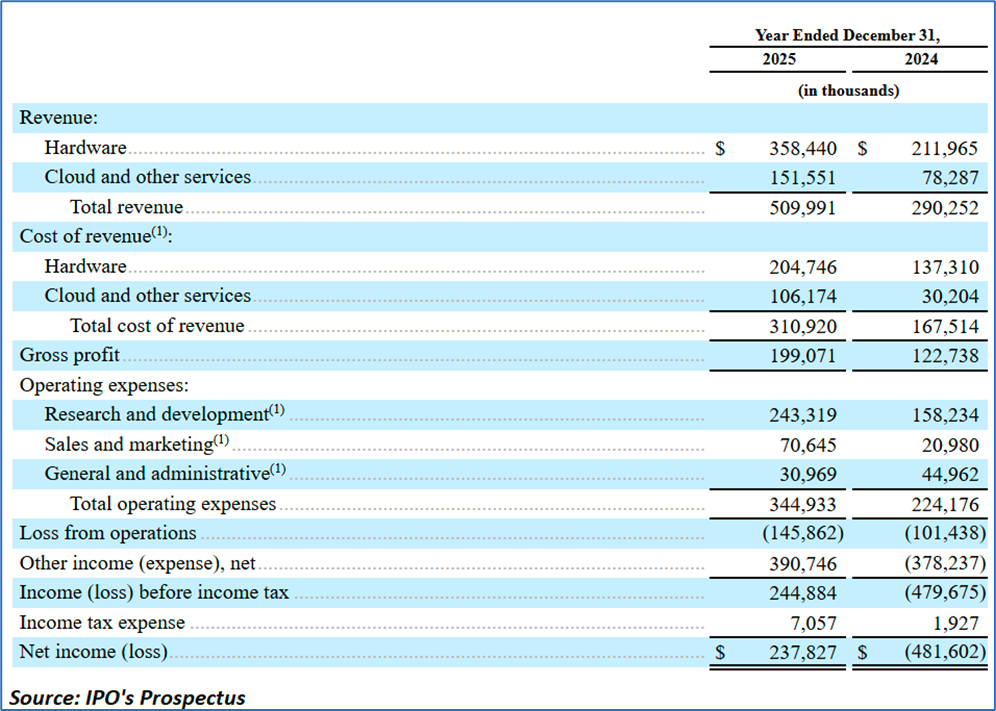
- Revenue Growth and Business Mix Transformation: Cerebras reported fiscal 2025 revenue of USD 510 million (+76% YoY), split between hardware at USD 358 million (70%, +69% YoY) and cloud services at USD 152 million (30%, +94% YoY). The Master Revenue Agreement with OpenAI will fundamentally shift revenue composition toward recurring services in future periods. However, growth masks extreme customer concentration risk: G42, MBZUAI, OpenAI, and AWS account for substantially all revenue, with the filing explicitly warning that loss of any significant customer would materially harm financial performance. Hardware sales concentrate on Abu Dhabi Sovereign AI initiatives, while the OpenAI cloud commitment creates both visibility and execution risk.
- Profitability Analysis and Operating Economics Reality; Cerebras reported USD 238 million net income in fiscal 2025 versus USD 482 million loss in 2024, but profitability is illusory. The gain resulted from USD 391 million in non-recurring other income (primarily USD 1.0 billion fair value remeasurement of warrants offset by USD 618 million debt extinguishment losses), masking a core operating loss of USD 146 million. Cloud gross margin collapsed to 30% from 61% as infrastructure investments preceded revenue realization, while R&D consumed USD 243 million (48% of revenue). The business remains structurally unprofitable operationally despite reported GAAP earnings, with cloud margin compression creating near-term profitability headwinds as OpenAI capacity ramps.
- Cash Flow Dynamics and Capital Intensity Concerns: Despite USD 238 million reported net income, Cerebras generates negative operating cash flow from operating losses, working capital consumption (TSMC advance payments, extended customer terms), and aggressive cloud infrastructure buildout. Management explicitly acknowledges cloud offerings "require significant data center capacity and capital investments for which we expect to require significant additional capital," signaling the USD 3.36 billion IPO proceeds may prove insufficient. OpenAI MRA obligations require substantial upfront capex with multi-year service delivery creating cash flow timing mismatches, while 48% R&D intensity (USD 243 million) represents fixed costs pressuring cash generation. The capital consumption profile suggests additional financing need within 18-24 months absent rapid margin expansion or revenue acceleration.
- Balance Sheet Position and Future Funding Requirements: Cerebras' USD 3.36 billion raise and acknowledgment of "significant additional capital" needs beyond IPO proceeds signals 18-24 months liquidity runway at current burn rates (USD 146 million operating losses plus cloud capex and working capital). Management explicitly states future funding will come "through future issuances of debt or equity securities," creating dilution risk for IPO investors. The OpenAI MRA creates upfront capital requirements with delayed compensation over service periods. Valuation at 30x trailing sales and 72x reported earnings (though operationally unprofitable) prices in flawless execution, requiring cloud gross margin expansion to 50%+, customer diversification beyond current concentration, and cash flow breakeven before requiring dilutive follow-on financing.
Key Management Highlights
Risk Associated (High)
Investment in the initial public offering of Cerebras Systems Inc. (CBRS) is subject to several material risk factors, including the following:
- Extreme Customer Concentration Risk: Substantial revenue derives from only four strategic relationships (G42, MBZUAI, OpenAI, AWS), with loss of any single customer capable of materially harming financial performance, as explicitly warned in the filing.
- Operational Unprofitability Masked by Accounting Gains: Core operating loss of USD 146 million in fiscal 2025 demonstrates the business remains structurally unprofitable despite reported USD 238 million net income driven by USD 391 million non-recurring fair value remeasurement gains.
- Capital Intensity Requiring Near-Term Dilutive Financing: Management explicitly acknowledges "significant additional capital" needs beyond the USD 3.36 billion IPO proceeds, with 18-24 month liquidity runway suggesting dilutive debt or equity issuance required before achieving cash flow breakeven.
Conclusion
Cerebras Systems has successfully commercialized wafer-scale integration technology, becoming the only company to bring processors built from entire silicon wafers to market after solving semiconductor manufacturing challenges that eluded the industry for 75 years. The WSE-3 processor delivers measurable performance advantages including inference speeds up to 15 times faster than leading GPU solutions and 2,625 times greater memory bandwidth than NVIDIA's B200 package, stemming from architectural innovations that eliminate off-chip data movement bottlenecks. The company has secured strategic partnerships with OpenAI, which selected Cerebras for production inference powering its Codex-Spark code generation platform, and Amazon Web Services, which signed a binding term sheet to become the first hyperscaler deploying Cerebras systems in its data centers. Revenue reached USD 510 million in fiscal 2025, representing 76% growth year-over-year, with cloud services growing 94% as the company transitions toward recurring revenue models. The Master Revenue Agreement with OpenAI provides contracted capacity commitments, while hardware deployments to G42 and MBZUAI support Sovereign AI initiatives in Abu Dhabi. The company operates a full-stack AI infrastructure platform combining the Wafer-Scale Engine processor, CS-3 system integration, and comprehensive software enabling customers to deploy frontier-scale models without distributed programming complexity.
Hence, given the proven technology differentiation, strategic validation from OpenAI and AWS, accelerating revenue momentum toward recurring cloud models, but balanced against extreme customer concentration risks, operational unprofitability despite accounting gains, and near-term dilutive financing requirements, "Cerebras Systems Inc. (CBRS)" IPO appears " Attractive " at the IPO price.
Disclaimer-
This report (“Report”) has been issued by Kalkine Pty Limited (ABN 34 154 808 312) (Australian financial services licence number 425376) (“Kalkine”) and prepared by Kalkine and its related bodies corporate who are authorised to provide general financial product advice. Kalkine.com.au and its associated pages are published by Kalkine.
Any advice provided in this Report is general advice only and does not take into account your objectives, financial situation or needs. You should therefore consider whether the advice is appropriate for your objectives, financial situation and needs before acting upon it.
There may be a Product Disclosure Statement, Information Memorandum or other offer document (“Offer Document”) for the securities or other financial products referred in this Report. You should obtain a copy of the relevant Offer Document and consider it before making any decision about whether to acquire the security or financial product.
Kalkine strongly recommends that you seek advice from a financial adviser, stockbroker or other professional (including taxation and legal advice) before acting on any of the general advice in this Report or on the Kalkine website. Not all investments are appropriate for all people.
The information in this Report and on the Kalkine website has been prepared from a wide variety of sources, which Kalkine, to the best of its knowledge and belief, considers accurate. Kalkine has made every effort to ensure the reliability of the information contained in its reports (including this Report), newsletters and websites. All information represents our views at the date of publication and may change without notice.
The information in this Report does not constitute an offer to sell securities or other financial products or a solicitation of an offer to buy securities or other financial products. Our reports contain general recommendations to invest in securities and other financial products. Kalkine is not responsible for, and does not guarantee, the performance of, or returns on, any investments mentioned in this Report.
Kalkine does not issue, sell or deal in any financial products.
This Report may contain information on past performance of particular investments. Past performance is not a reliable indicator of future performance. Returns stated do not take into account transaction costs and taxes. To the extent permitted by law, and excluding any dishonesty or gross negligence by Kalkine, Kalkine disclaims and excludes all liability for any direct, indirect, implied, punitive, special, incidental or other consequential loss or damage arising from the use of or reliance on this Report, the Kalkine website and any information published on the Kalkine website without any warranties or representations by Kalkine to you. To the extent the law prohibits or limits this exclusion, Kalkine limits its liability to the resupply of services.
Please also read our Terms & Conditions and Financial Services Guide for further information. Employees and/or associates of Kalkine and its related entities may hold interests in the securities or other financial products covered in this Report or on the Kalkine website. Any such employees and associates are required to comply with certain, procedures and disclosures as required by law.
Kalkine Media Pty Ltd, an affiliate of Kalkine Pty Ltd, may have received, or be entitled to receive, financial consideration in connection with providing information about certain entity(s) covered on its website including entities covered in this Report.
Copyright 2026 Krish Capital Pty. Ltd. (ABN 61629651510). All Rights Reserved. No part of this report, or its content, may be reproduced in any form without our prior consent.
Past performance is not a reliable indicator of future performance.

 CA
 NZ
 UK
 US
 IND

 AU

 Please wait processing your request...