
 CA
 NZ
 UK
 US
 IND

 AU

 Share
 X (Formerly Twitter)
 Whatsapp
 Facebook
 LinkedIn
 Telegram
 Email This Article
 Copy Link
 Summarize with AI
 Chat GPT
 Perplexity

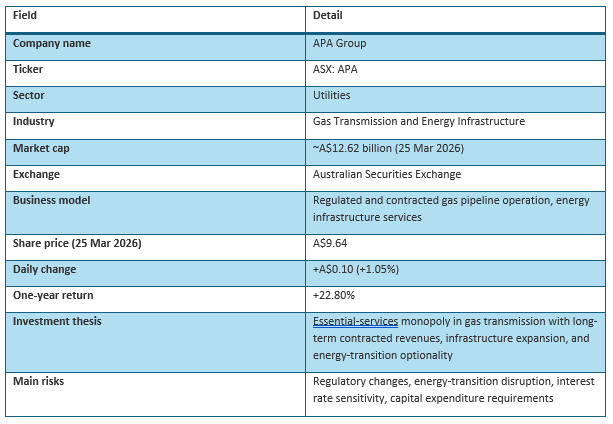
APA Group (ASX:APA) is Australia's largest natural gas infrastructure company. It owns and operates a network of gas transmission pipelines, storage facilities, compression assets, and power generation plants that collectively transport approximately half of Australia's domestic natural gas supply. With a market capitalisation of approximately A$12.62 billion as of 25 March 2026, APA is a constituent of the ASX 50 index and one of the most widely held utility stocks on the exchange.
On 25 March 2026, APA's shares traded at A$9.64, up 1.05% on the day, with a one-year return of 22.80 per cent. While this performance is modest compared to the explosive gains of smaller companies like 4DMedical or Elsight, it is significant for a large-cap utility that is typically valued for its income characteristics and defensive qualities rather than capital growth.
At a Glance: APA Group
Business Model
APA's business model revolves around owning and operating critical energy infrastructure under long-term contracts with gas producers, retailers, and industrial users. The company generates revenue primarily through tariffs charged for the transmission, storage, and processing of natural gas.
This model has several attractive characteristics. First, the contracts are typically long-term, often spanning ten to twenty years, which provides revenue visibility. Second, many contracts include inflation-linked escalation clauses, which means APA's revenue tends to grow in line with or above the Consumer Price Index. Third, the physical infrastructure itself represents a significant barrier to entry; building a competing gas pipeline network across Australia would require billions of dollars and years of regulatory approvals.
APA operates across three main segments: Energy Infrastructure, which encompasses its core pipeline and gas storage assets; Asset Management, which provides services to third-party asset owners; and Energy Investments, which includes stakes in various energy projects and facilities.
Infrastructure Projects and Growth
APA is not a static infrastructure owner. The company has been actively investing in both traditional gas infrastructure and emerging energy opportunities.
Among the notable projects underway or recently completed as of early 2026 are the Moomba to Sydney Ethane Pipeline (MSEP) conversion, targeting 2025 completion with an investment of approximately A$25 million; the MSP off-peak capacity expansion, which came online for the summer of 2025-2026 with an investment of approximately A$15 million; and the Sturt Plateau Pipeline, a new 23-mile pipeline under construction to bring gas from the Beetaloo Basin to the Northern Territory, with first gas targeted from 2026.
The Beetaloo Basin, in particular, represents a significant growth opportunity. The basin is one of Australia's most prospective onshore gas resources, and APA is positioning itself as the primary pipeline operator to bring Beetaloo gas to market. If the basin delivers on its potential, APA's infrastructure will be central to the supply chain.
APA has also made investments in renewable energy, including solar and wind farms, as part of a broader strategy to diversify its revenue streams beyond natural gas. While these investments are currently a small portion of total revenue, they signal management's awareness of the energy-transition theme and a willingness to adapt the business model over time.
Dividend and Income Characteristics
APA Group is widely held as an income stock. The company has a long history of paying regular distributions to unitholders. For income-focused investors, the key metrics to track are the distribution yield, the payout ratio, and the sustainability of cash flows underpinning the distribution.
As a stapled security consisting of a trust and a company component, APA's distributions are structured differently from ordinary dividends. Investors should consult the latest distribution guidance from the company and consider the tax implications, including the potential for tax-deferred components, which can be beneficial for certain investors.
The one-year return of 22.80 per cent as of 25 March 2026 includes both capital appreciation and distributions, making APA one of the better-performing utility stocks on the ASX over this period.
Risks
- Energy transition: The long-term shift away from fossil fuels could reduce demand for natural gas infrastructure. While gas is often positioned as a transition fuel, the timeline and pace of this transition are uncertain.
- Regulatory risk: APA's pipeline tariffs are subject to regulatory oversight. Changes in regulatory frameworks could affect pricing and returns on capital.
- Interest rate sensitivity: As an income stock with infrastructure characteristics, APA's valuation tends to be inversely correlated with interest rates. Rising rates can make the distribution yield less attractive relative to bonds and term deposits.
- Capital expenditure: Large infrastructure projects carry execution risk, including cost overruns, delays, and environmental approvals.
- Concentration: Approximately half of Australia's gas flows through APA's network, which creates systemic importance but also regulatory and political scrutiny.
Section Recap
APA Group is the prototypical defensive utility stock: essential infrastructure, long-term contracts, inflation-linked revenues, and a meaningful distribution yield. For beginner investors seeking relatively lower-risk exposure to the Australian energy sector, APA offers a well-understood business model with visible cash flows. The stock's 22.80 per cent one-year return demonstrates that even defensive names can deliver solid total returns in the right environment. The primary long-term risk is the energy transition, but APA's investments in renewables and its role as a transition-fuel carrier provide some buffer.


 Nov 12, 2026





 Please wait processing your request...