
 CA
 NZ
 UK
 US
 IND

 AU

 Share
 X (Formerly Twitter)
 Whatsapp
 Facebook
 LinkedIn
 Telegram
 Email This Article
 Copy Link
 Summarize with AI
 Chat GPT
 Perplexity

Caprice Resources is a micro-cap exploration company that has attracted market attention through share price momentum and elevated trading volumes. While momentum can be a legitimate short-term trading signal, the analytical challenge with CRS is separating genuine fundamental progress from sentiment-driven price action — a distinction that is critical for investors managing risk appropriately.
At its core, CRS is an early-stage explorer. Its value is prospective, its revenue base is non-existent, and its share price is subject to the same dynamics that characterise all micro-cap exploration stocks: amplified response to news flow, retail trading concentration, and high sensitivity to sector-wide sentiment shifts.
- Business Model
CRS's value creation model is exploration-driven, following the conventional junior mining company pathway:
- Acquire prospective tenements
- Execute drilling programs
- Define resources
- Advance toward development or attract a strategic acquirer
This model is not inherently flawed — it is how the majority of the world's mines are discovered. However, the statistical reality of exploration is that the vast majority of early-stage explorers do not ultimately define economic resources, and among those that do, many do not reach production as standalone entities.
- Market Behaviour & Trading Dynamics
CRS has exhibited characteristics common to momentum-driven micro-cap stocks:
- High day-to-day price volatility relative to its market capitalisation
- Elevated trading volumes that are disproportionate to underlying fundamental news flow
- Retail investor concentration, which can amplify both upside moves and corrections
- Price action that is more responsive to sector-wide rare earth sentiment than company-specific catalysts
These dynamics are not unique to CRS — they are structural features of the micro-cap exploration segment. However, they require investors to maintain a clear distinction between price movement and value creation.
- Financial Position
- No revenue from operations
- Expenditure limited to exploration and corporate overhead
- Dependent on equity markets for all funding requirements
- Market capitalisation modest relative to development-stage peers, reflecting the early stage of the project
Stock Performance
Caprice Resources Ltd (ASX: CRS) last traded at AUD 0.085, up from its previous close of AUD 0.075, reflecting strong short-term momentum. The stock gained 13.33% intraday and 6.25% over the past week, indicating renewed buying interest.
However, performance remains mixed across longer periods, with declines of 12.37% over one month, 9.57% over three months, and 32.00% over six months. Despite this, CRS has delivered solid gains of 57.41% over nine months and 44.07% over one year, highlighting periods of strong upside.
On a shorter horizon, the stock is up 7.59% week-to-date (WTD) and 13.33% month-to-date (MTD), suggesting improving near-term sentiment.
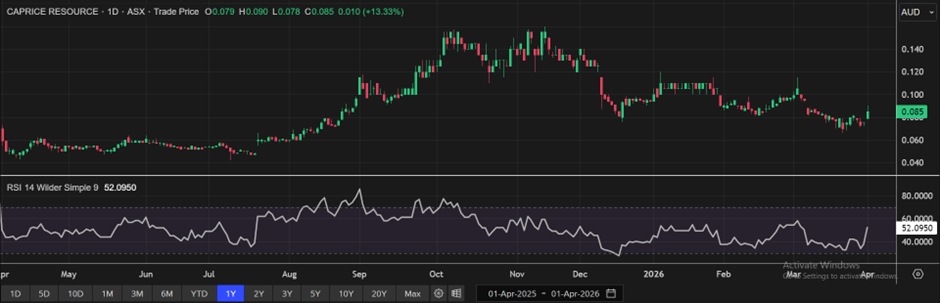
Data source: EODHD/Others as of April 01, 2026
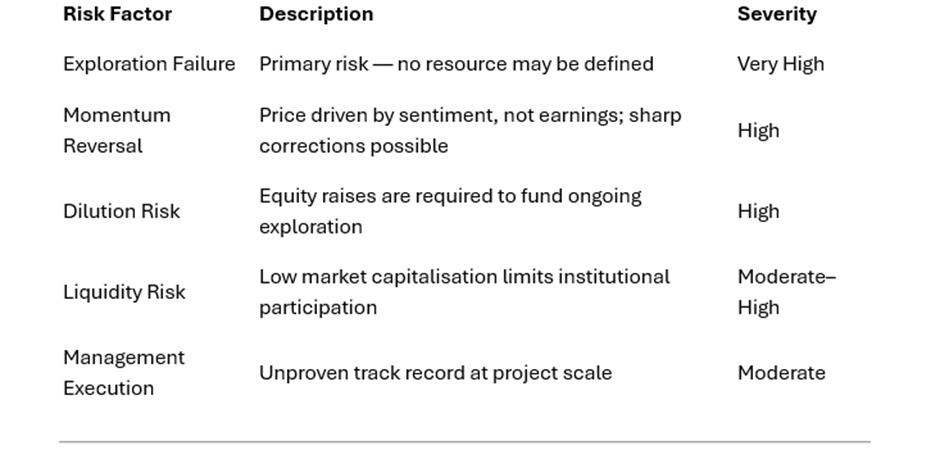
- Risk Assessment
- Bull & Bear Case
Bull Case: A meaningful exploration discovery is announced, generating genuine re-rating based on resource potential. Momentum attracts broader market attention and a discovery-driven share price re-rating materially above current levels.
Bear Case: Drilling delivers inconclusive or negative results. Momentum reverses sharply in a sector sentiment shift, and the absence of underlying earnings provides no valuation floor. Equity raises at depressed prices accelerate dilution.
- Investment Conclusion
CRS is best approached as a short-duration, high-risk trading position rather than a long-term investment. The absence of revenue, the dependence on drilling success, and the momentum-driven price action all point to a risk profile that is unsuitable for investors seeking capital preservation or income.
For traders with discipline around entry price, position sizing, and stop-loss management, micro-cap exploration stocks like CRS can generate short-term returns. For long-term investors, the risk/reward profile is unfavourable relative to more advanced companies with established assets and clearer development pathways.
Best suited for: Short-term traders with strict risk management discipline and small, defined position sizes.


 Nov 13, 2026





 Please wait processing your request...