
 CA
 NZ
 UK
 US
 IND

 AU

 Share
 X (Formerly Twitter)
 Whatsapp
 Facebook
 LinkedIn
 Telegram
 Email This Article
 Copy Link
 Summarize with AI
 Chat GPT
 Perplexity
Highlights
- Focuses on high-margin processing via A$1.65B government-funded Eneabba Refinery for NdPr oxides.
- Mineral sands cash flow funds transition; monazite feedstock from own ops and partners.
- Defensive infrastructure play with premium margins in supply chain bottleneck.
Iluka Resources (ASX:ILU) approaches the rare earth sector from a fundamentally different angle than its ASX peers. Rather than competing in the exploration and mining segment, Iluka is investing in the processing and refining layer — the most capital-scarce, highest-margin, and most strategically contested segment of the rare earth supply chain. Underpinned by a legacy mineral sands business generating consistent cash flow and backed by approximately A$1.65 billion in government funding for its Eneabba Refinery, Iluka represents the closest thing to an infrastructure investment in the Australian rare earth sector.
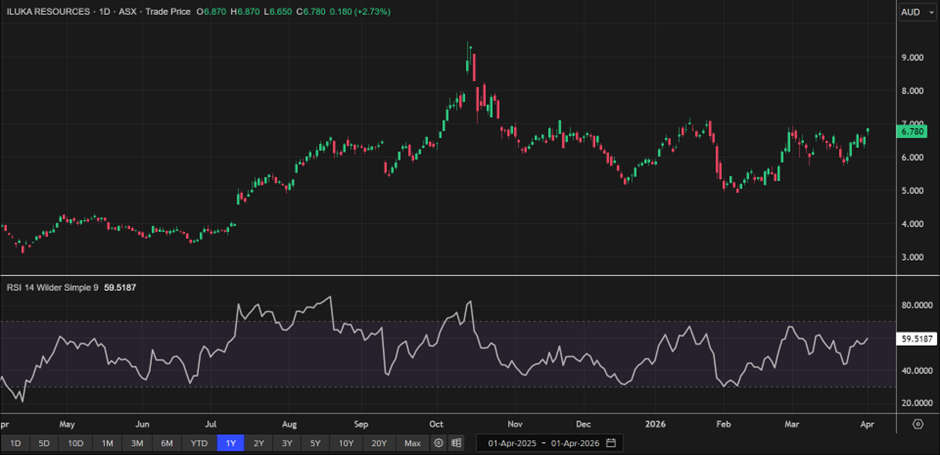
Iluka Resources gained 2.727% to $6.780 on volume of 2,042,282 shares.
Bid/offer range of $6.780-$6.790 shows balanced trading in this processing-focused play.
The $2.84B market cap reflects steady interest in Eneabba Refinery's government-backed potential.
Source: EODHD/Others
- Strategic Positioning: The Processing Layer Thesis
The global rare earth supply chain has two fundamental constraints: ore supply and processing capacity. China's dominance is most entrenched not at the mining stage, but at the separation and refining stage. Building credible ex-China processing capacity is therefore the highest-priority challenge for Western governments and the highest-margin opportunity for companies capable of executing it.
Iluka's strategy is explicitly focused on this layer. By targeting rare earth separation and refining rather than mining, Iluka:
- Accesses the highest-margin segment of the value chain
- Reduces direct exposure to mine development risk
- Positions itself as a strategic national infrastructure asset
- Benefits from government alignment and funding support unavailable to conventional miners
This is a structurally distinct strategy from every other company in this report, and it carries a correspondingly distinct risk and return profile.
- Legacy Business: Mineral Sands Operations
Iluka's existing mineral sands business — producing zircon, rutile, and synthetic rutile — provides the financial foundation for its rare earth transition.
Key attributes:
- Consistent revenue and operating cash flow through the commodity cycle
- Established customer relationships and operational infrastructure
- Provides financial resilience that pure rare earth developers cannot match
- Funds a portion of the Eneabba development without full reliance on government support or equity markets
The mineral sands business is not the primary investment thesis for rare earth-focused investors, but it is a meaningful source of downside protection.
- Flagship Initiative: Eneabba Rare Earth Refinery
The Eneabba Refinery in Western Australia is Iluka's central strategic project and the asset most likely to drive long-term value creation.
Key project parameters:
- Backed by approximately A$1.65 billion in government concessional financing — one of the largest government commitments to a single rare earth project in Australia
- Designed to produce separated rare earth oxides, including NdPr, from monazite feedstock
- Positioned as Australia's first integrated rare earth refinery of commercial scale
- Strategic alignment with government objectives for domestic critical mineral processing capacity
The government funding commitment is significant not only as a financial de-risking mechanism, but as a signal of the project's national infrastructure classification. This distinction is likely to attract long-term, stable demand from government-aligned customers and provide pricing stability that pure market-exposed producers cannot guarantee.
- Feedstock Considerations
A key strategic variable for Iluka that differs from vertically integrated peers is feedstock sourcing. As a processor rather than a miner, Iluka must secure a reliable supply of rare earth mineral concentrate (monazite) to feed the Eneabba refinery.
This introduces a supply chain dependency that integrated producers like Lynas do not face. Iluka is managing this through:
- Existing monazite production from its own mineral sands operations
- Potential third-party feedstock agreements with Australian rare earth miners
The adequacy and cost of feedstock supply is a key variable in the long-term economics of Eneabba and warrants close monitoring.
- Financial Profile
Iluka's financial position is among the strongest in the Australian rare earth sector:
- Mineral sands cash flow provides a recurring revenue base
- Government loan facility reduces equity dilution risk for the Eneabba development
- Conservative balance sheet management relative to peers
The principal financial risk is the capital intensity of the Eneabba build and the extended timeline before rare earth processing revenues commence. Investors must assess the opportunity cost of capital tied up in a long-duration infrastructure project.
- Risk Assessment
|
Risk Factor |
Description |
Severity |
|
Refinery Execution Risk |
Cost overruns or technical challenges in refinery construction |
High |
|
Feedstock Supply Risk |
Securing reliable, cost-effective monazite supply |
Moderate |
|
Development Timeline |
Long construction and commissioning period before revenue |
Moderate |
|
Mineral Sands Cyclicality |
Legacy business earnings sensitive to zircon/rutile pricing |
Moderate |
|
Limited Exploration Upside |
Infrastructure model offers less upside than pure producers |
Low–Moderate |
- Bull & Bear Case
Bull Case: Eneabba is completed on schedule, securing long-term feedstock supply at favorable economics. Processing margins prove superior to mining margins as rare earth supply chains tighten globally. Government backing attracts sovereign and OEM customers seeking provenance-assured, Australian-processed rare earths, and Iluka commands a pricing premium accordingly.
Bear Case: Eneabba construction costs escalate beyond the government funding envelope, requiring additional equity. Feedstock supply proves more constrained or expensive than anticipated. Development timelines extend materially, delaying the transition to rare earth processing revenue. The market applies a conglomerate discount to the combined mineral sands and rare earth business.
- Investment Conclusion
Iluka offers the most defensive rare earth investment profile of any company in this report. Its combination of operating cash flow, government-backed capital, and a focus on the highest-margin segment of the supply chain makes it well-suited to investors seeking critical minerals exposure with meaningfully lower development-stage risk than pure rare earth explorers or developers.
The trade-off is upside. Iluka's infrastructure orientation and diversified business model cap the speculative upside available to investors in pre-production developers. This is not a multi-bagger story in the conventional sense — it is a long-duration, infrastructure-style compounding thesis.
Best suited for: Conservative to moderate-risk investors seeking rare earth thematic exposure with downside protection from operating cash flows and government capital backing.


 Nov 13, 2026





 Please wait processing your request...