
 CA
 NZ
 UK
 US
 IND

 AU

 Share
 X (Formerly Twitter)
 Whatsapp
 Facebook
 LinkedIn
 Telegram
 Email This Article
 Copy Link
 Summarize with AI
 Chat GPT
 Perplexity
Ionic Rare Earths is one of the most conceptually differentiated rare earth companies on the ASX. Its strategy is built not on mining alone, but on a dual-vertical model combining upstream resource development in Uganda with downstream rare earth magnet recycling operations based in the United Kingdom. This circular economy orientation aligns Ionic with the growing regulatory and commercial emphasis on secondary supply chains, ESG-compliant sourcing, and reduced environmental footprints — themes that are increasingly influencing procurement decisions from Western OEMs and governments.
The investment case is nuanced. The recycling business offers a faster path to revenue and a more defensible ESG narrative than conventional mining, while the Makuutu Project provides longer-term scale. The key challenge is execution across two materially different business lines simultaneously, in two geographically and operationally distinct environments.
- Business Model: The Circular Rare Earth Value Chain
IXR's dual-vertical structure is its defining characteristic and primary differentiator from ASX peers:
Vertical 1 — Upstream Resource Development (Makuutu, Uganda)
- Ionic clay-hosted rare earth deposit in Uganda's Eastern Region
- Targets magnet rare earth production, including NdPr
- Clay-hosted deposit geology enables lower-capital extraction relative to hard rock peers
Vertical 2 — Downstream Recycling & Processing (UK Operations)
- Rare earth magnet recycling from end-of-life industrial and consumer products
- Produces separated rare earth oxides from recycled feedstock
- Qualifies as secondary supply — increasingly prioritised by European regulators and manufacturers
The logic of combining these two verticals is sound: recycling provides near-term revenue potential and ESG credentials, while Makuutu provides longer-term production scale. Together they create a supply chain proposition that neither a pure miner nor a pure recycler can replicate.
- Core Mining Asset: Makuutu Project, Uganda
The Makuutu deposit is an ionic adsorption clay-hosted rare earth system, a deposit type that shares geological characteristics with the clay deposits that underpin much of China's heavy rare earth production.
Key characteristics:
- Ionic clay-hosted mineralogy enables ambient-temperature leaching, which is significantly less energy-intensive and capital-heavy than hard rock processing
- Magnet rare earth content, including NdPr, supports the high-value product mix essential for commercial project economics
- Lower capex profile relative to hard rock peers improves project financing accessibility
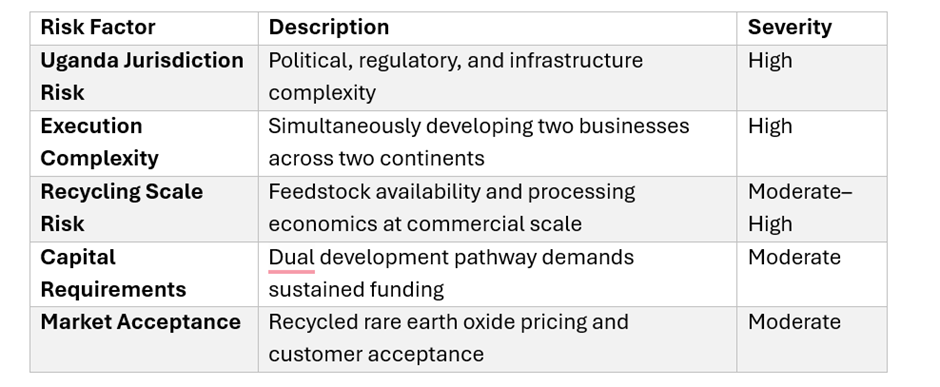
Jurisdiction considerations — Uganda: Uganda presents a more complex sovereign and regulatory environment than Australia, North America, or Brazil. Investors should apply an appropriate country risk premium, acknowledging that while African jurisdictions can be operationally viable, permitting timelines, political stability, and infrastructure constraints warrant ongoing scrutiny. This is the most significant non-technical risk in the IXR thesis.
- Strategic Differentiator: The Recycling Business
IXR's rare earth recycling operations in the UK represent its most strategically distinctive asset and, arguably, its most near-term value-creating opportunity.
Why recycling matters now:
- The European Union's Critical Raw Materials Act and associated regulations are actively incentivising secondary rare earth supply within European supply chains
- End-of-life rare earth recovery from wind turbines, EV motors, and industrial equipment is gaining commercial traction as volumes of recyclable material grow
- Recycled rare earth oxides carry ESG provenance credentials that primary mined material cannot provide, increasingly commanding price premiums from sustainability-focused customers
- Capital requirements are substantially lower than mine development, enabling earlier revenue generation
The recycling vertical is the component of IXR's business model most likely to generate near-term commercial milestones, and progress here deserves close attention from investors tracking the investment case.
- Financial Profile
IXR is pre-revenue across both verticals, though the recycling business is closer to commercial operation than the Makuutu mining project. Key financial dynamics include:
- Lower aggregate capex requirements than hard rock mining peers, partially due to clay-hosted deposit characteristics
- Dual development pathway creates diversified capital allocation needs — a strength in optionality but a complexity in prioritisation
- Reliance on equity markets for ongoing funding, consistent with peers at this development stage
Stock Performance
Ionic Rare Earths Limited (ASX: IXR) last traded around AUD 0.295, reflecting a decline from its previous close of AUD 0.31, indicating short-term selling pressure. The stock recorded an intraday fall of 4.84%, highlighting weak momentum during the latest session. Over the past week, IXR has slipped 3.27%, while the one-month and three-month returns show a sharp decline of over 31%, pointing to sustained downward pressure in the near term.
The longer-term trend also remains under pressure, with the stock down 42.15% over six months and 24.35% over nine months, reflecting continued volatility in the rare earths segment. However, on a broader timeframe, IXR has delivered a positive one-year return of 22.91%, indicating periods of strong upside despite recent corrections.
On a shorter horizon, the stock is down 4.83% month-to-date (MTD) and quarter-to-date (QTD), suggesting that weakness has persisted into the current quarter. The mixed performance across timeframes highlights a stock that has seen long-term gains but remains under short-term pressure, consistent with broader volatility seen in mining and rare earth equities.
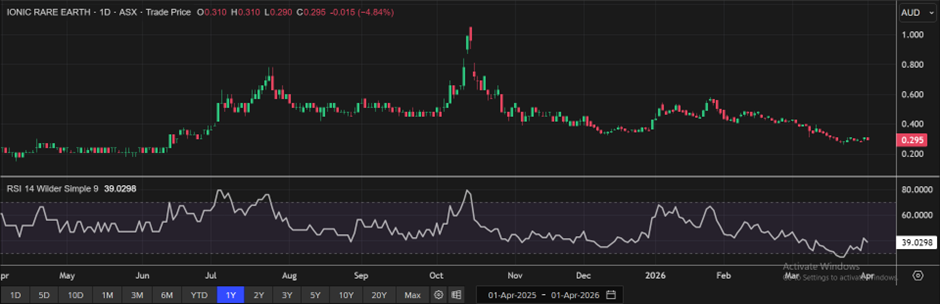
Data source: EODHD/Others as of April 01, 2026
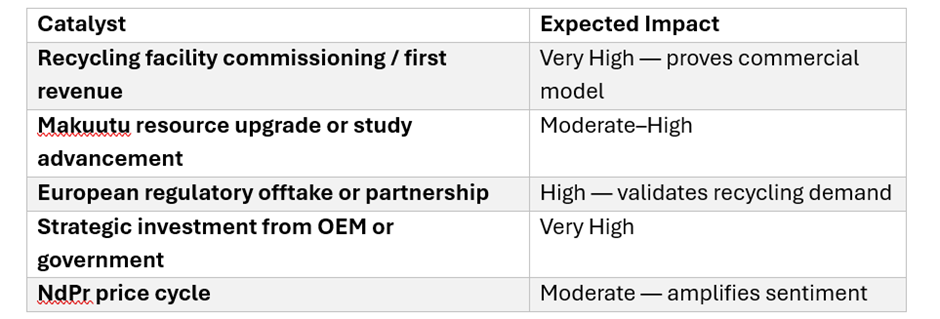
- Investment Catalysts
- Risk Assessment
- Bull & Bear Case
Bull Case: The UK recycling facility reaches commercial operation, generating IXR's first revenue stream and demonstrating the circular economy model. European OEM or government partnerships validate the recycled product and secure offtake. Makuutu advances through feasibility concurrently, providing long-term scale optionality. The combined narrative attracts ESG-aligned institutional capital.
Bear Case: Recycling scale-up proves more technically and commercially challenging than anticipated, delaying first revenue. Uganda regulatory or operational challenges slow Makuutu progress. The dual-vertical model stretches management bandwidth and capital, delivering sub-optimal outcomes across both businesses.
- Investment Conclusion
IXR is the most strategically innovative company in this report. The circular economy model — integrating recycling with primary resource development — is genuinely differentiated and aligned with where global rare earth supply chain policy is heading. The recycling business, in particular, has the potential to generate revenue well ahead of any new mine coming into production.
The risks are real: Uganda is a more challenging jurisdiction than Australian peers, and executing two materially different businesses simultaneously requires exceptional management bandwidth and capital discipline. But for investors seeking a rare earth story with a credible ESG narrative and a near-term commercial catalyst beyond drill results, IXR warrants serious consideration.
Best suited for: ESG-oriented thematic investors and those seeking differentiated rare earth exposure with recycling and circular economy upside.


 Nov 13, 2026





 Please wait processing your request...