
 CA
 NZ
 UK
 US
 IND

 AU

 Share
 X (Formerly Twitter)
 Whatsapp
 Facebook
 LinkedIn
 Telegram
 Email This Article
 Copy Link
 Summarize with AI
 Chat GPT
 Perplexity

The Gold Sector in Full Flight
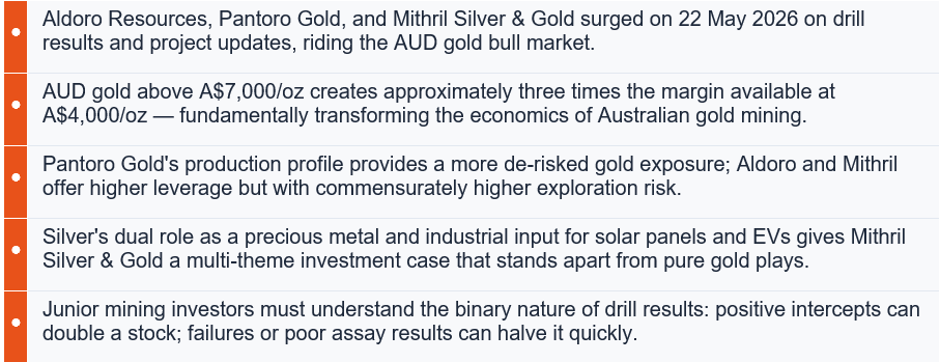
Three names exemplified the extraordinary conditions in the Australian gold and silver sector on 22 May 2026: Aldoro Resources, Pantoro Gold, and Mithril Silver & Gold. Each company delivered company-specific news — drill results, resource updates, or project milestones — that resonated powerfully with investors already positioned for the AUD gold Bull Market. The context is everything: at A$7,000+ per troy ounce in AUD terms, the Economics of Australian gold Mining have been transformed, and any news that advances a project toward production has immediate and significant valuation implications.
To understand why AUD gold above A$7,000 matters so much, consider the arithmetic. A project with all-in sustaining costs of A$2,500 per ounce — broadly representative of a mid-cost Australian producer — generated a Margin of A$1,500 per ounce when gold was at A$4,000. At A$7,000, the same project generates A$4,500 per ounce — a threefold improvement in per-ounce economics from the same physical production base. This is not incremental improvement; it is a step-change in profitability that justifies a re-rating of the entire sector.
Aldoro Resources: Exploration Leverage in Full
Aldoro Resources is a Western Australian gold and lithium explorer operating in established mineralised corridors of the Goldfields and Pilbara. The company's session move was triggered by drill results that extended the known mineralisation at one of its key targets — either deeper extensions of an existing resource or lateral extensions that suggest a larger overall deposit footprint. For exploration investors, the key metric is the drill intercept: width in metres multiplied by grade in grams per tonne gives a rough sense of the 'metre-gram' quality of the intersection. High-grade, wide intersections in proximity to existing resources are the catalyst for the largest single-day moves.
Pantoro Gold: Production with a Growth Story
Pantoro Gold occupies a more advanced position on the development spectrum. The company has established gold production operations — meaning it is already generating Revenue from gold sales rather than purely burning exploration cash. Pantoro's session move reflected either a quarterly production report beating guidance, a reserve update extending mine life, or a development milestone at one of its key operations. For investors who want gold price leverage without the binary risk of pure exploration, Pantoro represents a middle path: real production economics, but still with exploration upside from adjacent tenements.
Mithril Silver & Gold: The Dual Metal Thesis
Mithril Silver & Gold brings a distinctive dimension to the precious metals story. Silver has traditionally moved in sympathy with gold — investors treat it as a lower-priced version of gold's monetary and store-of-value properties. But in 2026, silver carries an additional Investment narrative that is genuinely new: silver is a critical input in solar photovoltaic panels and an increasingly important material in electric vehicle components. As global solar capacity and EV fleets expand — the IEA projects the global EV fleet to grow sixfold to 510 million vehicles by 2035 — industrial Demand for silver is growing alongside its traditional monetary demand.
This dual demand thesis creates a valuation floor for silver that doesn't exist for pure precious metals plays. Even if investor sentiment toward precious metals cools, the industrial demand trajectory provides ongoing support. For Mithril, this means its project economics are underpinned by not one but two demand growth stories simultaneously — a positioning that sophisticated Commodity investors recognise as genuinely differentiated.
Risk Warning: Understand the Binary Nature
It is essential that investors approaching the junior gold and silver sector understand the fundamental risk structure. Drill results are binary in nature: a positive intercept can legitimately double a stock in a day; a disappointing result — narrow mineralisation, low grade, or absence of gold — can halve it with equal speed. The failure rate in mineral exploration is high; for every discovery, there are multiple disappointments. This is not a reason to avoid the sector, but it is a reason to size positions conservatively and diversify across multiple names rather than concentrating in one.


 Nov 13, 2026





 Please wait processing your request...