
 CA
 NZ
 UK
 US
 IND

 AU

 Share
 X (Formerly Twitter)
 Whatsapp
 Facebook
 LinkedIn
 Telegram
 Email This Article
 Copy Link
 Summarize with AI
 Chat GPT
 Perplexity

Five companies, five strategies: the backbone of ASX Mining
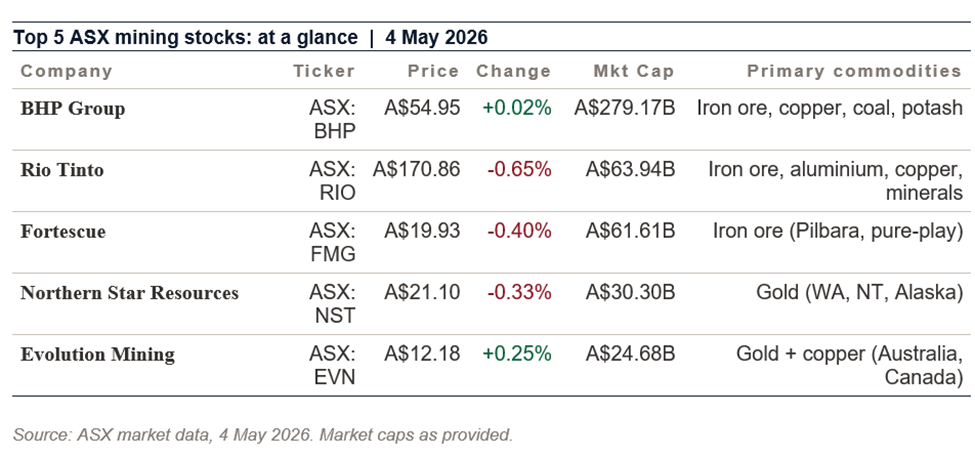
Australia's five largest ASX-listed Mining stocks span the world's biggest diversified miner, two of the globe's largest iron ore producers, and two gold miners benefiting from record AUD gold prices. Together they represent over A$460 billion in Market Capitalisation -- and together they define what investing in Australian resources means.
Mining is not a single industry. BHP and Rio Tinto operate across multiple commodities on multiple continents. Fortescue is a single-Commodity pure-play of extraordinary scale. Northern Star and Evolution Mining/">Mining/">Mining are gold companies whose returns are driven by a price dynamic entirely different from the iron ore cycle. What unites them is their ASX listing, their status as globally significant Commodity/">Commodity/">Commodity producers, and their importance to Australian investors seeking resources exposure.
The analysis that follows covers each company's Business/">Business/">Business model, financial performance, price performance, valuation and key risks -- drawing on company ASX filings and annual reports as the primary data source.
|
BHP Group Limited A$54.95 +0.02% | Market Cap: A$279.17B
What BHP does: BHP Group Limited is the world's largest Mining/">Mining/">Mining company by Market Capitalisation, operating iron ore mines in the Pilbara (Western Australia), copper mines in Chile and South Australia, metallurgical coal in Queensland, and the Jansen potash project under development in Saskatchewan, Canada. BHP's ASX listing (following the 2022 unification of its dual-listed structure) makes it Australia's largest listed company. Iron ore: BHP's Western Australian Iron Ore (WAIO) operations produce approximately 250-260 million tonnes per year from Pilbara mines including Mining/">Mining/">Mining Area C, Jimblebar, Yandi and Samarco (JV). Iron ore is the dominant Earnings/">Earnings/">Earnings contributor -- typically 50-60 per cent of group EBITDA -- and BHP's Pilbara cash costs are among the world's lowest at approximately $18-20 per tonne. Copper: Escondida in Chile (the world's largest copper mine, 57.5% BHP interest), Olympic Dam in South Australia (copper-uranium-gold-cobalt), and Carrapateena and Prominent Hill (acquired with OZ Minerals in 2023) form BHP's copper portfolio. Copper is BHP's chosen growth vehicle for the energy transition -- every electric vehicle, wind turbine and solar installation requires copper, and Demand/">Demand/">Demand is growing faster than new Supply/">Supply/">Supply can be developed. Potash: The Jansen potash mine in Saskatchewan, Canada is BHP's longest-duration growth project. Potash is an essential crop nutrient with Demand/">Demand/">Demand tied to global food production. Stage 1 is under construction with first production targeted for the late 2020s.
BHP's Earnings/">Earnings/">Earnings are dominated by iron ore, which generates exceptional EBITDA margins at Pilbara cash costs well below the current iron ore Spot Price. The company operates a progressive Dividend/">Dividend/">Dividend policy with a 50 per cent minimum Payout Ratio of underlying attributable profit -- making it one of the ASX's most reliable large-cap Dividend/">Dividend/">Dividend stocks. BHP's Balance Sheet is strong, with modest net Debt/">Debt/">Debt and substantial free Cash Flow generation even at current (moderated) Commodity/">Commodity/">Commodity prices. BHP's FY2024 results reflected lower iron ore and copper prices relative to the 2021-2022 super-cycle highs, but the company remained highly profitable. Underlying EBITDA of approximately $22 billion and free Cash Flow generation of approximately $10 billion in FY2024 underscored the resilience of the Business/">Business/">Business model even in a moderated price environment.
BHP's share price of A$54.95 (4 May 2026), up +0.02 per cent on the day, represents a company that has tracked the iron ore price cycle over the past three years -- rising dramatically in 2021 as iron ore exceeded $200 per tonne and moderating as prices normalised to the current $95-105 per tonne range. The stock trades at a valuation that reflects its dual nature: a defensive, cash-generative iron ore Business/">Business/">Business and a higher-growth copper optionality.
BHP is typically valued on a sum-of-the-parts basis: WAIO iron ore at an EV/EBITDA multiple, copper operations separately, Jansen as a development option. At A$54.95, the stock is broadly fairly valued relative to current spot Commodity/">Commodity/">Commodity prices, with upside if copper prices remain elevated (current live price approximately $6.00/lb) and downside if iron ore prices soften toward $80 per tonne on Chinese steel Demand/">Demand/">Demand weakness. Key risks: Iron ore price decline on Chinese Demand/">Demand/">Demand moderation; copper price Volatility/">Volatility/">Volatility; Jansen Capital/">Capital-expenditure/">Capital/">Capital/">Capital Expenditure overruns; failed M&Amp;Amp/">Amp;Amp/">Amp/">Amp;A (the unsuccessful Anglo American bid in 2024 demonstrated execution risk in large transactions); and nickel market deterioration (Nickel West suspended July 2023).
BHP's medium-term outlook is shaped by three forces: China's steel Demand/">Demand/">Demand (the iron ore price driver); global copper Demand/">Demand/">Demand growth from the energy transition; and Jansen's development progress. The company has positioned well for copper -- its portfolio across Escondida, Olympic Dam and OZ Minerals Assets/">Assets/">Assets makes it among the world's largest copper producers. Continued copper price strength at $6.00/lb materially enhances the Earnings/">Earnings/">Earnings outlook beyond what iron ore alone provides. FREQUENTLY ASKED QUESTIONS Q: What are BHP's main businesses? A: Iron ore (Pilbara WA), copper (Escondida Chile, Olympic Dam SA), metallurgical coal (Queensland) and potash (Jansen Canada, under development). [Source: BHP Annual Report FY2024] Q: Why is BHP the world's largest miner? A: By Market Capitalisation -- A$279.17B at 4 May 2026. BHP's combination of the world's largest iron ore operations, major copper Assets/">Assets/">Assets and a strong Balance Sheet supports this premium. [Source: ASX market data] Q: What is BHP's Dividend/">Dividend/">Dividend policy? A: Progressive Dividend/">Dividend/">Dividend targeting a minimum 50 per cent payout of underlying attributable profit. In surplus Capital/">Capital/">Capital years, special dividends are paid. [Source: BHP Annual Report FY2024] Source: BHP Group Limited Annual Report FY2024; ASX filings (asx.com.au); ASX market data 4 May 2026. |
|
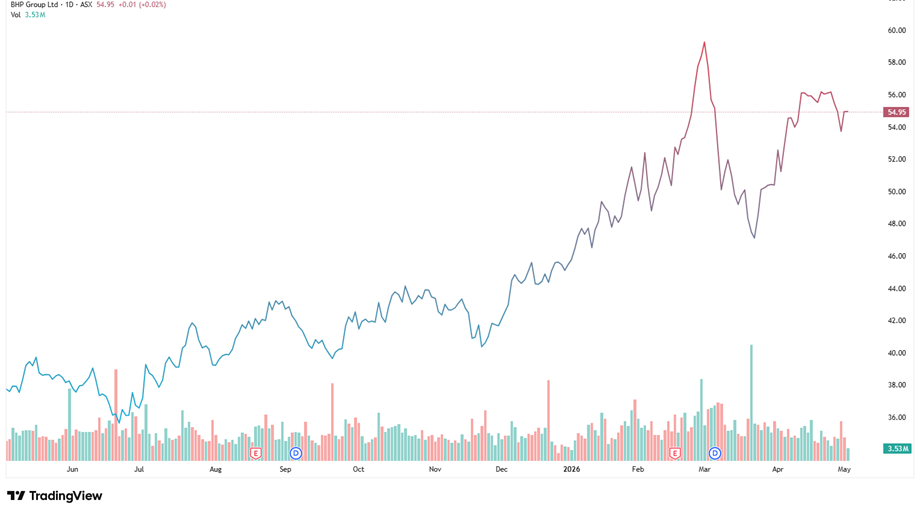
STOCK 2 OF 5 -- ASX: RIO Rio Tinto Limited A$170.86 -0.65% | Market Cap: A$63.94B
What Rio Tinto does: Rio Tinto is one of the world's largest diversified Mining/">Mining/">Mining groups, with major operations in iron ore (Pilbara WA), aluminium (global), copper (Mongolia, Chile, US) and industrial minerals (titanium dioxide, borates, lithium). The company operates through four product groups: Iron Ore, Aluminium, Copper, and Minerals. Rio Tinto's ASX listing sits alongside its primary listing on the LSE. Iron ore -- the Pilbara flagship: Rio Tinto's Pilbara iron ore system -- comprising Robe Valley, Brockman Hub, Hope Downs, Gudai-Darri and related infrastructure -- is one of the world's most efficient iron ore Supply/">Supply/">Supply chains, producing approximately 330 million tonnes per year. Rio's Pilbara operations benefit from an integrated mine-rail-port system that keeps costs among the world's lowest and enables continuous production expansion. Aluminium: Rio Tinto is the world's largest producer of aluminium, operating bauxite mines, alumina refineries and aluminium smelters across Australia, New Zealand, Canada, Iceland and other countries. The aluminium value chain -- from bauxite Mining/">Mining/">Mining to finished aluminium products -- provides Diversification/">Diversification/">Diversification from the iron ore cycle. Aluminium Demand/">Demand/">Demand is growing as the metal is increasingly used in electric vehicles and lightweight structures. Copper growth: Rio Tinto's copper growth portfolio is led by the Oyu Tolgoi copper-gold mine in Mongolia -- one of the largest copper deposits in the world, now in production from its underground mine. Oyu Tolgoi represents a multi-decade source of copper growth for Rio, expected to produce approximately 500,000 tonnes per year at peak capacity. The company also holds the Resolution copper project in Arizona (subject to permitting) and Kennecott copper in Utah.
Rio Tinto's financial results are characterised by high EBITDA margins in iron ore (consistent with BHP's Pilbara Economics/">Economics/">Economics) and lower but improving margins in aluminium and copper. The company operates a payout policy targeting 40-60 per cent of underlying Earnings/">Earnings/">Earnings, with supplementary dividends when the Balance Sheet is strong. Rio Tinto has maintained one of the most reliable Dividend/">Dividend/">Dividend records among ASX-listed companies. The A$170.86 share price reflects the relatively high per-share price typical of Rio Tinto's ASX listing (the LSE price is in GBP terms). Rio's FY2024 underlying Earnings/">Earnings/">Earnings and free Cash Flow remain strong despite lower iron ore prices, supported by the aluminium and copper Diversification/">Diversification/">Diversification that distinguishes Rio from the pure-play iron ore exposure of Fortescue.
Rio Tinto's share price of A$170.86, down -0.65 per cent on 4 May 2026, reflects the broader re-rating of iron ore producers on moderating Chinese steel Demand/">Demand/">Demand and lower iron ore prices. The high absolute share price -- relative to BHP and FMG -- is a function of Rio's fewer shares on issue rather than a Valuation Premium. On an EV/EBITDA basis, Rio typically trades broadly in line with BHP.
Rio Tinto is valued at a modest premium to resource replacement cost, reflecting the quality of its Pilbara operations, the growth value of Oyu Tolgoi and the Earnings/">Earnings/">Earnings stability provided by the aluminium Business/">Business/">Business. The Investment/">Investment/">Investment case rests on three pillars: reliable iron ore cash generation, Oyu Tolgoi copper growth, and the aluminium Diversification/">Diversification/">Diversification buffer. Key risks: Iron ore price decline on China slowdown; Mongolian sovereign risk at Oyu Tolgoi (the government has periodically renegotiated the project Economics/">Economics/">Economics); aluminium Margin/">Margin/">Margin compression on energy cost increases; and legacy environmental liabilities (the Juukan Gorge destruction in 2020 led to significant regulatory and governance changes).
Rio Tinto's medium-term outlook is positive. Oyu Tolgoi's underground mine is ramping up toward its 500,000 tonne per year copper target, adding a significant growth leg to a Business/">Business/">Business historically dominated by iron ore income. Aluminium Demand/">Demand/">Demand growth from electric vehicles and sustainable construction provides a supportive Demand/">Demand/">Demand context for that segment. The iron ore Business/">Business/">Business, while facing Chinese Demand/">Demand/">Demand headwinds, remains highly profitable at current prices. FREQUENTLY ASKED QUESTIONS Q: What makes Rio Tinto different from BHP? A: Rio has a larger aluminium Business/">Business/">Business (world's largest), a significant copper growth asset at Oyu Tolgoi (Mongolia), and roughly similar iron ore exposure. BHP has more copper (Escondida is larger than any single Rio copper mine) and the Jansen potash development. Both are globally diversified iron-ore-anchored majors. [Source: Rio Tinto Annual Report 2024] Q: What is Oyu Tolgoi? A: One of the world's largest undeveloped copper-gold deposits, located in Mongolia. The underground mine is now in production and ramping toward approximately 500,000 tonnes of copper per year at peak. It is Rio's primary copper growth engine for the next decade. [Source: Rio Tinto Annual Report 2024] Q: What is Rio Tinto's Dividend/">Dividend/">Dividend policy? A: Rio targets a payout of 40-60 per cent of underlying Earnings/">Earnings/">Earnings, with supplementary dividends when the Balance Sheet allows. The company has maintained a consistent Dividend/">Dividend/">Dividend record over many years. [Source: Rio Tinto Annual Report 2024] Source: Rio Tinto Limited Annual Report 2024; ASX filings (asx.com.au); ASX market data 4 May 2026. |
|
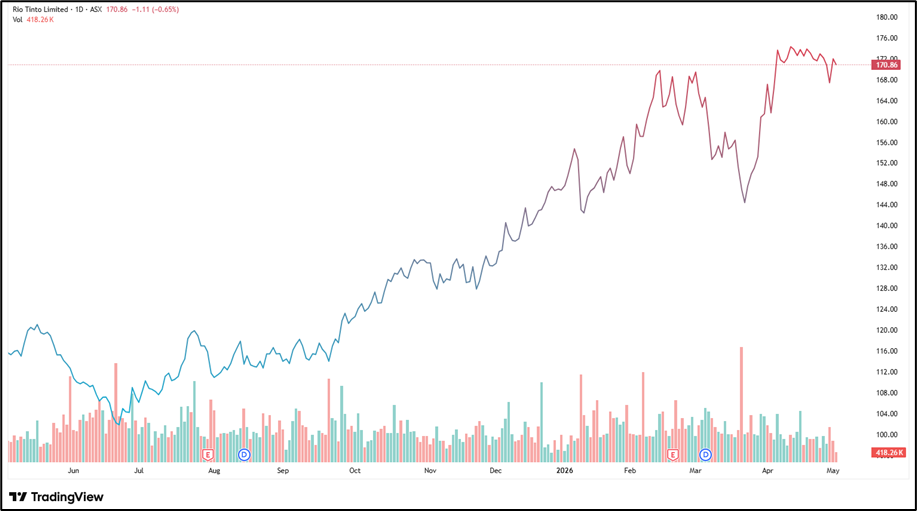
Fortescue Ltd A$19.93 -0.40% | Market Cap: A$61.61B
What Fortescue does: Fortescue Ltd is Australia's third-largest iron ore miner and the world's fourth-largest, producing approximately 190-200 million tonnes of iron ore per year from its Pilbara operations in Western Australia. Founded by Andrew Forrest in 2003, the company built a fully integrated iron ore system -- mine, railway and port -- in the Pilbara in just five years, one of the most remarkable infrastructure achievements in Australian Mining/">Mining/">Mining history. Pure-play iron ore with a green energy twist: Fortescue is unique among the major Pilbara producers in that it has no material Revenue/">Revenue/">Revenue Diversification/">Diversification/">Diversification away from iron ore. BHP and Rio both have significant copper and other Commodity/">Commodity/">Commodity businesses; Fortescue is overwhelmingly an iron ore company. What sets Fortescue apart is its aggressive green energy strategy -- Fortescue Future Industries (now Fortescue Green) is pursuing hydrogen, ammonia and green energy projects around the world, reflecting Andrew Forrest's personal commitment to decarbonisation. Pilbara operations: Fortescue's iron ore Assets/">Assets/">Assets include Cloudbreak, Christmas Creek, Eliwana, Iron Bridge (magnetite) and the Solomon Hub. The company's ore grade is generally lower than BHP and Rio's (Fortescue's blend typically grades 57-58% Fe versus the 62% benchmark), but its cost structure is sufficiently low to remain profitable across most iron ore price environments. Iron Bridge magnetite: The Iron Bridge magnetite project, which came into production in 2024, produces higher-grade (67% Fe) magnetite concentrate. This adds a premium-grade product to Fortescue's portfolio that commands a price above the 62% Fe benchmark, improving the realised price mix over time.
Fortescue's financial results are almost entirely driven by the iron ore price and the Volume/">Volume/">Volume of ore shipped. Because of this concentration, Fortescue has the highest Earnings/">Earnings/">Earnings Leverage/">Leverage/">Leverage to iron ore of the three Pilbara producers -- when prices rise, Fortescue's Earnings/">Earnings/">Earnings surge disproportionately; when prices fall, Earnings/">Earnings/">Earnings fall sharply. At current iron ore prices of approximately $99-105 per tonne and Fortescue's C1 costs of approximately $18-19 per tonne, the operation remains highly profitable. Fortescue has been one of the ASX's most extraordinary Dividend/">Dividend/">Dividend stories -- at the peak of the iron ore cycle in FY2021, the company paid dividends totalling A$3.58 per share, representing an extraordinary Yield/">Yield/">Yield on even then-elevated prices. The Dividend/">Dividend/">Dividend has moderated with iron ore prices, but remains substantial relative to Fortescue's cost base. The green energy investments through Fortescue Green have absorbed significant Capital/">Capital/">Capital. The company has scaled back some of the most ambitious green hydrogen targets following cost and commercial reality assessments, but the commitment to decarbonising the Pilbara operations (eliminating diesel from Mining/">Mining/">Mining operations) remains a genuine and Capital/">Capital/">Capital-intensive undertaking.
Fortescue's share price of A$19.93, down -0.40 per cent on 4 May 2026, sits well below its 52-week high -- the stock peaked above A$28 in early 2024 and has declined as iron ore prices moderated from those levels. For investors, the current price represents a different risk-return calculation from BHP or Rio: Fortescue has higher Earnings/">Earnings/">Earnings Leverage/">Leverage/">Leverage to iron ore (upside and downside), a less diversified Revenue/">Revenue/">Revenue base, and a management philosophy that prioritises growth Investment/">Investment/">Investment alongside returns.
Fortescue trades at a discount to BHP and Rio on EV/EBITDA multiples, reflecting its lower ore grade, single-Commodity/">Commodity/">Commodity concentration and the execution risk in the green energy investments. This discount is not unreasonable but may represent value for investors who believe iron ore prices will stabilise or recover from current levels. Key risks: Iron ore price is the primary risk -- as a pure-play producer, there is no Diversification/">Diversification/">Diversification buffer. Lower ore grade (57-58% Fe versus 62% benchmark) means Fortescue's realised price is structurally below the headline iron ore price and the discount can widen in weak markets. Green energy Capital/">Capital-expenditure/">Capital/">Capital/">Capital Expenditure represents a use of Capital/">Capital/">Capital that has not yet generated commercial returns. Governance risk: the company's strategy is closely tied to Andrew Forrest's personal vision
Fortescue's near-term outlook is directly tied to the iron ore price. Volume/">Volume/">Volume growth from Iron Bridge magnetite adds an improving grade mix to the production profile. The company's decarbonisation programme -- replacing diesel with green electricity and hydrogen in Pilbara operations -- represents both a cost-saving opportunity (if energy transition costs decline) and a Capital/">Capital/">Capital allocation challenge. FREQUENTLY ASKED QUESTIONS Q: Why is Fortescue's ore grade lower than BHP and Rio? A: Fortescue's ore deposits in the Pilbara blend to approximately 57-58% iron content, versus the 62% benchmark that BHP and Rio produce. Fortescue sells at a discount to the 62% Fe price. Iron Bridge magnetite adds 67% Fe product to the mix. [Source: FMG Annual Report FY2024] Q: What is Fortescue Green? A: The company's green energy division, pursuing hydrogen, ammonia and green electricity projects as part of Andrew Forrest's decarbonisation vision. Fortescue has committed to eliminating diesel from its Pilbara Mining/">Mining/">Mining operations by 2030. [Source: FMG Annual Report FY2024] Q: Why does Fortescue's Dividend/">Dividend/">Dividend vary so much? A: Because Fortescue's Earnings/">Earnings/">Earnings are almost entirely iron-ore-price-driven, dividends track Commodity/">Commodity/">Commodity prices closely. At peak iron ore prices (FY2021), dividends were extraordinary. At current prices they are lower but still material. [Source: FMG Annual Report FY2024] |
|
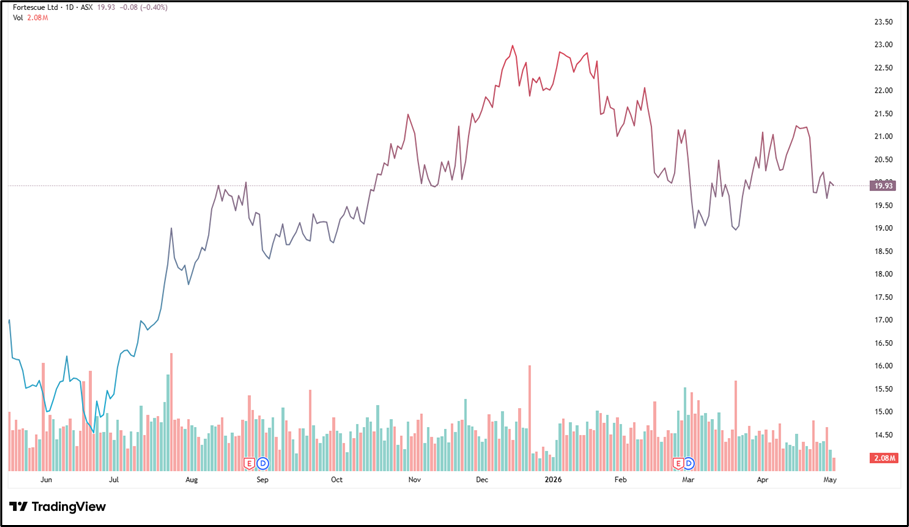
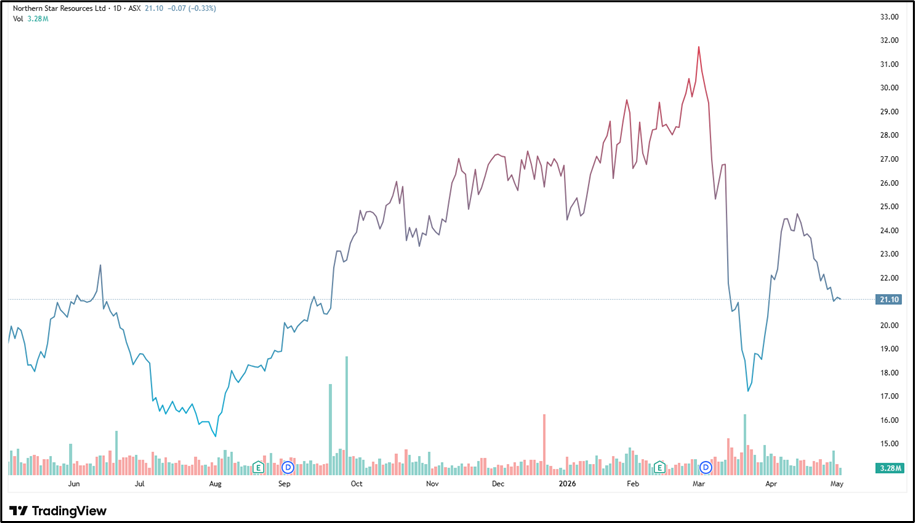
Northern Star Resources Limited A$21.10 -0.33% | Market Cap: A$30.30B
What Northern Star does: Northern Star Resources is Australia's largest ASX-listed pure-play gold producer and one of the top ten gold producers in the world by output. The company's portfolio is anchored by the Kalgoorlie Superpit (50% interest in KCGM, jointly operated with Newmont), the Yandal operations (Jundee and Thunderbox mines) in Western Australia, and the Pogo mine in Alaska, United States. Kalgoorlie Superpit (KCGM): The Kalgoorlie Consolidated Gold Mines (KCGM) operation -- the famous Superpit open-cut mine on the Golden Mile -- is one of the world's most recognisable gold Mining/">Mining/">Mining operations. At approximately 3.8 kilometres long, 1.5 kilometres wide and 570 metres deep, it processes millions of tonnes of ore per year. Northern Star's 50 per cent share of KCGM production is the largest single contributor to the company's annual gold output. Yandal operations: The Jundee and Thunderbox mines in the Yandal greenstone belt north of Kalgoorlie are high-grade underground and open-cut operations. Thunderbox has been expanded with a new processing Facility/">Facility/">Facility significantly increasing throughput capacity. These operations provide additional high-quality production alongside KCGM. The 2Mozpa growth target: Northern Star has articulated a strategic target to reach 2 million ounces of annual gold production, up from current levels of approximately 1.6 million ounces per year. This growth pathway -- through KCGM expansion and Yandal optimisation -- underpins the premium valuation investors assign to NST relative to smaller gold producers.
Northern Star's financial results are exceptional in the current gold price environment. With an AUD gold price above A$7,000 per troy ounce (reflecting USD gold near $4,628/oz and an AUD/USD rate of approximately 0.63-0.65), every ounce Northern Star produces generates margins that are transformational relative to any prior period in the company's history. At 1.6 million ounces per year, each A$1,000 per ounce improvement in the AUD gold price adds approximately A$1.6 billion to annual Revenue/">Revenue/">Revenue. All-In Sustaining Cost (AISC) -- the comprehensive measure of gold production cost including sustaining Capital/">Capital/">Capital -- is the primary Margin/">Margin/">Margin metric for gold investors. Northern Star's AISC guidance is disclosed in quarterly production reports. At current gold prices, the operating Margin/">Margin/">Margin (AUD gold price minus AISC) is among the highest in the company's history, driving strong free Cash Flow and Dividend/">Dividend/">Dividend growth.
Northern Star's share price of A$21.10, down -0.33 per cent on 4 May 2026, reflects the strong re-rating of Australian gold stocks that has accompanied the surge in AUD gold prices. The stock has significantly outperformed the broader ASX market over the past two years, tracking the gold price higher with operational Leverage/">Leverage/">Leverage (profits growing faster than gold prices as fixed costs are spread over larger Revenue/">Revenue/">Revenue).
Northern Star is valued on a price/net asset value (P/NAV) basis. At record gold prices, NAV has risen dramatically, and P/NAV multiples have actually compressed even as the share price has risen -- the stock may be cheaper relative to its fundamental value than it appears on a trailing Earnings/">Earnings/">Earnings basis. The Investment/">Investment/">Investment debate is whether record gold prices represent a new normal or a cyclical peak. Key risks: Gold price Reversal/">Reversal/">Reversal -- a return toward $3,000 per troy ounce (still above long-term average) would reduce margins but not eliminate profitability given NST's cost structure. KCGM expansion execution risk. Pogo mine performance (Alaska has higher operating costs than WA). Reserve depletion -- maintaining mine life through exploration is an ongoing Capital/">Capital/">Capital requirement.
Northern Star's outlook is directly linked to the gold price, which at $4,628/oz (30 April 2026) provides an exceptional Margin/">Margin/">Margin environment. The 2Mozpa production growth target, if achieved, would add significant scale and reduce per-ounce fixed costs. The key near-term catalysts are KCGM expansion progress, quarterly production delivery against guidance, and any reserve resource updates confirming the depth of the mine portfolio. FREQUENTLY ASKED QUESTIONS Q: What is the Kalgoorlie Superpit? A: One of the world's most famous open-cut gold mines, located on the Golden Mile in Kalgoorlie-Boulder WA. Approximately 3.8 km long, 1.5 km wide and 570 m deep. Northern Star owns 50%, Newmont owns 50%. [Source: NST Annual Report FY2024] Q: Why are gold miners doing so well in 2026? A: The AUD gold price exceeds A$7,000 per troy ounce, reflecting USD gold near $4,628/oz (TradingView, 30 April 2026) and a relatively soft AUD/USD rate. Every ounce produced generates exceptional margins against AUD-denominated operating costs. Q: What is Northern Star's growth target? A: The company has set a target of 2 million ounces of annual gold production, up from approximately 1.6 million ounces currently. Growth is expected from KCGM expansion and Yandal optimisation. [Source: NST Annual Report FY2024] Source: Northern Star Resources Annual Report FY2024; KCGM JV ASX disclosures; ASX market data 4 May 2026. |
|
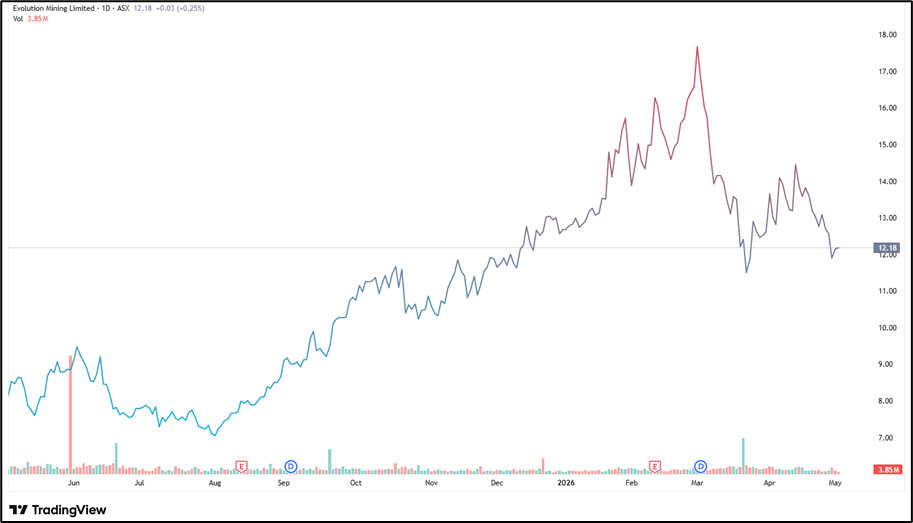
Evolution Mining/">Mining/">Mining Limited A$12.18 +0.25% | Market Cap: A$24.68B
What Evolution does: Evolution Mining/">Mining/">Mining is a diversified Australian gold producer with operations spanning Cowal (New South Wales), Mungari (Western Australia), Mt Rawdon (Queensland), Red Lake (Ontario, Canada) and -- critically -- Ernest Henry (Queensland), a copper-gold skarn deposit that provides substantial copper by-product Revenue/">Revenue/">Revenue. Evolution is regarded as one of Australia's most disciplined and well-managed gold companies. Cowal -- the flagship: Located in central New South Wales, Cowal is one of Australia's lowest All-In Sustaining Cost gold operations. Evolution has developed the Cowal Underground (CUG) project alongside the existing open-cut, adding high-grade ore to the mine's production profile and extending mine life. Cowal's combination of scale, grade and processing efficiency makes it the anchor of Evolution's portfolio. Ernest Henry -- the copper Kicker/">Kicker/">Kicker: Evolution owns 100 per cent of the Ernest Henry copper-gold mine in Queensland, acquired from Glencore. Ernest Henry is a copper-gold skarn deposit producing approximately 60,000-70,000 tonnes of copper per year alongside gold. The copper by-product Revenue/">Revenue/">Revenue -- at current copper prices of approximately $6.00 per pound -- materially reduces Evolution's effective All-In Sustaining Cost per ounce, making it structurally one of the lowest-cost gold producers in Australia. Mungari and Mt Rawdon: Mungari (formerly Kundana, acquired from Northern Star) is an underground WA gold operation that adds production from the Kalgoorlie goldfields. Mt Rawdon is a Queensland open-cut gold mine with additional mine life. These Assets/">Assets/">Assets add production diversity and geographic spread to the portfolio.
Evolution's financial profile is exceptional in the current environment: high gold prices, high copper prices (both at record or near-record levels), and a portfolio of low-cost operations. The Ernest Henry copper Credit/">Credit/">Credit is the single most important differentiator in Evolution's financial model -- at $6.00/lb copper, the Credit/">Credit/">Credit can reduce Evolution's effective gold AISC by $100-200 per ounce, making it among the most profitable gold producers in Australia on a net-cost basis. Evolution has been generating strong free Cash Flow at current prices, which management has directed toward Debt/">Debt/">Debt reduction (following the Ernest Henry Acquisition/">Acquisition/">Acquisition from Glencore in 2022), organic growth Investment/">Investment/">Investment (Cowal Underground expansion) and dividends. The Balance Sheet has improved materially, and the company is well positioned for further Capital/">Capital/">Capital returns as Debt/">Debt/">Debt is retired.
Evolution's share price of A$12.18, up +0.25 per cent on 4 May 2026, reflects the re-rating of Australian gold stocks alongside the surge in AUD gold prices. Evolution has performed strongly as the dual benefit of record gold prices and elevated copper prices flows through to its Ernest Henry-enhanced cost structure. The +0.25 per cent positive move on a day when Northern Star (-0.33%) and the broader market were mixed reflects the specific tailwind of copper price support.
Evolution trades at a moderate premium to net asset value, reflecting its quality portfolio, low-AISC operations and the copper structural advantage. Compared with Northern Star, Evolution is slightly more diversified geographically (Red Lake, Canada) but has a smaller overall production profile. The Ernest Henry copper Credit/">Credit/">Credit is the key valuation differentiator -- it is not fully reflected in simple gold price Earnings/">Earnings/">Earnings models and may cause the stock to be undervalued by analysts using gold-only frameworks. Key risks: Gold price Reversal/">Reversal/">Reversal remains the primary risk. Copper price decline would reduce the Ernest Henry Credit/">Credit/">Credit and raise effective AISC. Red Lake (Ontario, Canada) has historically underperformed expectations and represents ongoing execution risk. Cowal Underground ramp-up -- delivering high-grade ore from the underground on schedule is operationally important.
Evolution's outlook is among the most positive of any ASX Mining/">Mining/">Mining company in the current price environment. Record AUD gold prices combined with elevated copper prices create a Margin/">Margin/">Margin environment that funds all organic growth, Debt/">Debt/">Debt reduction and Dividend/">Dividend/">Dividend growth simultaneously. The Cowal Underground expansion adds production from a high-grade source over the coming years, and Ernest Henry's copper production provides a durable low-cost differentiator irrespective of the gold price level. FREQUENTLY ASKED QUESTIONS Q: What makes Evolution different from Northern Star? A: Evolution has the Ernest Henry copper mine, which provides substantial copper by-product Revenue/">Revenue/">Revenue that materially reduces the effective gold All-In Sustaining Cost. At $6.00/lb copper, this is a significant financial advantage. Northern Star is a purer gold play with more production Volume/">Volume/">Volume. Both benefit from record AUD gold prices. [Source: EVN Annual Report FY2024] Q: What is the Ernest Henry copper-gold mine? A: A copper-gold skarn deposit in Queensland producing approximately 60,000-70,000 tonnes of copper per year alongside gold. Evolution acquired 100% from Glencore in 2022. The copper Revenue/">Revenue/">Revenue is treated as a by-product Credit/">Credit/">Credit, reducing effective gold AISC. [Source: EVN Annual Report FY2024] Q: Is Evolution's share price tracking gold prices? A: Yes -- Evolution's Earnings/">Earnings/">Earnings are dominated by gold and copper prices. At record AUD gold above A$7,000/oz and copper near $6.00/lb, Evolution is generating exceptional margins. The share price has reflected these conditions through a significant re-rating over the past two years. [Source: ASX market data; EVN Annual Report FY2024] Source: Evolution Mining/">Mining/">Mining Annual Report FY2024; ASX filings (asx.com.au); ASX market data 4 May 2026. |
COMPARATIVE ANALYSIS
How the five stocks compare: a framework for Mining/">Mining/">Mining investors
The five companies divide naturally into two groups: three bulk Commodity/">Commodity/">Commodity producers exposed to the iron ore cycle, and two gold producers benefiting from record AUD gold prices. The Investment/">Investment/">Investment case for each is fundamentally different.
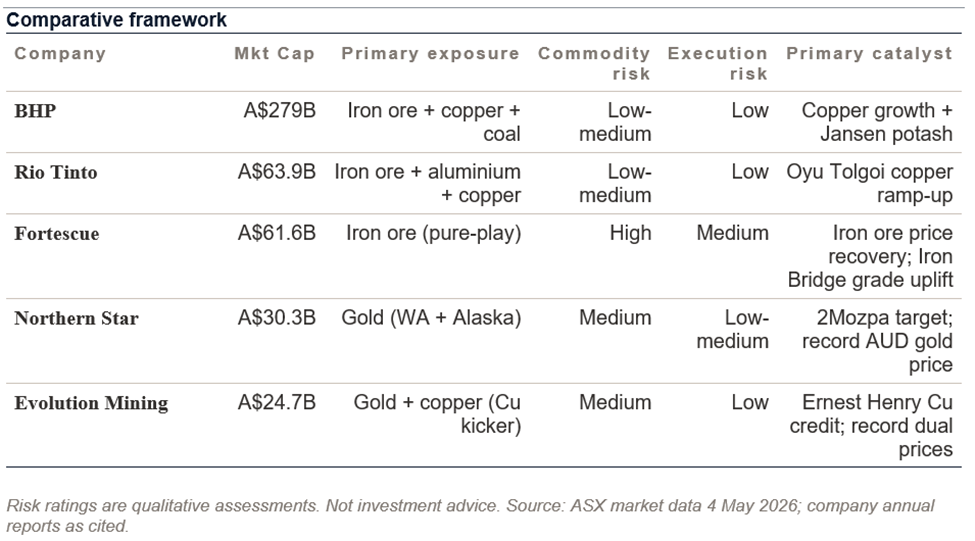

For the diversified Mining/">Mining/">Mining investor: BHP is the natural first choice -- world's largest miner, reliable Dividend/">Dividend/">Dividend, copper growth, Pilbara efficiency. Rio Tinto offers a different Diversification/">Diversification/">Diversification mix (aluminium and Oyu Tolgoi copper) at a lower market cap.
For the iron ore pure-play investor: Fortescue offers the highest Earnings/">Earnings/">Earnings Leverage/">Leverage/">Leverage to iron ore prices of the three Pilbara producers -- the biggest upside if prices recover and the biggest downside if they weaken further.
For the gold investor: Northern Star is the scale play -- the largest ASX pure-play gold producer with a clear 2Mozpa growth target. Evolution Mining/">Mining/">Mining offers the additional copper structural advantage through Ernest Henry, potentially creating a lower-cost-per-ounce Earnings/">Earnings/">Earnings profile than NST at current copper prices.


 Nov 13, 2026





 Please wait processing your request...