
 CA
 NZ
 UK
 US
 IND

 AU

 Share
 X (Formerly Twitter)
 Whatsapp
 Facebook
 LinkedIn
 Telegram
 Email This Article
 Copy Link
 Summarize with AI
 Chat GPT
 Perplexity

Highlights
- Capital Gains Tax reform debate is prompting ASX investors to reassess long-term portfolio strategies
- Potential changes to CGT concessions could affect after-tax returns across shares and property
- Investor sentiment may shift as tax policy uncertainty influences Capital allocation decisions
- Small Business succession planning and Wealth structures could face implications from any reforms
- Advisory Demand may rise as investors seek guidance amid policy and market uncertainty
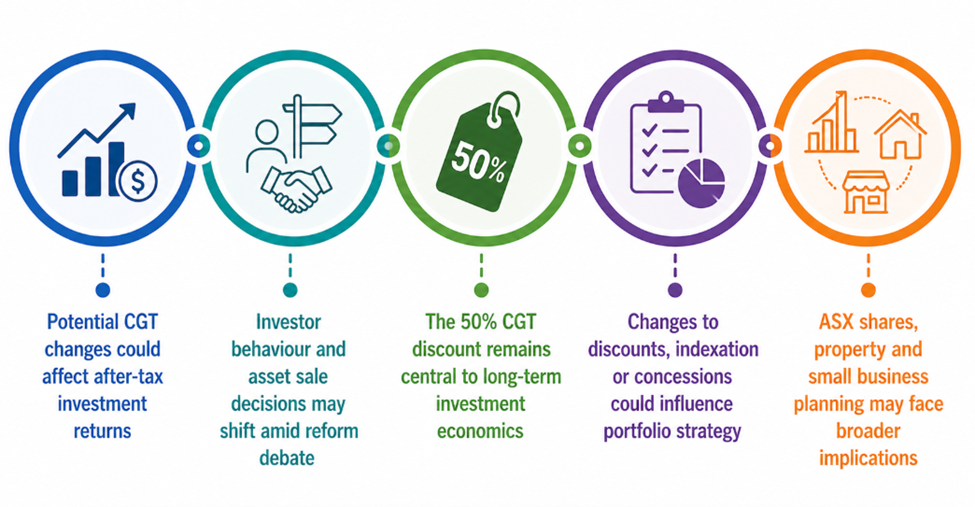
Capital Gains Tax (CGT) changes are again on the policy agenda, with the federal government keeping Options open as it considers tax reform. Any modification to CGT rules has potentially wide-ranging implications for ASX investors, property owners and small Business operators. Even the prospect of changes can affect investor behaviour, asset sales decisions and broader market sentiment. For Australian shareholders, CGT is a critical part of after-tax Investment returns. Existing rules provide concessions for Assets held longer than 12 months, with the 50 per cent CGT discount being a defining feature of long-term Investment Economics. Any adjustment – whether to discount rates, indexation arrangements or specific concessions – would influence portfolio decisions across the board. Understanding how potential CGT changes interact with ASX investing, Dividend strategies, property exposure and small Business succession planning is essential. Even where details remain uncertain, the broader debate is shaping investor thinking and risk management.
AI-Powered Image
Market Context
Australia’s Capital Gains Tax framework was established in the 1980s and significantly reformed in 1999, when indexation was replaced with the 50 per cent discount for Assets held longer than 12 months. This discount remains a cornerstone of long-term Investment returns for individuals, trusts and Superannuation funds, particularly in the retirement income phase. Reform debates have continued for years. Proponents of changes argue that current arrangements favour wealthier households, encourage speculative Investment and reduce government Revenue. Opponents argue that any tightening risks distorting Investment behaviour, reducing Capital availability for productive activities and creating unintended consequences across small businesses, family succession planning and retirement savings. Macro conditions add another layer. Persistent budget pressures, the cost of major spending programmes and demographic shifts have intensified pressure on tax reform. Capital flows into ASX shares, residential property and small businesses are sensitive to taxation considerations, with even speculative discussions of changes potentially influencing investor sentiment and decision-making.
Company-Specific Analysis
Although CGT primarily affects investor returns rather than corporate operations, it indirectly influences ASX-listed companies through investor behaviour. Companies with strong long-term track records, sustainable dividends and Capital growth potential rely on investor patience – behaviour that is influenced by tax frameworks. Major ASX-listed companies such as Commonwealth Bank, BHP, CSL, Macquarie Group and Wesfarmers feature prominently in long-term investor portfolios. Any change to CGT rules could affect Demand patterns, particularly among self-managed Superannuation funds and individual investors approaching retirement. Property-related stocks, including REITs and developers, also interact with CGT considerations. Small Business succession planning, often tied to ASX Investment portfolios through family Wealth structures, is sensitive to taxation arrangements. Financial advisers, accountants and Wealth management firms experience increased client engagement during periods of CGT debate. Changes to rules can prompt accelerated transactions before implementation, creating short-term effects on asset markets, with subsequent adjustments to investor strategy following any reform.
Sector Impact
CGT considerations affect multiple sectors of the ASX. Long-term Equity holders, including Superannuation funds, individuals and trusts, Factor CGT into Investment decisions. Property exposure, both direct and through REITs, is shaped by CGT rules. Small Business sales and succession planning are sensitive to taxation arrangements, often involving ASX-listed Assets within family Wealth structures. Financial advisers and Wealth management firms experience increased advisory Demand around tax reform discussions. Accountants, lawyers and estate planners play key roles in advising on transaction timing and strategy. Capital flows can shift in anticipation of changes, with potential effects on asset market Liquidity. Beyond direct effects, CGT debates interact with broader policy questions, including Superannuation rules, negative gearing and intergenerational Wealth transfer. Government Revenue considerations, demographic dynamics and broader fiscal challenges all contribute to the ongoing reform discussion. ASX investors should consider these dynamics holistically when planning long-term strategies and Capital allocation decisions.
Investor Implications
AI-Powered Image
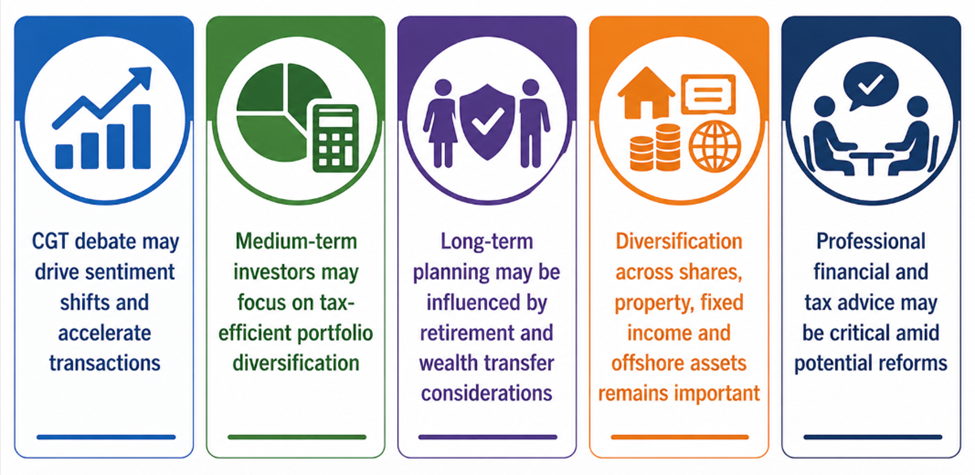
For short-term investors, CGT debate can drive sentiment shifts and prompt accelerated transactions if changes appear imminent. Active investors typically monitor policy announcements, budget commentary and political dynamics. Medium-term investors emphasise tax-efficient portfolio construction, Asset Class Diversification and the use of legitimate tax planning structures. Long-term investors should consider how potential CGT changes interact with Retirement Planning, intergenerational Wealth transfer and broader Investment objectives. Diversification across ASX shares, property, fixed income and offshore Assets remains important. Engaging professional financial and tax advice is essential when navigating reform discussions and implementing changes to Investment strategies. This article reflects general commentary on potential CGT changes affecting Australian investors and is not personal financial or tax advice. Individual circumstances vary significantly, and licensed financial advisers, accountants and tax professionals can provide tailored guidance aligned with personal goals, Risk tolerance and broader financial objectives.
Risks and Uncertainties
Policy risk is central, with potential changes to CGT discount rates, indexation arrangements, asset eligibility or grandfathering provisions all under consideration. Behavioural risk applies, as anticipation of changes can affect transaction timing and asset prices. Macroeconomic risk includes broader market reactions to tax reform announcements. Sector-specific risk affects property and Equity markets differently. Compliance risk applies to investors implementing strategies in response to potential or actual reforms. Estate planning risk arises if reforms affect intergenerational Wealth transfer. Liquidity risk can emerge if accelerated selling triggers market disruption. Currency risk applies to investors with international Assets. Regulatory complexity risk applies as reform implementation can be intricate. Finally, communication risk affects investor sentiment, with mixed messaging from policymakers contributing to uncertainty. ASX investors should approach CGT-related considerations with comprehensive risk management, balancing potential opportunities against the realities of tax policy uncertainty over time.
Outlook
The base case over the next six to twelve months is one of continued debate around CGT, with formal reform announcements possible but not certain. Investor behaviour will likely reflect heightened sensitivity to policy commentary, particularly during budget cycles and pre-election periods. The upside case includes stable existing arrangements, providing investors with continuity and confidence in long-term planning. In such a scenario, Capital flows into ASX shares and property remain supported by tax certainty. The downside case includes significant CGT changes that disrupt investor behaviour, prompt accelerated transactions and reshape long-term Investment strategies. In that environment, market Volatility could increase, particularly across asset classes most exposed to taxation. ASX investors should remain alert to policy developments while focusing on long-term Investment fundamentals. Engaging with licensed advisers and tax professionals is essential for navigating uncertainty and ensuring portfolios remain aligned with personal financial goals across changing policy environments.
Conclusion
Capital Gains Tax considerations remain a critical part of long-term Investment strategy for ASX investors, property owners and small Business operators. With the government keeping Options open, the prospect of CGT changes adds another layer of complexity to portfolio decisions. While details remain uncertain, the broader debate is already influencing investor behaviour, Capital flows and advisory engagement across the Wealth management ecosystem. For ASX investors, the priority is to remain informed, focus on quality investments and engage professional advice to navigate potential changes. Diversification, disciplined risk management and a long-term perspective remain core principles. As policy debates evolve, the interaction between tax reform, Investment strategy and economic growth will continue to shape outcomes for Australian investors across the years ahead.


 Nov 12, 2026





 Please wait processing your request...