
 CA
 NZ
 UK
 US
 IND

 AU

 Share
 X (Formerly Twitter)
 Whatsapp
 Facebook
 LinkedIn
 Telegram
 Email This Article
 Copy Link
 Summarize with AI
 Chat GPT
 Perplexity

Highlights
- Australia’s PCbCR regime significantly raises global tax transparency standards.
- Multinationals must disclose detailed financial data by jurisdiction.
- Companies that fail to meet compliance requirements may face severe penalties and significant reputational damage.
- Reporting obligations apply to global parent entities, not just local subsidiaries.
- Early preparation and governance alignment are critical for compliance success.
Australia’s introduction of Public Country-by-Country Reporting (PCbCR) marks a significant shift in global tax transparency. Designed to provide greater visibility into how multinational enterprises (MNEs) operate and pay taxes across jurisdictions, the regime sets a new benchmark for disclosure requirements. Effective for reporting periods starting from 1 July 2024, the framework requires large corporations to publicly disclose detailed financial and tax-related information, reshaping compliance expectations and stakeholder scrutiny.
This initiative reflects a broader global movement toward transparency, where governments, investors, and the public demand clearer alignment between a company’s economic activities and the taxes it pays. By mandating comprehensive reporting, Australia aims to strengthen trust, discourage aggressive tax planning, and ensure fair contribution to public finances.
Understanding the Scope and Requirements
The PCbCR regime applies primarily to large multinational groups with annual global income exceeding AUD 1 billion and a significant presence in Australia. The responsibility for reporting lies with the global parent entity, irrespective of whether it is located in Australia or abroad.
Entities must meet several criteria, including being part of a reporting group, having Australian-sourced income above a defined threshold, and operating within or through Australia during the reporting period.
Under this framework, companies are required to disclose extensive information such as revenues, profits, income taxes paid, employee numbers, and business activities on a jurisdiction-by-jurisdiction basis. For certain jurisdictions, this data must be reported individually, while for others it may be aggregated.
Organisations must also outline their tax approach, including governance and compliance strategies. This requirement goes beyond traditional reporting and integrates tax transparency into broader corporate governance and ESG (Environmental, Social, and Governance) considerations.
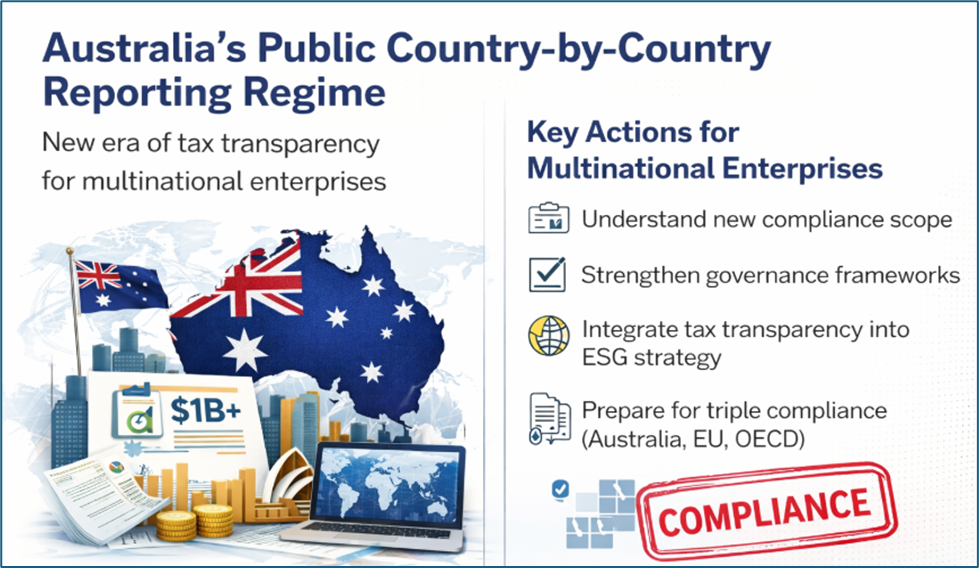
Source: AI Powered Image
Implications for Multinational Enterprises
The introduction of PCbCR significantly increases compliance complexity for multinational enterprises. Unlike earlier frameworks such as OECD’s confidential CbC reporting, Australia’s regime requires public disclosure, making sensitive financial data accessible to stakeholders worldwide.
This heightened transparency creates both opportunities and risks. On one hand, companies can demonstrate accountability and strengthen investor confidence by aligning their tax practices with ethical standards. On the other hand, discrepancies between reported profits and tax contributions may attract scrutiny from regulators, media, and the public.
Moreover, organisations must prepare for “triple compliance,” as they may need to adhere simultaneously to Australian PCbCR rules, EU disclosure requirements, and OECD reporting standards. This overlap increases administrative burdens and necessitates robust data management systems.
The reputational stakes are particularly high. Public reporting exposes corporate tax strategies to unprecedented levels of examination, making it essential for businesses to ensure consistency, accuracy, and clarity in their disclosures.
Compliance Challenges and Strategic Preparation
Meeting PCbCR requirements is not simply a matter of compiling existing financial data. Companies must ensure that their reports reconcile with consolidated financial statements and comply with specific formats prescribed by the Australian Taxation Office (ATO), including XML-based submissions.
A key challenge is data collection and system readiness. Many organisations need to redesign internal processes to capture jurisdiction-specific information accurately. This includes separating related-party transactions and ensuring data consistency across multiple jurisdictions.
Timelines further add pressure. Reports are due within 12 months after the reporting period ends, with the first submissions expected by mid-2026. Missing deadlines or failing to correct errors within 28 days can result in substantial penalties.
To address these challenges, companies should focus on early preparation. This includes assessing applicability, strengthening governance frameworks, engaging stakeholders, and implementing robust tracking mechanisms to ensure timely reporting.
The Broader Impact on Global Tax Transparency
Australia’s PCbCR regime represents more than a national regulatory change—it signals a broader evolution in global tax policy. By setting higher disclosure standards than many existing frameworks, it encourages other jurisdictions to adopt similar measures, potentially leading to a more unified global approach to tax transparency.
For stakeholders, including investors and policymakers, the availability of detailed tax data enhances the ability to assess corporate behaviour and economic contribution. It also supports efforts to combat base erosion and profit shifting (BEPS), a long-standing concern in international taxation.
However, this shift also raises questions about confidentiality and competitive disadvantage. Companies may be reluctant to disclose sensitive financial information that could be used by competitors. While exemptions are available in exceptional circumstances, they are granted at the discretion of authorities and are expected to be limited.
Ultimately, the success of the regime will depend on balancing transparency with practicality, ensuring that reporting requirements are both meaningful and manageable.
Australia’s Public Country-by-Country Reporting regime is a landmark development in corporate tax transparency. By requiring multinational enterprises to publicly disclose detailed financial and tax information, it reshapes how businesses approach compliance, governance, and stakeholder engagement.
While the challenges are significant—ranging from data management to reputational risk—the opportunities for building trust and demonstrating accountability are equally compelling. Organisations that adapt early will be better equipped to handle regulatory changes and sustain stakeholder trust.
As global transparency standards continue to rise, PCbCR is likely to play a pivotal role in shaping the future of corporate reporting, making early preparation and strategic alignment essential for long-term success.


 Nov 12, 2026





 Please wait processing your request...