
 CA
 NZ
 UK
 US
 IND

 AU

 Share
 X (Formerly Twitter)
 Whatsapp
 Facebook
 LinkedIn
 Telegram
 Email This Article
 Copy Link
 Summarize with AI
 Chat GPT
 Perplexity

Key Highlights
- Depreciation allows investors to claim property wear and tear as tax deductions over time
- New properties provide full capital works and higher plant and equipment deductions
- ATO-approved methods determine how depreciation is calculated annually
- PAYG withholding variations can improve in-year cash flow
Depreciation is what the Australian Taxation Office recognises as the gradual decrease in value of your investment property's assets over time. In simple terms, it reflects how buildings and their internal assets lose value as they age.
For investors building or buying a brand-new property, depreciation is more than a technical concept—it is a financial strategy that can improve cash flow and reduce tax obligations. It allows you to claim the wear and tear of a property as a tax deduction over several years, helping generate ongoing tax savings and improved cash flow.
For PAYG investors earning a salary, a PAYG withholding variation may also be available through the Australian Taxation Office. This enables reduced tax deductions from salary throughout the year, reflecting property-related deductions like depreciation.
Types of Depreciation for New Investment Properties
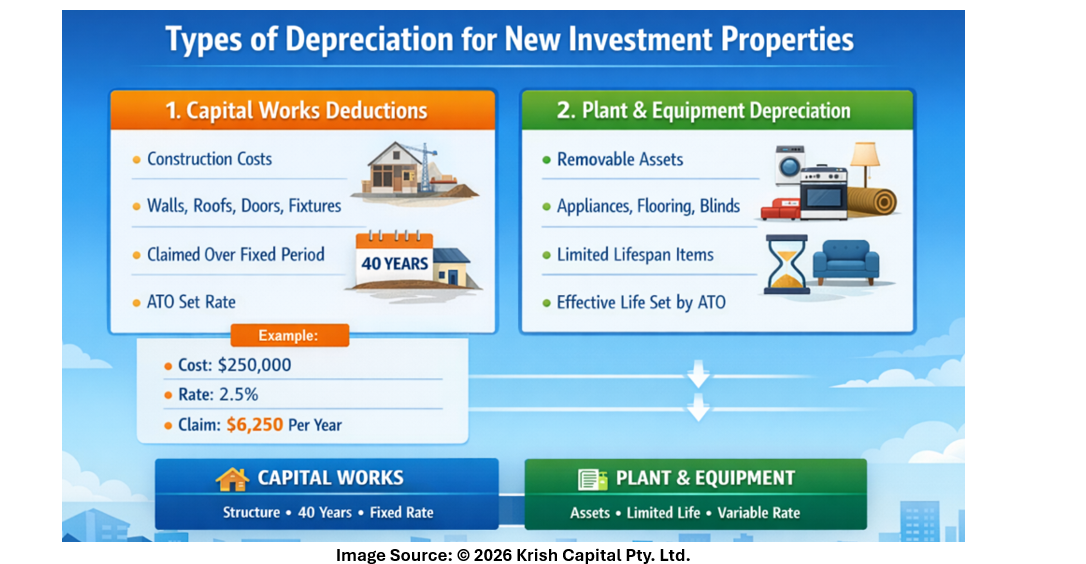
Depreciation for new properties falls into two main categories.
Capital Works Deductions
Capital works deductions relate to construction costs, including structural elements such as walls, roofs, doors, and built-in fixtures. These are claimed at a rate specified by the Australian Taxation Office over a fixed period, typically 40 years.
For example, if construction costs are $250,000 at a 2.5% rate, an investor can claim $6,250 annually over 40 years.
Plant and Equipment Depreciation
This covers removable or mechanical assets with a limited lifespan, such as appliances, flooring, and blinds. These items are depreciated over their effective life, as determined by the Australian Taxation Office.
Benefits of Depreciation for New Properties
New properties offer stronger depreciation advantages compared to older properties. Investors can claim the full 40-year capital works deduction from the completion of construction. In addition, plant and equipment assets can be claimed at their full value.
By contrast, investors who purchased second-hand residential properties after 9 May 2017 are generally unable to claim depreciation on existing plant and equipment assets, limiting their deductions.
Depreciation Methods
The Australian Taxation Office allows two methods to calculate depreciation.
Prime Cost Method
This method spreads deductions evenly across the asset’s effective life, providing consistent annual claims. For instance, a $1,400 dishwasher with a 10-year life would generate a $140 annual deduction.
Diminishing Value Method
This method provides higher deductions in the earlier years by applying depreciation to the remaining value of the asset. Using the same dishwasher example, the first-year claim would be $280, followed by $224 in the second year, with the value reducing over time.
Practical Steps to Claim Depreciation
To claim depreciation effectively, investors should confirm eligibility under Australian Taxation Office guidelines, obtain a depreciation report from a quantity surveyor, and work with an accountant to include the deductions in their tax return.
FAQs
- What is depreciation in property investment?
Depreciation is the decline in value of a property’s structure and assets over time, which can be claimed as a tax deduction.
- Why do new properties offer better depreciation benefits?
New properties allow full capital works deductions and full-value claims on plant and equipment, unlike many second-hand properties.
- How can investors claim depreciation?
Investors can claim depreciation by obtaining a depreciation schedule and including it in their annual tax return with the help of an accountant.


 Nov 12, 2026





 Please wait processing your request...