
 CA
 NZ
 UK
 US
 IND

 AU

 Share
 X (Formerly Twitter)
 Whatsapp
 Facebook
 LinkedIn
 Telegram
 Email This Article
 Copy Link
 Summarize with AI
 Chat GPT
 Perplexity

Key Highlights
- The Government will introduce a $250 Working Australians Tax Offset from 2027–28 for more than 13 million workers.
- The 50 per cent Capital Gains Tax discount will be replaced with an Inflation-based system from 1 July 2027.
- Negative gearing will be limited to new builds from 1 July 2027, while existing property holdings before Budget night remain unchanged.
- The Government will permanently extend the $20,000 instant asset write-off for eligible small businesses from 1 July 2026.
- New Venture Capital and R&D incentive measures are planned to support start-ups, innovation and Business Investment.
The Australian Government has announced a broad series of tax reforms aimed at workers, housing investors, businesses and emerging industries, describing the measures as part of a wider strategy to improve economic resilience, encourage productive investment and support future generations.
The reforms cover personal tax offsets, capital gains tax, negative gearing, discretionary trusts, business tax settings, venture capital incentives, Research and Development support, and electric vehicle Fringe Benefits tax arrangements.
New Tax Offset for Workers
 AI-Powered Image
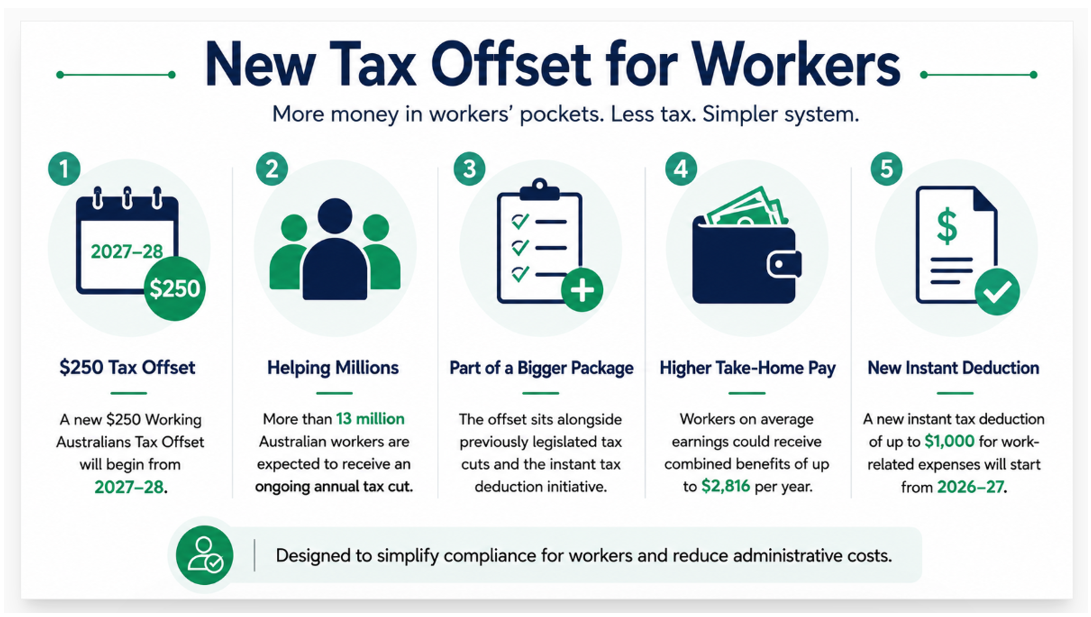
One of the centrepieces of the package is the introduction of a $250 Working Australians Tax Offset from 2027–28. According to the Government, the measure is expected to provide an ongoing annual tax cut for more than 13 million Australian workers.
The offset will sit alongside previously legislated tax cuts and the instant Tax deduction initiative. The Government stated that workers on average Earnings could receive combined benefits of up to $2,816 per year through the suite of tax measures.
The reforms also include a new instant tax deduction of up to $1,000 for work-related expense deductions from 2026–27. The Government said this measure is intended to simplify compliance requirements for workers and reduce administrative costs.
Capital Gains Tax Changes
The Government plans to replace the current 50 per cent Capital Gains Tax discount with a system based on inflation from 1 July 2027. A minimum 30 per cent tax on gains will also be introduced under the revised framework.
According to the announcement, the reform is intended to ensure investors pay tax only on “real Capital Gain”, restoring what the Government described as the original intent of the CGT arrangements.
The new arrangements will only apply to gains arising after 1 July 2027. Investors in new residential builds will be able to choose either the existing 50 per cent discount or the new inflation-linked system.
Negative Gearing Reforms
Changes to negative gearing form another major part of the package. From 1 July 2027, negative gearing will be limited to new residential builds, with the Government stating the move is designed to direct tax support towards increasing housing Supply.
Existing arrangements for properties held before Budget night will remain unchanged. Investors purchasing new builds will continue to be able to deduct losses from other income.
For investors purchasing established housing after Budget night, losses will only be deductible against residential property income. Unused losses can be carried forward to future years, but they will no longer be deductible against other income such as wages.
Changes to Trust Taxation
The Government also announced plans to introduce a minimum 30 per cent tax on discretionary trusts from 1 July 2028, subject to certain exceptions.
To support restructuring, rollover relief will be provided for three years from 1 July 2027 for small businesses and others wishing to change their arrangements.
Measures Targeting Businesses and Start-Ups
A series of reforms aimed at businesses and start-ups were also outlined in the package. The Government will reintroduce loss carry back provisions from 2026–27, allowing eligible companies making losses to obtain refunds against tax paid in the prior two income years. The measure is expected to benefit up to 85,000 companies, mostly small businesses.
Additional support for start-ups will come through a new loss refundability arrangement from 2028–29. Small start-ups in their first two years of operation will be able to receive refunds for tax losses up to the value of fringe benefits tax and Withholding tax paid on employee wages.
The Government also confirmed the $20,000 instant asset write-off for small businesses with turnover up to $10 million will become permanent from 1 July 2026. The measure is estimated to improve Cash Flow for small businesses by around $890 million over five years.
Venture Capital and R&D Incentives
The reform package also includes expanded venture capital tax incentives from 1 July 2027. Changes to venture capital Partnership programs are intended to improve access to funding and industry expertise for start-ups and high-growth businesses.
In relation to research and development, the Government announced changes to the Research and Development Tax Incentive from 1 July 2028. Measures include increasing offsets for experimental core R&D, reducing intensity thresholds, increasing expenditure caps, and expanding support for younger firms.
The Government said the reforms respond to recommendations from the Ambitious Australia Report and are intended to encourage more R&D activity within Australia.
Electric Vehicle Tax Changes
Changes were also announced for electric vehicle fringe benefits tax arrangements. The Government plans to transition support settings to a permanent 25 per cent fringe benefits tax discount for eligible electric vehicles above $75,000 from 1 April 2027, and for all eligible electric vehicles from 1 April 2029.
Electric vehicles priced up to $75,000 will continue to receive a full fringe benefits tax exemption where arrangements commence before 1 April 2029.
FAQs
What is the new Working Australians Tax Offset?
The Government will introduce a $250 annual Working Australians Tax Offset from 2027–28 for more than 13 million workers.
When will the Capital Gains Tax reforms begin?
The Capital Gains Tax reforms are scheduled to apply to gains arising after 1 July 2027.
How will negative gearing rules change?
From 1 July 2027, negative gearing will be limited to new residential builds, while existing properties held before Budget night will retain current arrangements.
What support measures were announced for small businesses?
The Government announced the permanent extension of the $20,000 instant asset write-off, the return of loss carry back provisions, and new start-up tax loss refundability measures.


 Nov 12, 2026





 Please wait processing your request...