
 CA
 NZ
 UK
 US
 IND

 AU

 Share
 X (Formerly Twitter)
 Whatsapp
 Facebook
 LinkedIn
 Telegram
 Email This Article
 Copy Link
 Summarize with AI
 Chat GPT
 Perplexity

Key Highlights
- Division 296 introduces a new tax on Superannuation Earnings above defined balance thresholds.
- The legislation replaces earlier proposals by removing taxation on unrealised capital gains.
- A tiered system applies additional tax rates for balances above $3 million and $10 million.
- Thresholds will be indexed to Inflation to limit long-term bracket creep
- SMSF trustees can elect a one-off cost base reset before June 30, 2026.
Australia’s Superannuation landscape is undergoing a structural shift with the introduction of Division 296, a reform targeting individuals with large retirement balances. After years of debate, legislative revisions, and industry pushback, the final law presents a markedly different framework from its initial proposal.
Set to take effect from July 1, 2026, the reform introduces additional taxes on Earnings linked to higher super balances. While the changes focus on a relatively small segment of investors, they signal a broader shift in how retirement savings are taxed and managed.
From Controversy to Compromise
The origins of Division 296 date back to early proposals aimed at tightening tax concessions for high-balance accounts. Initial drafts drew criticism for including taxation on unrealised capital gains and for not indexing thresholds to Inflation.
Following sustained opposition from industry groups and policymakers, the final legislation reflects key concessions. The removal of unrealised gains taxation and the introduction of indexed thresholds represent significant changes designed to address earlier concerns while maintaining the reform’s core objectives.
Tiered Tax Structure Explained
At the centre of Division 296 is a progressive, two-tier tax system applied to Earnings above specified balance levels.
For balances between $3 million and $10 million, Earnings attributable to this portion face an additional 15% tax. When combined with the existing 15% tax within super funds, this results in an effective rate of 30% for that segment.
For balances exceeding $10 million, a second tier applies. Earnings linked to this portion attract an additional 25% tax, bringing the effective rate to 40% when combined with the base tax.
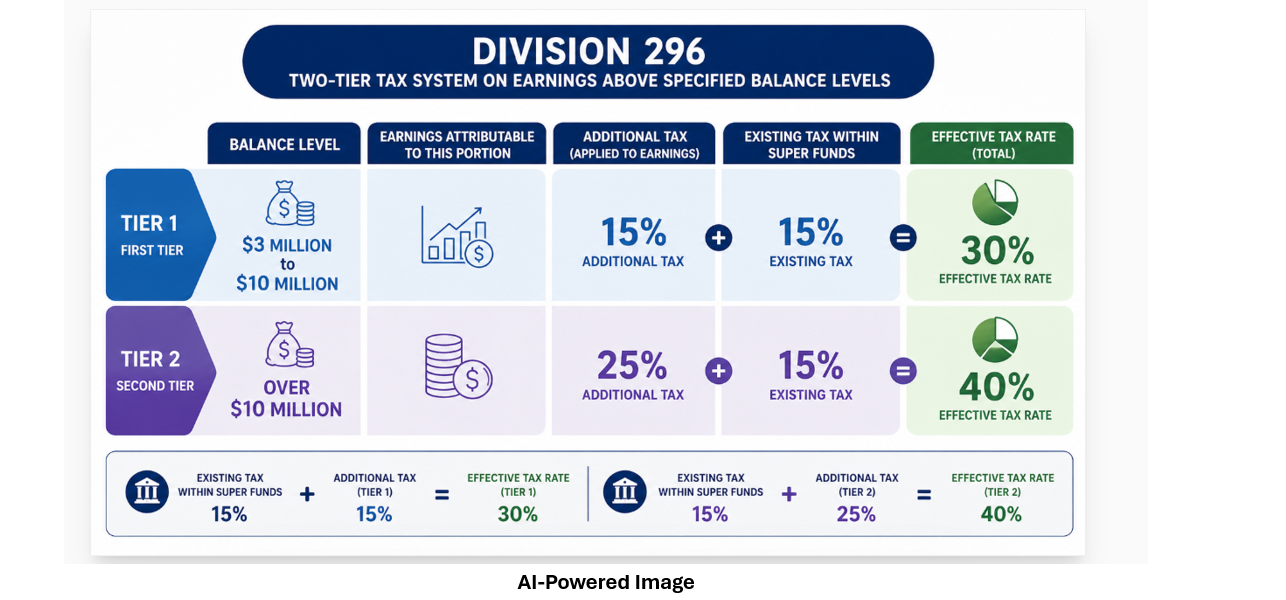
Importantly, the tax is applied proportionally. Only the portion of Earnings corresponding to balances above these thresholds is taxed at higher rates, rather than the entire super balance.
Realised Earnings Approach
One of the most notable features of the final legislation is its reliance on realised Earnings. The tax applies only to actual income generated within the fund, such as dividends, interest, rental income, and realised capital gains.
This approach aligns with traditional taxation principles and avoids the complexities associated with taxing unrealised asset appreciation. It also reduces Liquidity concerns, as tax liabilities arise only when income is generated or Assets are sold.
Indexation and Long-Term Impact
To maintain the targeted nature of the tax, both the $3 million and $10 million thresholds will be indexed to Inflation. Adjustments will occur in defined increments, helping prevent gradual expansion of the tax’s reach over time.
This mechanism ensures that the thresholds remain aligned with economic conditions, reducing the risk of middle-income earners being captured by the policy in the future.
Cost Base Reset Opportunity
A key transitional feature of Division 296 is the one-off cost base reset available to self-managed super funds (SMSFs) and similar structures.
This provision allows trustees to adjust the value of Assets to their market level as of June 30, 2026. By doing so, any capital gains accrued prior to this date are effectively excluded from future tax calculations under Division 296.
However, the reset applies to all eligible Assets and cannot be reversed once elected. It also requires accurate market valuations, making timely preparation essential.
Transitional Rules and Planning Considerations
The first year of implementation includes transitional rules that determine tax Liability based on the end-of-year balance. This creates a temporary window for individuals to adjust their super balances before June 30, 2027.
Beyond this period, ongoing calculations will consider balances at both the beginning and end of each financial year. The proportional nature of the tax, combined with evolving thresholds, introduces new complexity into long-term financial planning.
Broader System Changes
Division 296 forms part of a wider reform agenda aimed at reshaping Australia’s Superannuation system. Alongside higher taxes for large balances, measures such as expanded support for low-income earners highlight a broader effort to rebalance incentives across the system.
These changes collectively signal a shift away from unlimited tax advantages toward a more structured and progressive framework.
FAQs
What is Division 296 tax?
Division 296 is a new tax applied to Superannuation Earnings linked to balances exceeding specific thresholds, starting from July 1, 2026.
Does the tax apply to unrealised gains?
No, the final legislation applies only to realised Earnings, such as dividends, interest, and capital gains from asset sales.
Who is affected by Division 296?
The tax primarily impacts individuals with total Superannuation balances above $3 million, with higher rates applying to balances exceeding $10 million.


 Nov 12, 2026





 Please wait processing your request...