
 CA
 NZ
 UK
 US
 IND

 AU

 Share
 X (Formerly Twitter)
 Whatsapp
 Facebook
 LinkedIn
 Telegram
 Email This Article
 Copy Link
 Summarize with AI
 Chat GPT
 Perplexity

Highlights
- Running an SMSF gives trustees greater control over Investment decisions, but it also comes with ongoing legal, administrative, and compliance responsibilities.
- A well-structured SMSF relies on strong foundations, including the right Trustee structure, a documented investment strategy, proper record-keeping, and regular compliance reviews.
- Successful SMSF trustees treat the fund as a long-term responsibility by maintaining consistent administration, engaging professional advisers, managing risk carefully, and planning ahead for pension phase and eventual wind-up.
Australians are an independent bunch, and the idea of running a self-managed super fund appeals to anyone who would rather make their own decisions than wait on hold. The catch is that running an SMSF is not just about choosing the investments. It is about taking on a structured legal and administrative role, doing it consistently for many years, and accepting that the regulator can ask to see your homework at any time. This article walks you through what is actually involved, from the moment you decide to start a fund through the day-to-day work of keeping it compliant.
The setup phase
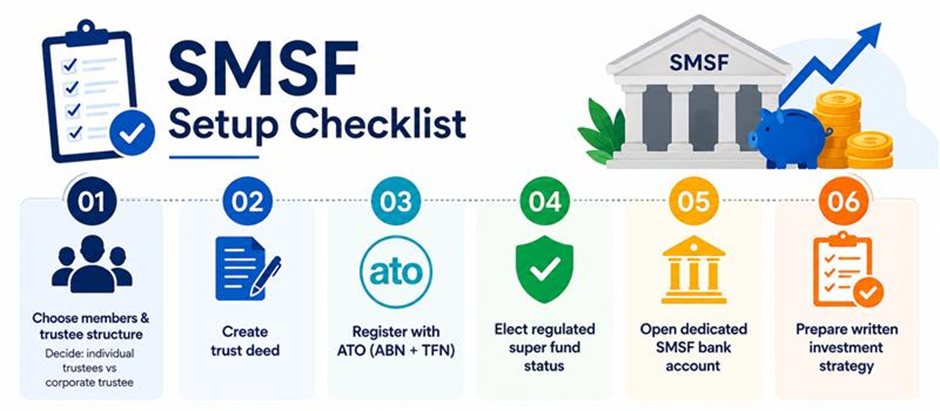
Before you can begin investing, an SMSF must be properly established. That means choosing your members and trustees, deciding between an individual or corporate trustee structure, drafting and signing the trust deed, agreeing on a written investment strategy, and applying to the ATO for registration. You will need an Australian Business Number, a Tax File Number, election to be regulated under the SIS Act, and a dedicated bank account in the fund's name. The ATO has a 60-day window for the trustee declaration and key registrations once the fund is established, and skipping any of these steps can cause early problems.
AI-Powered Image
Choosing a trustee structure
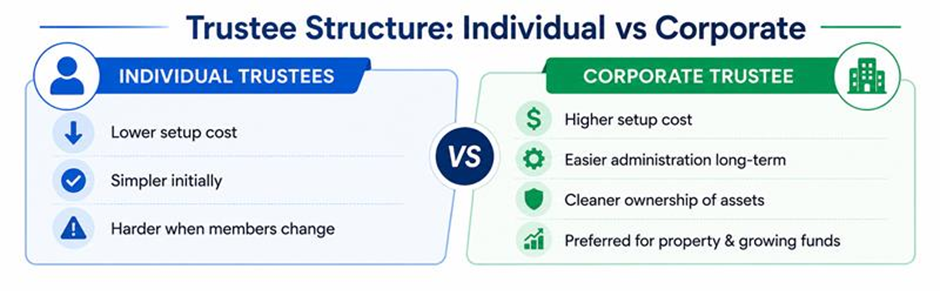
There are two trustee Options. With individual trustees, each member is appointed personally as a trustee. With a corporate trustee, the members become directors of a company that acts as trustee. The corporate trustee model costs more upfront but is easier to maintain when membership changes, since the trustee company stays the same and Assets do not need to be re-titled. Many advisers prefer the corporate trustee for funds that intend to hold property or that expect to add or remove members over time.
AI-Powered Image
Building the investment strategy
An SMSF must have a written investment strategy that addresses risk and return, Diversification, Liquidity, the ability to discharge liabilities and the insurance needs of each member. Trustees should review the strategy regularly and update it whenever circumstances change, like a new member joining, a property purchase, or a shift to pension phase. The strategy is the document that demonstrates trustees are thinking carefully about how the fund's assets will deliver retirement benefits, not just listing what they happen to own.
Day-to-day administration
Once the fund is operating, administration becomes a steady rhythm. Each contribution is recorded against the right member. Each rollover is reconciled. Each investment trade is documented with the underlying contract or confirmation. Each related-party transaction is checked against the in-house asset rules. Trustees keep minutes of decisions, especially anything material like changing the investment strategy, accepting a property valuation or paying a benefit. Most trustees use an administrator to handle bookkeeping, but trustees still review and sign off the work.
Investing the fund's money
An SMSF can hold a wide range of assets: cash and term deposits, listed shares, Exchange-traded funds, managed funds, residential and commercial property, and certain collectables under strict storage rules. The fund cannot lend to members, cannot acquire most assets from related parties and must keep in-house assets below 5 per cent of total fund value. Borrowing is generally prohibited, with the narrow exception of a Limited Recourse Borrowing Arrangement to acquire a single asset. Every investment decision must satisfy the Sole Purpose Test.
The annual cycle
Each year, the fund prepares financial statements, engages an approved SMSF auditor, lodges its SMSF annual return, and pays the supervisory levy. If members are receiving pensions, minimum drawdown amounts must be paid by 30 June and Transfer Balance Account Reports must be lodged for relevant events. Audit findings are addressed before the return is lodged. Trustees are expected to read and understand the audit, not just sign it. The annual cycle is also when trustees review the investment strategy and consider whether anything needs to change for the year ahead.
Engaging professionals
Most SMSFs use a small team. An Accountant or administrator handles bookkeeping and the annual return. An approved SMSF auditor signs off the audit. A licensed financial adviser supports investment and product decisions. A solicitor may help with the trust deed and estate planning. Some funds also use a buyers' agent for property, a registered tax agent for complex issues, and an actuary if required for pension calculations. Picking the team is one of the most important early decisions, and switching providers later is rarely free.
Managing risk over time
Trustees should think about risk in three layers. There is investment risk, like market falls, property vacancies and concentration. There is operational risk, like missing a lodgement, mis-recording a contribution or losing a key document. And there is compliance risk, like breaching in-house asset rules or paying a benefit before a condition of release. Each layer needs different controls. Investment risk is managed through diversification and review. Operational risk is managed through process and a calendar of obligations. Compliance risk is managed through education and asking before acting.
Pension phase and beyond
When members reach a condition of release, the fund can begin paying retirement benefits. Most retirees move some or all of their balance into the pension phase, where investment Earnings are typically taxed at zero. The fund must pay at least the minimum pension each year and report transfer balance events to the ATO. Trustees who have planned for liquidity find this transition smooth. Trustees who hold predominantly Illiquid assets, like a single property, sometimes need to sell or restructure to fund pension payments.
Winding up
Every SMSF will eventually wind up. The reasons vary: members get older and less willing to manage the fund, balances drop, family circumstances change, or a member passes away. Wind-up requires settling member benefits, lodging a final return, completing a final audit, distributing or rolling over assets, paying outstanding tax, closing the bank account and notifying the ATO. Funds that planned for the exit at setup tend to wind up cleanly. Those that did not can face years of complications.
An everyday illustration
Picture Aaron, 56, with a 950,000 dollar balance, who decides to start an SMSF after a long career in IT. He chooses a corporate trustee, drafts a strategy with his adviser, and rolls over from his existing fund. He uses a low-cost administrator and a separate auditor. He invests in a diversified portfolio of ETFs and direct property. The first year takes more time than he expected, mostly because he had not realised how many small decisions an SMSF requires. By year three the rhythm is settled, and he spends three or four hours a month on the fund. Not everyone has a balance, an interest or a Job that allows that pattern, but for Aaron the structure works.
A typical trustee's monthly rhythm
A trustee's month rarely looks dramatic. Early in the month, they review bank reconciliations and broker statements from the previous month. They check pending decisions, like a potential investment switch or a contribution to be processed. They sign trustee minutes for any material decisions. They respond to emails from the administrator. Mid-month, they may read market commentary or Fund Manager updates. Late in the month, they review any quarterly TBAR or contribution timing. The work is steady but rarely urgent. Trustees who keep the rhythm find the role manageable.
Preparing for the audit
Audit preparation begins long before the auditor is engaged. Trustees should spend a few hours each quarter making sure records are current: bank reconciliations are clean, property valuations are scheduled, related-party leases have updated terms, trustee minutes are written for every material decision, and member balances are reconciled. With this discipline, the formal audit takes a few days rather than weeks.
Choosing service providers
Trustees usually engage four kinds of providers: an administrator or accountant for bookkeeping and the annual return; an approved SMSF auditor; a licensed financial adviser; and, where useful, a solicitor for trust deed and estate planning. Some funds use a single firm for everything. Others prefer separate firms for independence. There is no single right answer, but trustees should be clear about who is responsible for what. Misunderstood handoffs are a common source of compliance gaps.
Dealing with bad market years
Bad market years test trustees' discipline. Strategies that looked sensible during a Bull Market can feel uncomfortable when balances fall. The temptation to shift everything to cash or to chase a recently-popular asset is strong. Successful trustees stick to the written strategy and adjust slowly with evidence, not quickly with emotion. Trustees who do not have a written strategy often discover, in a market crisis, that the structure offered control without a plan. The plan is what makes control valuable.
Decision-making for couple-run funds
Many SMSFs have two trustees, often spouses. Decision-making works best when both trustees are genuinely involved. If one trustee makes every decision while the other signs without engagement, the fund effectively has one decision-maker, and the second trustee's name on minutes is not an accurate record. The pattern can produce trouble in the event of separation, illness or dispute. Engaged co-trustees, who discuss decisions and review records together, build a more resilient fund.
When to bring children in as members
Adding adult children as members is not a casual decision. The members must agree on strategy, share governance and accept that decisions affect each other. Some families pool successfully across generations; others find the differences in time horizon, Risk tolerance and contribution capacity create friction. Before adding children, talk through the structural questions: how will decisions be made; how will contributions and benefits be coordinated; what happens if a member's circumstances change. The conversation is harder before the structure changes than after, but it is more useful before.
What good trustees actually do
Across many SMSFs, the trustees who do well share a small set of behaviours. They review the strategy each year, even if nothing has changed. They keep records current rather than reconstructing them at year-end. They engage the auditor as a partner rather than treating the audit as a hurdle. They ask before acting on unusual transactions. They plan for life events, including incapacity and death, while everyone is well. None of this is dramatic. All of it is what makes "control" valuable rather than burdensome. Trustees who treat the SMSF as a long-term project, rather than a one-off product, tend to extract more value from the structure across decades. The work is steady, the rewards are real when matched to circumstances, and the role rewards careful preparation more than enthusiasm.


 Nov 03, 2026





 Please wait processing your request...