
 CA
 NZ
 UK
 US
 IND

 AU

 Share
 X (Formerly Twitter)
 Whatsapp
 Facebook
 LinkedIn
 Telegram
 Email This Article
 Copy Link
 Summarize with AI
 Chat GPT
 Perplexity

Highlights
- An SMSF is a private super fund, regulated by the ATO, with up to six members who all act as trustees.
- Compared to APRA-regulated funds, SMSFs offer more Investment flexibility and more responsibility.
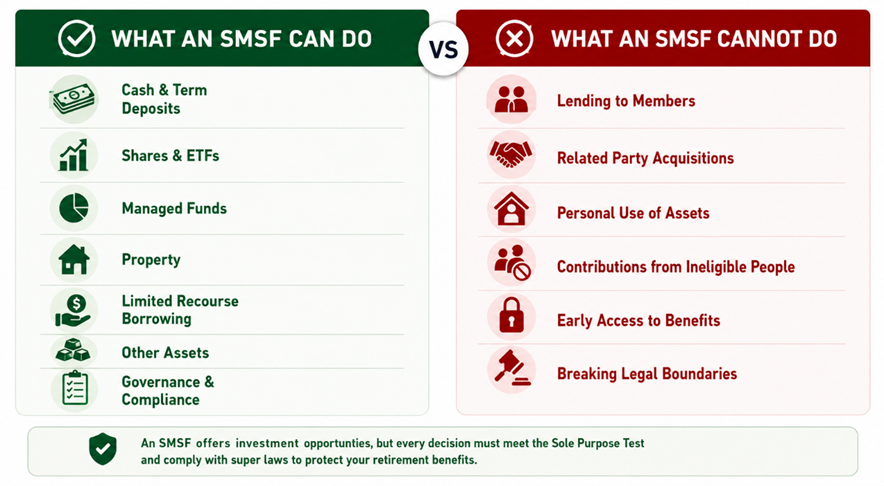
- Allowed Assets include shares, managed funds, property and certain collectables.
- Strict rules govern related-party transactions, in-house assets and benefit payments.
- Pension phase, transfer balance cap and minimum drawdown rules apply when paying retirement income.
- Family pooling can reduce relative costs but increases the importance of governance.
- Suitability depends on balance, time, support and strategy, not enthusiasm alone.
Self-managed super funds have moved from a niche corner of the retirement industry to a mainstream conversation. ATO data shows there are now well over 600,000 SMSFs in Australia, holding hundreds of billions of dollars in assets and serving more than a million members. Whether you hear about them at the dinner table or in the financial press, the questions are usually the same. What is an SMSF, who can have one, and why are so many Australians considering one for their retirement? This explainer answers those questions in plain language and points out the considerations that often get glossed over.
What an SMSF?
An SMSF is a private Superannuation fund regulated by the ATO. It can have up to six members. Each member is also a Trustee, or a director of a corporate trustee, and is responsible for running the fund within Australian superannuation law. The fund holds investments, pays benefits at retirement and lodges its own annual return. In effect, you become both the customer and the manager of your own super fund. That dual role distinguishes SMSFs from every other type of super fund in Australia.
How an SMSF differs from an industry or retail fund
Industry and retail funds are regulated by APRA. They pool millions of members, employ professional staff, and offer a small set of investment Options curated by the fund. An SMSF is regulated by the ATO and is built around the trustees' decisions. There is no investment menu. The trustees create one. There is no automatic insurance design. The trustees consider it. There is no central call centre. The trustees and their advisers handle the fund's operations. The annual cost mix shifts too: trustee time and professional fees replace the percentage-based admin fees of larger funds.
Why interest is rising
Several forces have pushed SMSFs into the spotlight. Australians have built larger super balances over decades of compulsory contributions. Online Brokers, ETFs and direct property investment make self-directed strategies easier than they were twenty years ago. Family pooling and estate planning conversations are more common. Tax outcomes inside super are appealing once you understand them. Retirees who want to design their own income streams find SMSFs attractive. Combined, these factors have driven steady growth in fund numbers and assets, particularly among Australians aged 45 and above.
AI-Powered Image
How retirement income flows from an SMSF
When a member is eligible, the SMSF can pay a lump sum or convert all or part of the member's balance into an account-based pension. The pension pays a regular income stream that meets minimum drawdown rules. There are also transfer balance cap rules that limit how much can be moved into the retirement phase, and trustees must report transfer balance events to the ATO using TBAR. Used well, the SMSF can integrate accumulation and pension phases for different members of a family at the same time, which is one of the structural advantages people most often cite.
Family pooling, in practice
Picture a family with two parents nearing retirement and two adult children early in their careers. By pooling balances inside one SMSF, the family can spread fixed costs across larger asset values, agree on a shared investment strategy and coordinate the timing of contributions and pension payments. Each member still has a clearly identifiable balance, and decisions still need to satisfy the Sole Purpose Test for everyone. Family pooling is not a free lunch, but for some families it can be efficient.
What advisers say to weigh up
Many advisers will tell you that the question is rarely "is an SMSF a good idea?" It is more often "is an SMSF a good idea for this person, in their stage of life, with this balance, this strategy and this support team?" An SMSF can be a powerful platform when paired with discipline, and a costly distraction when not. A good adviser does not assume the answer in advance, and a careful adviser will openly discuss the trustee burden, the wind-up plan and the comparison with reputable APRA-regulated alternatives.
A short example
Sienna and Daniel, both in their fifties, have combined super balances of around 1.4 million dollars. Daniel runs a small architecture practice and rents commercial space. They worked with their Accountant and licensed adviser to weigh whether an SMSF could buy the office and Lease it back at market rent. After modelling fees, audit costs, the Loan structure, exit timing and a stress test of vacancies, they decided the structure suited their plans. Their adviser stressed that this is a strategy, not a guarantee, and that the office had to be valued, leased at market rent and managed at arm's length to satisfy the rules.
Risks worth understanding
Concentration risk is common in SMSFs that hold a single property. Liquidity Risk arises when members reach pension age and the fund needs to pay drawdowns. Compliance risk grows whenever record keeping slips. Behavioural risk creeps in when trustees confuse confidence with information. And Market Risk, the ordinary kind, is no smaller in an SMSF than anywhere else. None of this is unique to SMSFs, but the trustees, not a Fund Manager, must address each one. A well-run SMSF spends as much time on risk as it does on returns.
How family pooling works in practice
Family pooling is one of the most quoted reasons to start an SMSF. Done well, it spreads fixed costs across a larger pool, allows coordinated investment decisions and supports cross-generational planning. Done poorly, it creates fairness disputes, governance complexity and friction at the worst possible time. Most successful family-pooled SMSFs have a written agreement among members that covers decision-making, contribution patterns and what happens when a member's circumstances change. The trust deed alone is not enough.
A useful test for family pooling is to imagine a worst-case scenario: one member separates from a spouse, another loses capacity, a third moves overseas, a fourth dies unexpectedly. If the structure can handle all of these without member disputes, it is well designed. If any one of them would cause significant disruption, the structure needs more thought before pooling proceeds.
How retirement income decisions interact with the cap
The transfer balance cap shapes how members move from accumulation into pension phase. Trustees and members must decide how much Capital to commit to retirement-phase income, how much to leave in accumulation, and how to handle assets that exceed the cap. The decisions involve tax, drawdown rules, member age and life expectancy. Many SMSFs run a hybrid where part of a member's balance supports a pension and part remains in accumulation, balancing tax efficiency with flexibility.
How property in an SMSF actually works
Property is one of the most common SMSF strategies. The fund can hold residential and commercial property, with limits on related-party transactions. Limited Recourse Borrowing Arrangements allow the fund to borrow under strict conditions to acquire a single asset. Trustees often hold Business real property leased back to a related business at market rent. Each of these strategies is well documented but each requires careful execution. Property is also the Asset Class that produces the most concentrated audit attention because it intersects with related-party rules, valuation, liquidity and the Sole Purpose Test.
A short history of how we got here
SMSFs in their current form have existed since the late 1990s, although the underlying concept is older. Reforms over time have introduced LRBAs, the transfer balance cap, the in-house asset rule, contribution caps and TBAR. The structure has evolved to give trustees more options while tightening compliance expectations. The current settings reflect decades of policy refinement. Trustees who understand the history are usually better at anticipating where future changes might come.
Why some advisers stay neutral
Some financial advisers neither recommend nor discourage SMSFs. They treat them as one option among several, depending on the member. The neutrality is intentional. An adviser who recommends an SMSF to every client risks providing inappropriate advice to those for whom an APRA-regulated fund is the better option. An adviser who discourages SMSFs uniformly misses the genuine cases where the structure delivers value. Neutrality, paired with careful assessment, tends to produce the best outcomes.
If your adviser appears to favour the SMSF before they have understood your situation, ask why. Equally, if they dismiss the SMSF without engaging with your specific circumstances, ask why. Useful answers in both directions point to a thoughtful professional. Reflexive answers in either direction are a warning sign.
What good ongoing engagement looks like
Trustees who engage with their fund quarterly, even briefly, often outperform trustees who engage annually. The quarterly check-in catches small issues early, supports better strategy decisions and keeps the trustees informed. The check-in does not need to be elaborate: a 30 to 60 minute review of statements, performance, decisions and any pending obligations is usually enough. The discipline is more important than the duration.
How retirement looks inside an SMSF
Retirement inside a well-run SMSF can feel orderly. The pension begins on a chosen date. Minimum drawdowns are scheduled and paid. The investment strategy shifts gently toward income and capital preservation. The transfer balance cap is monitored. The trustees continue to meet annual obligations, often with reduced complexity once the strategy is set. Many retirees describe the experience as fewer surprises than they expected, provided the structure was designed with retirement in mind from the outset.


 Nov 03, 2026





 Please wait processing your request...