
 CA
 NZ
 UK
 US
 IND

 AU

 Share
 X (Formerly Twitter)
 Whatsapp
 Facebook
 LinkedIn
 Telegram
 Email This Article
 Copy Link
 Summarize with AI
 Chat GPT
 Perplexity

Direct Cryptocurrency and crypto ETFs offer different paths to digital asset exposure for an Australian SMSF. The choice is rarely about which option is better in the abstract; it is about which option fits the fund's strategy, members and operational capacity.
This article compares SMSF direct crypto and crypto ETFs across the dimensions trustees most often care about.
Ownership and Custody
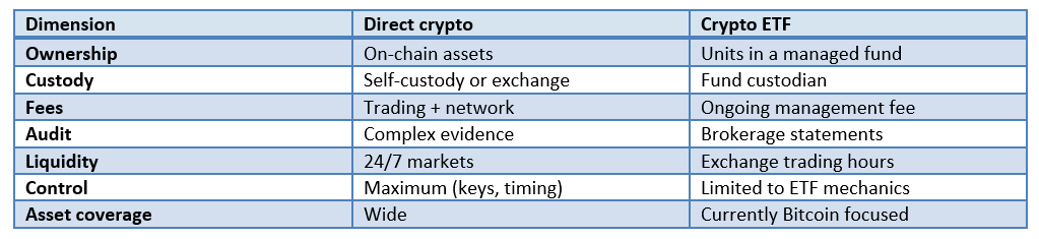
Direct crypto puts the SMSF in possession of wallets and keys. The fund owns the underlying asset on the blockchain. ETFs put the SMSF in possession of units of a managed fund; the Fund Manager handles custody.
Operational Burden
Direct crypto requires the trustees to manage wallets, exchange accounts, security and reconciliations. ETFs slot into standard brokerage and SMSF accounting processes.
Cost
Direct crypto involves trading fees, network costs and (potentially) custody fees. ETFs charge ongoing management fees — for example, 0.45% for VBTC, 0.49% for BTXX and 0.25% for IBTC at the time of writing.
Compliance Workload
Direct crypto demands rigorous ownership, valuation and audit evidence. ETFs reduce the compliance workload, with brokerage statements and tax reports doing much of the heavy lifting.
Side-by-Side Comparison
Tax Differences
Both Options sit within Australia's CGT framework, but mechanics differ. Direct crypto generates discrete cost bases per Acquisition and disposal. ETFs may distribute capital gains via annual tax statements. Trustees should obtain specific tax advice.
Liquidity Considerations
Direct crypto trades 24/7 across global exchanges. ETFs trade during exchange hours, although market makers help maintain liquidity. Spreads and execution quality vary.
Which Suits Which Trustee?
Trustees comfortable with technical custody and willing to invest in compliance infrastructure may prefer direct crypto. Trustees who value simplicity, regulated wrappers and tighter audit pathways may prefer ETFs. Some funds use both.
Practical Considerations for Australian Trustees
Beyond the headline rules, Australian self-managed super fund trustees should think about how the issues discussed above translate into day-to-day practice. Cryptocurrency is administered through digital systems that work around the clock, settle quickly and produce data that can be voluminous and highly granular. Trustees who treat SMSF crypto as a 'set and forget' asset often discover at audit time that the records they need were never captured.
Establish a documented procedures pack
A short procedures document — held alongside the trust deed and Investment strategy — can describe how the fund opens accounts, executes trades, custodies Assets, manages access, captures transactions, values holdings, prepares for audit and responds to incidents. Procedures need not be elaborate, but they should be tailored to the fund and reviewed when material changes occur.
Plan for trustee succession
Cryptocurrency access can be lost if a sole trustee becomes incapacitated, dies, or leaves the fund without handing over keys, wallets or passwords. Trustees should consider how access would be transferred in such events, including the role of enduring powers of attorney, executors and updated fund deeds. Multi-signature arrangements, custody providers and clear documentation can all reduce this risk.
Build a working relationship with specialists
SMSF crypto sits at the intersection of Superannuation law, tax law, anti-Money Laundering rules and digital asset technology. Few advisers cover all four areas deeply. Trustees often work with an SMSF specialist Accountant, a registered tax agent with crypto expertise, an approved SMSF auditor familiar with digital assets, and, where required, an SMSF lawyer. Coordinating these advisers helps ensure that decisions are properly considered before action is taken.
Illustrative Scenario
Consider a hypothetical four-member SMSF with $1.8 million in assets, comprising listed Australian shares, international Equity ETFs, cash and a small commercial property. Two of the members are in accumulation phase in their early 40s; two are in pension phase in their late 60s. The trustees decide they want to introduce a modest allocation to digital assets.
Working with their SMSF specialist accountant and lawyer, they update the trust deed to expressly authorise cryptocurrency, refresh the investment strategy to include a 0% to 4% crypto allocation range, and document the rationale, risk considerations and review cadence. They open an AUSTRAC-registered exchange account in the SMSF's full legal name, link it to the fund's dedicated bank account, and acquire a single, dedicated hardware wallet to hold long-term balances. They start with a small purchase of Bitcoin, document every transaction and capture a 30 June valuation in their first year of holding.
The trustees brief their approved SMSF auditor in advance, share the wallet ownership evidence, and provide the exchange statements at audit time. The fund does not stake or use DeFi. The trustees revisit the strategy a year later and decide whether to expand, hold or wind back the allocation. The example is illustrative only and does not reflect the situation of any specific fund.
Key Takeaways
- Direct crypto offers maximum control; ETFs offer maximum simplicity.
- Costs, fees and compliance burdens differ materially.
- ETFs currently focus on Bitcoin; direct crypto covers a wider universe.
- Tax mechanics differ; both fit within Australia's CGT framework.
- Suitability depends on the fund's strategy and capacity.


 Nov 03, 2026





 Please wait processing your request...