
 CA
 NZ
 UK
 US
 IND

 AU

 Share
 X (Formerly Twitter)
 Whatsapp
 Facebook
 LinkedIn
 Telegram
 Email This Article
 Copy Link
 Summarize with AI
 Chat GPT
 Perplexity

Tax is one of the most misunderstood aspects of holding Cryptocurrency inside an SMSF. While the headline message — that SMSFs enjoy concessional tax — is correct, the detailed treatment of CGT, income, staking, DeFi and overseas activity is complex. Trustees who treat crypto tax as an afterthought often pay more than they should and risk ATO scrutiny.
This article outlines the key SMSF crypto tax rules Australian investors need to understand. It is general information only and not a substitute for advice from a registered tax agent or crypto tax specialist.
Crypto as a CGT Asset
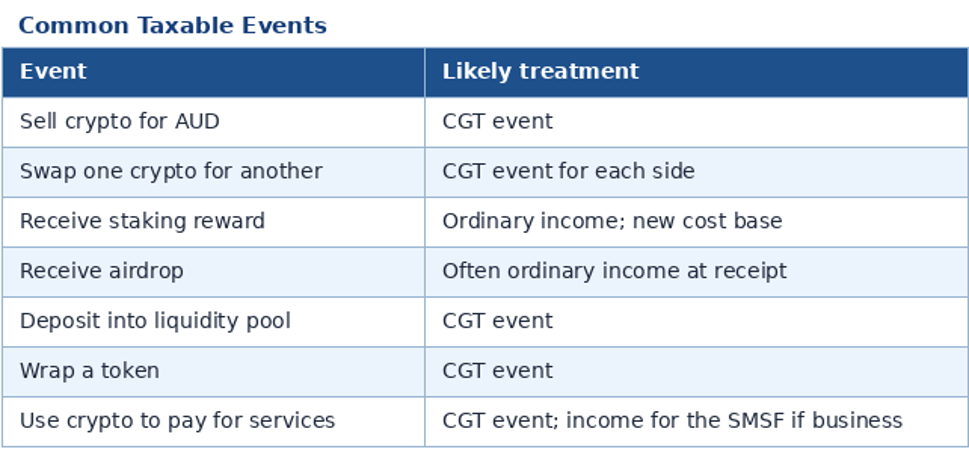
The ATO treats most cryptocurrencies as CGT Assets under the Income Tax Assessment Act 1997 — not as foreign currency. A CGT event occurs when an SMSF disposes of crypto, including by selling for AUD, swapping for another crypto, transferring beneficial ownership, or using it to pay for something.
Concessional SMSF Tax Rates
Complying SMSFs in accumulation phase are generally taxed at 15%, with a one-third CGT discount available where the asset has been held for at least 12 months (giving an effective rate around 10% on the gross gain). Assets supporting pension liabilities may attract a lower rate, subject to the transfer balance cap and other rules.
Staking Rewards
Staking rewards are generally assessable income at the Market Value when received. The new tokens then become CGT assets with cost bases equal to that market value. When disposed of, Capital gains or losses arise relative to the cost base.
DeFi and Wrapped Tokens
The ATO has stated that depositing crypto into a Liquidity pool, wrapping a token (such as converting ETH to wETH), and similar arrangements involving change of beneficial ownership can be CGT events. Reward distributions are typically income. The result is that a single DeFi position can generate multiple taxable events.
Cost Base Tracking
Maintaining cost bases for SMSF crypto is critical. Trustees should track Acquisition dates, AUD values at acquisition, fees, and any later events that affect the cost base (for example, swaps, splits or rebases). Specialist crypto tax software can help.
Common Taxable Events
Foreign Exchanges and Overseas Activity
Activity on overseas platforms remains within the scope of Australian tax. Trustees should keep AUD-equivalent values for every transaction, capture foreign Withholding tax issues, and consider the practical record-keeping challenges that come with offshore platforms.
Capital Losses
Capital losses can offset capital gains within the SMSF and be carried forward to future years. Losses cannot be offset against ordinary income. Trustees should consider tax timing in line with the Investment strategy, not for tax minimisation alone.
Reporting and Records
The SMSF annual return includes crypto activity. Trustees should keep records for at least five years after the relevant event. Records include transaction logs, exchange statements, cost-base calculations, valuation evidence and any tax adjustments.
Practical Considerations for Australian Trustees
Beyond the headline rules, Australian self-managed super fund trustees should think about how the issues discussed above translate into day-to-day practice. Cryptocurrency is administered through digital systems that work around the clock, settle quickly and produce data that can be voluminous and highly granular.
Establish a documented procedures pack
A short procedures document — held alongside the trust deed and investment strategy — can describe how the fund opens accounts, executes trades, custodies assets, manages access, captures transactions, values holdings, prepares for audit and responds to incidents.
Plan for Trustee succession
Cryptocurrency access can be lost if a sole trustee becomes incapacitated, dies, or leaves the fund without handing over keys, wallets or passwords. Multi-signature arrangements, custody providers and clear documentation can all reduce this risk.
Build a working relationship with specialists
SMSF crypto sits at the intersection of Superannuation law, tax law, anti-Money Laundering rules and digital asset technology. Trustees often work with an SMSF specialist Accountant, a registered tax agent with crypto expertise, an approved SMSF auditor familiar with digital assets, and, where required, an SMSF lawyer.
Illustrative Scenario
Consider a hypothetical four-member SMSF with $1.8 million in assets. Working with their SMSF specialist accountant and lawyer, they update the trust deed to expressly authorise cryptocurrency, open an AUSTRAC-registered exchange account in the SMSF's full legal name, and start with a small purchase of Bitcoin, documenting every transaction and capturing a 30 June valuation in their first year of holding. The example is illustrative only and does not reflect the situation of any specific fund.
Key Takeaways
- Most SMSF crypto is treated as a CGT asset by the ATO.
- Disposals trigger CGT events; staking and airdrops are typically income.
- DeFi and wrapped tokens can multiply taxable events.
- Concessional SMSF rates apply, but careful cost-base tracking is essential.
- A crypto tax specialist is highly recommended for active SMSFs.


 Nov 03, 2026





 Please wait processing your request...