
 CA
 NZ
 UK
 US
 IND

 AU

 Share
 X (Formerly Twitter)
 Whatsapp
 Facebook
 LinkedIn
 Telegram
 Email This Article
 Copy Link
 Summarize with AI
 Chat GPT
 Perplexity

Bitcoin and Ethereum dominate headlines as the world's largest cryptocurrencies, and Australian self-managed super fund trustees are asking whether their fund can buy them. SMSF crypto rules do not prohibit BTC or ETH, but the path from interest to ownership runs through several compliance checkpoints.
An SMSF that intends to hold Bitcoin or Ethereum must update its trust deed if needed, document the Investment in its written investment strategy, set up dedicated ownership arrangements, satisfy ATO record-keeping requirements and provide evidence to an approved SMSF auditor each year. Trustees who treat BTC or ETH as a casual side allocation risk both poor investment outcomes and compliance breaches.
This article explains the key SMSF crypto rules that apply specifically when a self-managed super fund wants to buy Bitcoin or Ethereum, with general information for Australian trustees.
Are Bitcoin and Ethereum Treated Differently by the ATO?
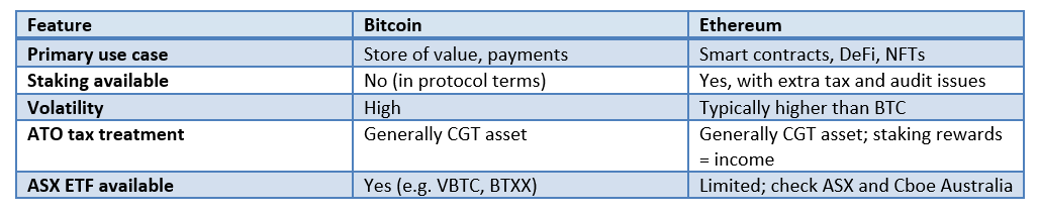
For most SMSF purposes, the ATO treats Bitcoin and Ethereum similarly. Both are generally CGT Assets, both must be held in the SMSF's name, and both must comply with the investment strategy, sole purpose test and audit rules. The differences emerge in the activities that can be performed with each asset — Ethereum, for example, can be staked and used across decentralised finance applications, both of which raise additional tax and compliance questions.
Step One: Check the Trust Deed
An SMSF cannot buy any asset the trust deed does not permit. Many older deeds focus on traditional asset classes such as shares, fixed income, managed funds and property. If digital assets, Cryptocurrency or virtual currency are not addressed, a deed update may be required before the fund can transact in BTC or ETH.
Trustees should consider engaging an SMSF lawyer to review the deed and to recommend wording that contemplates the practical features of crypto, including ownership through wallets, custody arrangements and the use of exchanges. The deed update should be properly executed and signed before the fund opens any exchange or custody account.
Step Two: Update the Investment Strategy
The written investment strategy is the document that links the fund's investments to its members' retirement objectives. A strategy that mentions 'cryptocurrency' in a single line is unlikely to satisfy ATO expectations if the fund actually allocates material amounts to BTC or ETH.
A robust strategy explains why the trustees believe a crypto allocation is consistent with the members' risk profile, Liquidity needs and retirement timeframe, how the fund will manage Volatility and custody risk, and the range of the proposed allocation. The strategy should be reviewed at least annually and after material changes in market conditions.
Step Three: Establish SMSF-Owned Wallets and Accounts
Bitcoin and Ethereum bought by the SMSF must be held in the fund's name. Trustees should open an exchange account using the SMSF's full legal name and Australian Business Number, not their personal name. If using a hardware wallet, the device should be dedicated to the fund. Keys, recovery phrases and access credentials should be controlled and stored in a way that demonstrates the fund — not the individual — is the legal owner.
Bitcoin in an SMSF: Specific Considerations
Volatility and concentration
Bitcoin's price history includes multiple drawdowns of more than 50% within a single year. Trustees who concentrate a meaningful share of fund assets in BTC should ensure that the fund retains enough liquidity to pay pensions and meet other liabilities even after a sharp price fall.
Custody choices
Bitcoin can be held on an exchange wallet, in self-custody using a hardware wallet, or through a third-party custody provider. Each option has different cyber security, liquidity and audit characteristics. SMSF trustees should weigh up the trade-offs and document their choice in the investment strategy.
Ethereum in an SMSF: Specific Considerations
Staking
Ethereum moved to a proof-of-stake consensus mechanism in 2022. Holders can stake ETH to validate the network and earn rewards. Staking inside an SMSF raises additional tax (ordinary income on receipt), custody and counterparty risks. Some staking arrangements may also involve related parties or pooled structures that need careful legal review.
DeFi activity
Ethereum is the leading platform for decentralised finance applications. The ATO has stated that depositing crypto into a liquidity pool, wrapping a token, or otherwise transferring beneficial ownership can each trigger a CGT event. SMSFs that use DeFi protocols face complex tax, audit and Legal risks.
Comparison Table: BTC vs ETH for SMSF Trustees
AUSTRAC Registration of Exchanges
Australian crypto exchanges that convert fiat to crypto or crypto to fiat must be registered as Digital currency Exchange providers with AUSTRAC under the Anti-Money Laundering and Counter-Terrorism Financing Act 2006. Trustees should confirm an exchange is on the AUSTRAC public register before opening an SMSF account. From 31 March 2026, the obligations are expanding to capture additional Virtual Asset Service Providers under the AML/CTF Amendment Act 2024.
Annual Audit Evidence
An approved SMSF auditor must check that BTC or ETH held by the fund is owned in the SMSF's name, valued correctly at 30 June, and supported by transaction records. Trustees should retain monthly or quarterly exchange statements, wallet address ownership evidence, and an independent valuation from a reputable exchange at year end.
Key Risks for BTC and ETH in an SMSF
- Severe price falls that may not recover within a member's retirement timeframe.
- Loss of access to wallets or recovery phrases.
- Cyber attacks on exchanges, custodians or trustees personally.
- Compliance breaches if ownership, valuation or record-keeping is inadequate.
- Tax complexity around staking, DeFi and overseas transactions.
Practical Considerations for Australian Trustees
Beyond the headline rules, Australian self-managed super fund trustees should think about how the issues discussed above translate into day-to-day practice. Cryptocurrency is administered through digital systems that work around the clock, settle quickly and produce data that can be voluminous and highly granular. Trustees who treat SMSF crypto as a 'set and forget' asset often discover at audit time that the records they need were never captured.
Establish a documented procedures pack
A short procedures document — held alongside the trust deed and investment strategy — can describe how the fund opens accounts, executes trades, custodies assets, manages access, captures transactions, values holdings, prepares for audit and responds to incidents. Procedures need not be elaborate, but they should be tailored to the fund and reviewed when material changes occur.
Plan for Trustee succession
Cryptocurrency access can be lost if a sole trustee becomes incapacitated, dies, or leaves the fund without handing over keys, wallets or passwords. Trustees should consider how access would be transferred in such events, including the role of enduring powers of attorney, executors and updated fund deeds. Multi-signature arrangements, custody providers and clear documentation can all reduce this risk.
Build a working relationship with specialists
SMSF crypto sits at the intersection of Superannuation law, tax law, anti-money laundering rules and digital asset technology. Few advisers cover all four areas deeply. Trustees often work with an SMSF specialist Accountant, a registered tax agent with crypto expertise, an approved SMSF auditor familiar with digital assets, and, where required, an SMSF lawyer. Coordinating these advisers helps ensure that decisions are properly considered before action is taken.
Illustrative Scenario
Consider a hypothetical four-member SMSF with $1.8 million in assets, comprising listed Australian shares, international Equity ETFs, cash and a small commercial property. Two of the members are in accumulation phase in their early 40s; two are in pension phase in their late 60s. The trustees decide they want to introduce a modest allocation to digital assets.
Working with their SMSF specialist accountant and lawyer, they update the trust deed to expressly authorise cryptocurrency, refresh the investment strategy to include a 0% to 4% crypto allocation range, and document the rationale, risk considerations and review cadence. They open an AUSTRAC-registered exchange account in the SMSF's full legal name, link it to the fund's dedicated bank account, and acquire a single, dedicated hardware wallet to hold long-term balances. They start with a small purchase of Bitcoin, document every transaction and capture a 30 June valuation in their first year of holding.
The trustees brief their approved SMSF auditor in advance, share the wallet ownership evidence, and provide the exchange statements at audit time. The fund does not stake or use DeFi. The trustees revisit the strategy a year later and decide whether to expand, hold or wind back the allocation. The example is illustrative only and does not reflect the situation of any specific fund.
Key Takeaways
- SMSFs can buy Bitcoin or Ethereum, but the trust deed, strategy, ownership and audit rules must be satisfied first.
- BTC and ETH are both generally CGT assets, with staking and DeFi adding extra tax complexity.
- AUSTRAC-registered exchanges should be preferred for fiat on- and off-ramps.
- Custody should be dedicated to the SMSF and not mixed with personal holdings.
- Trustees should obtain professional advice before committing to BTC or ETH.


 Nov 03, 2026





 Please wait processing your request...