
 CA
 NZ
 UK
 US
 IND

 AU

 Share
 X (Formerly Twitter)
 Whatsapp
 Facebook
 LinkedIn
 Telegram
 Email This Article
 Copy Link
 Summarize with AI
 Chat GPT
 Perplexity

Australia's regulatory framework for digital Assets is moving through one of its most significant phases. AUSTRAC obligations are expanding, ASIC is increasing scrutiny of SMSF advice, and the Corporations Amendment (Digital Assets Framework) Bill 2025 — passed in 2026 — is reshaping how digital asset platforms are licensed and supervised. SMSF trustees should keep up with these developments to remain compliant.
This article surveys the SMSF crypto regulatory outlook for Australian trustees.
AUSTRAC and AML/CTF
AUSTRAC has required Digital currency Exchange registration since 2018. Under the AML/CTF Amendment Act 2024, additional Virtual Asset Service Providers — including some crypto-to-crypto exchanges and digital asset transferors — must be enrolled from 31 March 2026. Trustees should verify that their chosen platforms are compliant with the expanded regime.
ASIC and AFSL Reforms
The Corporations Amendment (Digital Assets Framework) Bill 2025, which became law in 2026, extends AFSL requirements to digital asset platform service providers operating above defined thresholds. ASIC's no-action position for unlicensed platforms is winding down, and trustees should ask their providers about licensing plans.
ATO Guidance and Surveillance
The ATO maintains and updates SMSF-specific crypto guidance. Areas of ongoing focus include valuation, related-party rules, ownership separation, staking and DeFi tax treatment. Data-matching programs are extending into crypto.
Stablecoin Regulation
Stablecoins are receiving particular regulatory attention. Treasury consultations on payment stablecoin frameworks, ePayments-style protections and prudential considerations are progressing. Trustees holding stablecoins should follow these developments.
Custody and Consumer Protection
New legislation introduces money safeguarding obligations for digital asset platforms, including segregation of customer assets and limits on rehypothecation. These changes support better protection for SMSF assets held with platforms.
What Could Change Further
- Tighter rules on Advertising and promotion of crypto products.
- Expanded reporting requirements for digital asset platforms.
- Stricter custody standards for high-value SMSF holdings.
- Greater coordination between ASIC, AUSTRAC and the ATO.
- Potential frameworks for tokenised real-world assets.
What Trustees Can Do
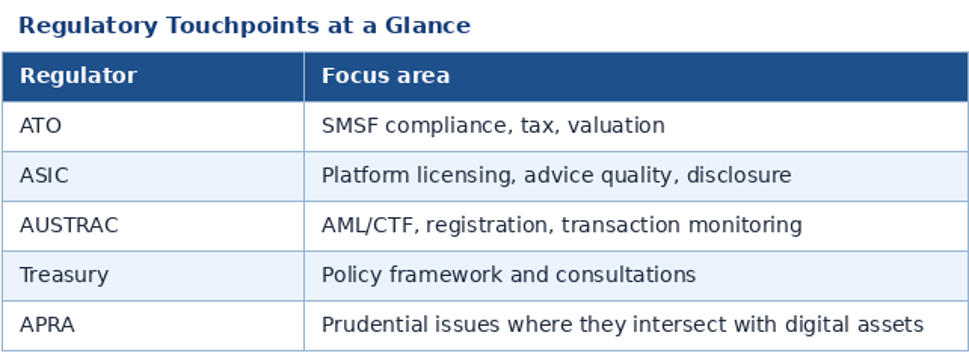
Stay informed through ATO, ASIC, AUSTRAC and Treasury communications. Engage SMSF specialist accountants, tax advisers and legal practitioners who actively monitor regulatory change. Review the fund's strategy and procedures whenever material changes occur.
Regulatory Touchpoints at a Glance
Practical Considerations for Australian Trustees
Beyond the headline rules, Australian self-managed super fund trustees should think about how the issues discussed above translate into day-to-day practice. Cryptocurrency is administered through digital systems that work around the clock, settle quickly and produce data that can be voluminous and highly granular.
Establish a documented procedures pack
A short procedures document — held alongside the trust deed and Investment strategy — can describe how the fund opens accounts, executes trades, custodies assets, manages access, captures transactions, values holdings, prepares for audit and responds to incidents.
Plan for Trustee succession
Cryptocurrency access can be lost if a sole trustee becomes incapacitated, dies, or leaves the fund without handing over keys, wallets or passwords. Multi-signature arrangements, custody providers and clear documentation can all reduce this risk.
Build a working relationship with specialists
SMSF crypto sits at the intersection of Superannuation law, tax law, anti-Money Laundering rules and digital asset technology. Trustees often work with an SMSF specialist Accountant, a registered tax agent with crypto expertise, an approved SMSF auditor familiar with digital assets, and, where required, an SMSF lawyer.
Illustrative Scenario
Consider a hypothetical four-member SMSF with $1.8 million in assets. Working with their SMSF specialist accountant and lawyer, they update the trust deed to expressly authorise cryptocurrency and open an AUSTRAC-registered exchange account in the SMSF's full legal name. The example is illustrative only and does not reflect the situation of any specific fund.
Key Takeaways
- Australia's SMSF crypto regulatory environment is changing materially.
- AUSTRAC and AFSL reforms affect the platforms trustees use.
- ATO surveillance and guidance continue to evolve.
- Trustees should monitor official sources and engage specialists.
- Documentation and procedures should be updated as rules change.


 Nov 03, 2026





 Please wait processing your request...