
 CA
 NZ
 UK
 US
 IND

 AU

 Share
 X (Formerly Twitter)
 Whatsapp
 Facebook
 LinkedIn
 Telegram
 Email This Article
 Copy Link
 Summarize with AI
 Chat GPT
 Perplexity

SMSF crypto compliance problems often start small — a forgotten valuation, a wallet shared with personal holdings, a strategy that has not been updated. Left unaddressed, they can compound into audit qualifications and ATO action.
This article highlights common SMSF crypto mistakes Australian trustees should watch for, along with practical ways to avoid them.
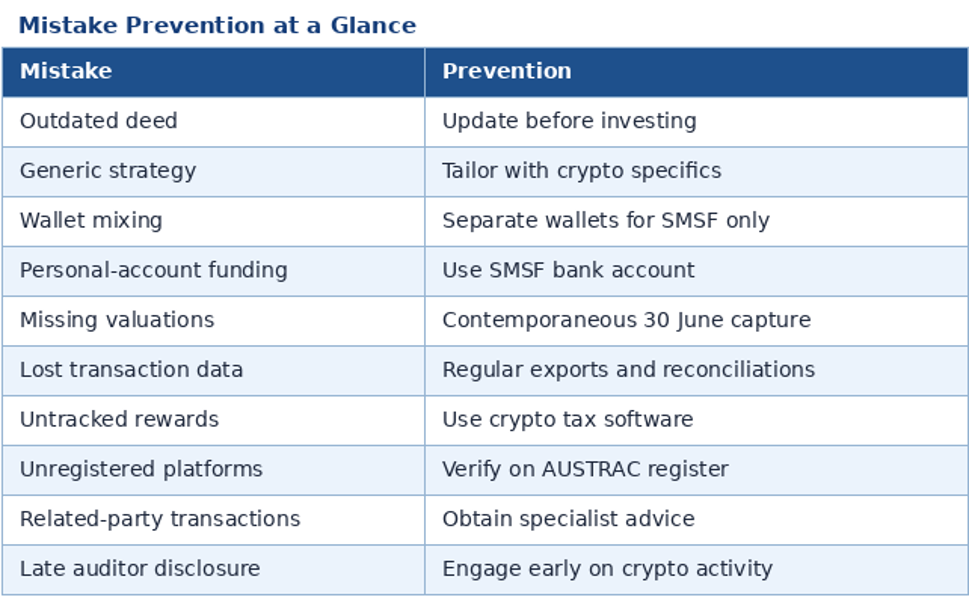
Mistake 1: Buying Crypto Before Updating the Trust Deed
Some trustees buy crypto first and check the deed later. If the deed does not permit Cryptocurrency, the Investment may be invalid. Updates should be made before any purchase.
Mistake 2: Generic Investment Strategy
Strategies that mention crypto in a single line are unlikely to satisfy auditors when meaningful allocations are made. The strategy should explain the rationale, risk, allocation range and review cadence.
Mistake 3: Mixing Personal and Fund Crypto
Holding fund and personal crypto in the same wallet undermines ownership separation and is a serious compliance breach. Use entirely separate wallets and exchange accounts for the SMSF.
Mistake 4: Funding Crypto Purchases From Personal Accounts
All SMSF crypto purchases should flow through the fund's bank account. Using a member's personal account creates contribution and ownership issues.
Mistake 5: No 30 June Valuation
Year-end valuations are required. Trustees should capture closing prices contemporaneously and retain evidence for the audit.
Mistake 6: Missing Transaction Records
Trustees sometimes lose access to exchange records, especially after platform changes. Regular reconciliation and export of transaction histories help avoid gaps.
Mistake 7: Untracked Staking and DeFi Rewards
Staking rewards and DeFi distributions are Taxable Income. Failing to track them creates tax issues and audit complications.
Mistake 8: Using Unregistered Platforms
Exchanges that should be registered with AUSTRAC but are not pose compliance and recovery risks. Trustees should verify registration before depositing fund money.
Mistake 9: Ignoring In-House Asset and Related-Party Rules
Crypto cannot generally be acquired from related parties, and structures involving related entities can fall foul of in-house asset rules.
Mistake 10: Delaying Disclosure to the Auditor
Early engagement with the approved SMSF auditor helps resolve issues before they escalate. Late disclosure can lead to qualified audits and contravention reports.
Mistake Prevention at a Glance
Practical Considerations for Australian Trustees
Beyond the headline rules, Australian self-managed super fund trustees should think about how the issues discussed above translate into day-to-day practice. Cryptocurrency is administered through digital systems that work around the clock, settle quickly and produce data that can be voluminous and highly granular.
Establish a documented procedures pack
A short procedures document — held alongside the trust deed and investment strategy — can describe how the fund opens accounts, executes trades, custodies Assets, manages access, captures transactions, values holdings, prepares for audit and responds to incidents.
Plan for Trustee succession
Cryptocurrency access can be lost if a sole trustee becomes incapacitated, dies, or leaves the fund without handing over keys, wallets or passwords. Multi-signature arrangements, custody providers and clear documentation can all reduce this risk.
Build a working relationship with specialists
SMSF crypto sits at the intersection of Superannuation law, tax law, anti-Money Laundering rules and digital asset technology. Trustees often work with an SMSF specialist Accountant, a registered tax agent with crypto expertise, an approved SMSF auditor familiar with digital assets, and, where required, an SMSF lawyer.
Illustrative Scenario
Consider a hypothetical four-member SMSF with $1.8 million in assets. Working with their SMSF specialist accountant and lawyer, they update the trust deed to expressly authorise cryptocurrency, refresh the investment strategy to include a 0% to 4% crypto allocation range, open an AUSTRAC-registered exchange account in the SMSF's full legal name, and capture a 30 June valuation in their first year of holding. The example is illustrative only and does not reflect the situation of any specific fund.
Key Takeaways
- Most SMSF crypto mistakes are preventable with structure and discipline.
- Update the deed and strategy before any purchase.
- Keep fund and personal crypto strictly separate.
- Capture transactions, rewards and valuations as you go.
- Engage SMSF specialists and your auditor early.


 Nov 03, 2026





 Please wait processing your request...