
 CA
 NZ
 UK
 US
 IND

 AU

 Share
 X (Formerly Twitter)
 Whatsapp
 Facebook
 LinkedIn
 Telegram
 Email This Article
 Copy Link
 Summarize with AI
 Chat GPT
 Perplexity

Holding digital Assets in an SMSF is not just about the initial purchase. The ATO expects ongoing compliance: maintained records, current valuations, updated Investment strategies and accurate annual returns. As Australian super law and digital asset regulation evolve, so do the demands on trustees.
This article focuses on staying compliant year after year, not just at fund setup. It is general information for Australian SMSF trustees, not personal financial, tax or legal advice.
Continuous Compliance Loop
Compliance for SMSF digital assets is best treated as a cycle. Trustees plan the strategy, execute transactions, capture records, value assets at year end, undergo audit, and feed lessons back into the next cycle. Skipping or rushing any stage creates gaps that may surface later.
Keep the Investment Strategy Live
An investment strategy is not a static document. ATO guidance emphasises that strategies must be reviewed regularly. Material changes — new asset types, large allocations, market dislocations or member life events — should trigger an update. Trustees should record the date, reason and outcome of each review.
Maintain Ownership Records Continuously
Trustees should keep evidence that every wallet and exchange account remains in the SMSF's name. When platforms merge, rebrand or update terms, trustees should obtain fresh confirmation that the accounts continue to be held for the fund. Wallet migrations should be documented at the time, not reconstructed years later.
Transaction Capture Discipline
Each transaction — purchase, sale, swap, transfer, staking reward, airdrop, DeFi event — should be captured at the time. Many trustees use specialist crypto tax software in conjunction with their SMSF administrator. Periodic reconciliation between on-chain activity, exchange statements and the fund's books reduces audit friction.
Year-End Valuation
The ATO requires SMSF assets to be reported at Market Value as at 30 June. For crypto, the closing price on a reputable Australian exchange at the end of 30 June is generally accepted. Trustees should capture and retain the source, time and reference exchange used. For thinly traded Altcoins, additional evidence may be needed.
Audit Preparation Checklist
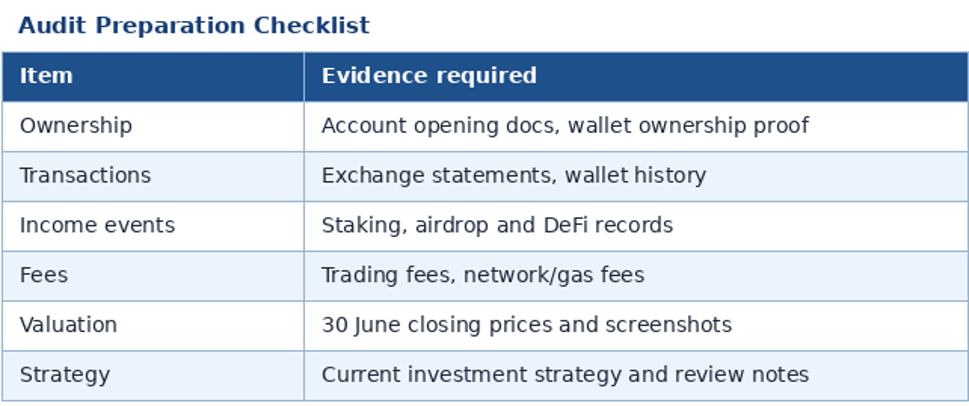
Tax Compliance Throughout the Year
Trustees should not wait until lodgement to think about tax. Capital gains, ordinary income from staking, expense apportionment and concessional CGT treatment need to be tracked throughout the year. A registered tax agent with SMSF and crypto expertise can help embed good practice.
Reacting to Regulatory Change
Australian regulators are actively reshaping the digital asset framework. AUSTRAC's expanded VASP obligations from 31 March 2026 and AFSL changes flowing from the Corporations Amendment (Digital Assets Framework) Bill 2025 are significant. Trustees should subscribe to updates and seek advice when material changes affect the platforms they use.
Periodic Compliance Health Checks
- Annual review of trust deed and investment strategy.
- Quarterly reconciliation of wallets and exchange accounts.
- Documented procedures for staking, DeFi and Stablecoin activity.
- Periodic review of custody arrangements and cyber security.
- Liaison with the approved SMSF auditor on emerging issues.
Practical Considerations for Australian Trustees
Beyond the headline rules, Australian self-managed super fund trustees should think about how the issues discussed above translate into day-to-day practice. Cryptocurrency is administered through digital systems that work around the clock, settle quickly and produce data that can be voluminous and highly granular.
Establish a documented procedures pack
A short procedures document — held alongside the trust deed and investment strategy — can describe how the fund opens accounts, executes trades, custodies assets, manages access, captures transactions, values holdings, prepares for audit and responds to incidents.
Plan for Trustee succession
Cryptocurrency access can be lost if a sole trustee becomes incapacitated, dies, or leaves the fund without handing over keys, wallets or passwords. Multi-signature arrangements, custody providers and clear documentation can all reduce this risk.
Build a working relationship with specialists
SMSF crypto sits at the intersection of Superannuation law, tax law, anti-Money Laundering rules and digital asset technology. Trustees often work with an SMSF specialist Accountant, a registered tax agent with crypto expertise, an approved SMSF auditor familiar with digital assets, and, where required, an SMSF lawyer.
Illustrative Scenario
Consider a hypothetical four-member SMSF with $1.8 million in assets. Working with their SMSF specialist accountant and lawyer, they update the trust deed to expressly authorise cryptocurrency, refresh the investment strategy to include a 0% to 4% crypto allocation range, and open an AUSTRAC-registered exchange account in the SMSF's full legal name. They capture a 30 June valuation in their first year of holding and brief their approved SMSF auditor in advance. The example is illustrative only and does not reflect the situation of any specific fund.
Key Takeaways
- Treat SMSF digital asset compliance as continuous, not annual.
- Keep the trust deed and strategy aligned with what the fund actually does.
- Capture every transaction and income event in real time.
- Prepare a thorough audit pack each year.
- Stay current with regulatory changes and engage specialists.


 Nov 03, 2026





 Please wait processing your request...