
 CA
 NZ
 UK
 US
 IND

 AU

 Share
 X (Formerly Twitter)
 Whatsapp
 Facebook
 LinkedIn
 Telegram
 Email This Article
 Copy Link
 Summarize with AI
 Chat GPT
 Perplexity

Highlights
- An SMSF gives you more control over investments but also makes you responsible for the fund's compliance.
- Setup and ongoing costs include audit, administration, levies and investment expenses.
- All trustees must understand and sign a trustee declaration and act within Australian super law.
- The Sole Purpose Test, in-house asset rules and contribution rules are non-negotiable.
- Many APRA-regulated funds now offer flexibility that may meet your needs without trustee duties.
- Compare time, cost and skill before you start, not after.
- If unsure, get advice from a licensed financial adviser, an SMSF accountant and, where useful, a solicitor.
Australians love a do-it-yourself project. From renovating a Queenslander to brewing kombucha in the laundry, we are wired to take the wheel. So when you hear that you can run your own super fund, the appeal is obvious: you choose the investments, you set the strategy, and you are no longer at the mercy of the fund manager who buried a fee in fine print. But before you sign the paperwork or move a single dollar out of your existing fund, it pays to understand what a self-managed super fund really involves and whether the trade-offs match your life. This article walks through what an SMSF is, why people consider one, what it costs in time and money, the responsibilities you cannot delegate, the most common mistakes, alternatives worth weighing, and the questions to bring to a professional adviser before you take the leap.
What an SMSF actually is
A self-managed super fund, or SMSF, is a private superannuation fund regulated by the Australian Taxation Office. Unlike retail or industry funds that pool millions of members, an SMSF can have up to six members, and every one of them must also serve as a trustee or director of the corporate trustee. That dual role is the whole point. You are not just a customer of the fund; you are responsible for running it, complying with super law, and meeting the Sole Purpose Test, which means the fund exists solely to provide retirement benefits to its members.
An SMSF is established with a trust deed, registered with the ATO, given an Australian Business Number, and held together by an ongoing investment strategy that the trustees prepare and review. It can hold listed shares, managed funds, residential and commercial property, term deposits, certain collectables, and other approved assets. What it cannot do is operate like a personal piggy bank or a side business. Every cent inside the fund belongs to members in their capacity as future retirees, not in their capacity as today's homeowners or business operators.
Why people are drawn to it
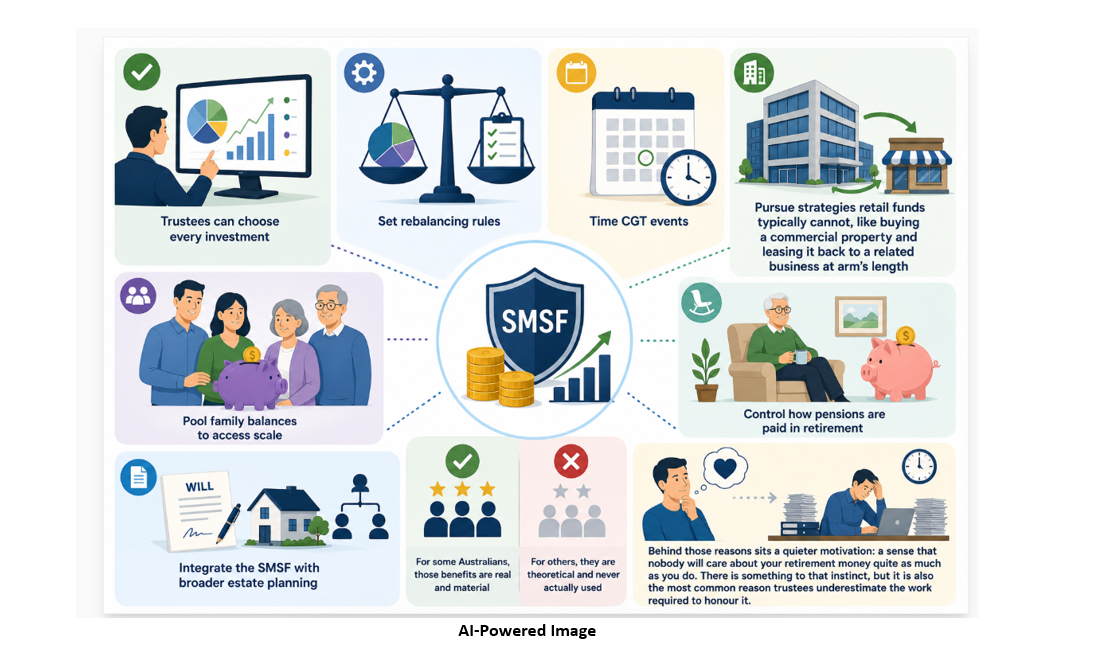
The pull factors are easy to list. Trustees can choose every investment, set rebalancing rules, time CGT events, and pursue strategies that retail funds typically cannot, like buying a commercial property and leasing it back to a related business at arm's length. They can pool family balances to access scale, control how pensions are paid in retirement, and integrate the SMSF with broader estate planning. For some Australians, those benefits are real and material. For others, they are theoretical and never actually used.
Behind those reasons sits a quieter motivation: a sense that nobody will care about your retirement money quite as much as you do. There is something to that instinct, but it is also the most common reason trustees underestimate the work required to honour it.
What it costs you in time and money
An SMSF is not free. There are establishment costs to set up the trust deed, register the fund and incorporate a trustee company if you choose that structure. Then there are recurring costs every year: an independent audit, the annual return, accounting and administration fees, the ATO supervisory levy, plus any specialist advice you pay for. Investment costs sit on top of that. The ATO publishes statistics each year showing average operating expenses, and many studies have shown that smaller balances struggle to make the maths work compared to a low-fee APRA-regulated fund.
Time is the cost people often underestimate. Reading market reports, reviewing investment performance, signing contracts, lodging documents and responding to your auditor takes hours every month. If those hours come out of your weekend, your business or your sleep, that is an opportunity cost worth pricing in. Trustees with a small consulting practice often discover that the time spent administering the fund could otherwise be spent earning consulting fees. The fund still has to justify both expenses.
The trustee responsibility you cannot delegate away
Trustees can outsource bookkeeping, accounting, audit and even portfolio management, but legal responsibility for the fund cannot be delegated. If something goes wrong, the ATO holds the trustees accountable. That includes failing the Sole Purpose Test, breaching in-house asset rules, mixing personal and fund money, accepting contributions you are not eligible to receive, or paying benefits before a member meets a condition of release.
All trustees must sign a trustee declaration within 21 days of becoming a trustee, confirming that they understand their duties. The ATO takes that declaration seriously. Saying you did not know is not a defence, and the ATO has been clear that ignorance of the rules does not reduce penalties when contraventions occur. The declaration must be retained by the fund for at least ten years and produced if requested.
Common mistakes new trustees make
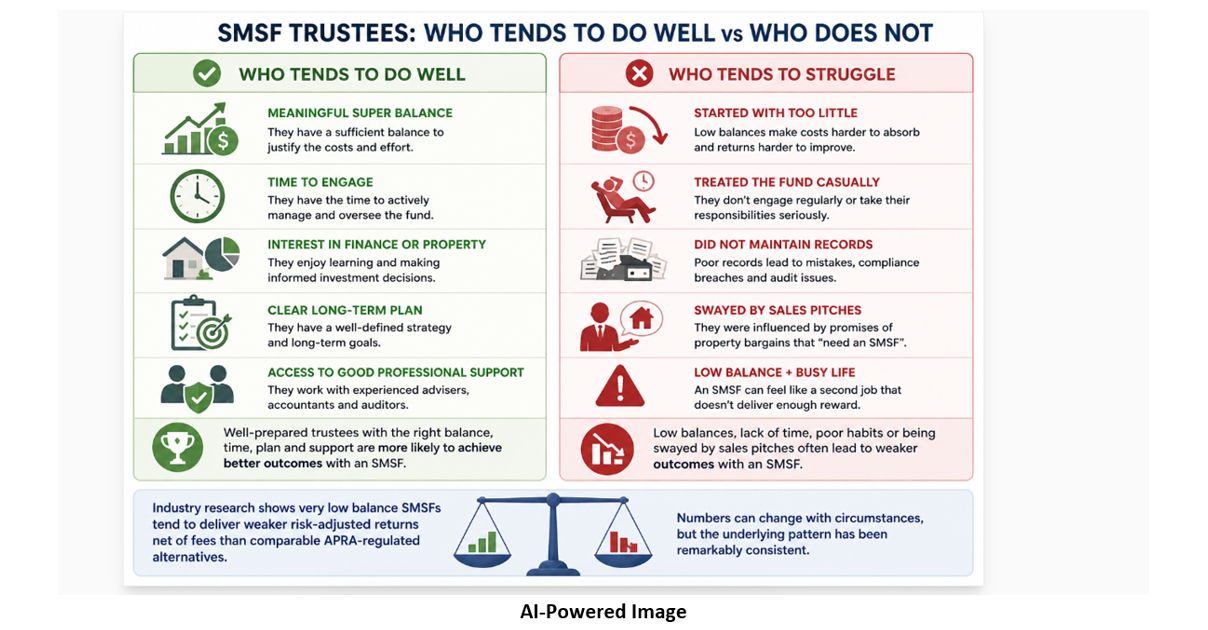
Some traps appear again and again. Mixing personal and fund bank accounts. Lending fund money to a related party. Buying a holiday house through the fund and using it occasionally. Forgetting to update the investment strategy when circumstances change. Not insuring members when the deed required it to be considered. Paying fund expenses from a personal credit card and then forgetting to reimburse from fund cash. Each of these can trigger an ATO compliance response and an audit qualification on your annual report.
The good news is that these mistakes are mostly avoidable with diligent administration and a willingness to ask before acting. The bad news is that the fix can sometimes be expensive or impossible after the fact. Selling a property to unwind a related-party tenancy, for example, can cost more in selling fees, capital gains and stamp duty than the rental advantage was ever worth.
A practical example
Consider Anya and James, both 48, with combined super balances of just over 700,000 dollars. They are tossing up between staying in their existing industry funds and starting an SMSF to buy a holiday cabin they could rent on a short-stay platform. On paper, the cabin sounds appealing. In practice, the Sole Purpose Test means they cannot ever stay in the cabin themselves, even if they pay market rate; they cannot let extended family stay there at mates' rates; they cannot leave personal belongings on site. The fund must charge market rent, document every booking and treat every dollar as retirement savings. After modelling the cabin's likely occupancy, audit costs and lender requirements, they decide the simpler answer is to keep their existing super and buy a small investment property in their own names.
Alternatives worth weighing
Before committing, consider whether your goals can be met inside an existing fund. Many APRA-regulated funds now offer member-directed investment options, including direct shares, ETFs and term deposits. Some allow you to nominate beneficiaries, manage insurance and choose income streams in retirement with reasonable flexibility. Comparing those options to a self-managed structure is not a step you should skip. If your only complaint about your existing fund is fees, switching to a low-fee option may give you nine-tenths of the financial benefit at none of the trustee cost.
Questions to bring to a professional
If you are still considering an SMSF after reading this, the next step is a conversation with a licensed financial adviser, an accountant who specialises in SMSFs and, depending on your structure, a solicitor. Bring written goals, expected balances, a draft of how you would invest, your insurance position and your willingness to commit time. Ask about likely costs over five and ten years, the worst-case compliance scenario, and how the fund would wind up if circumstances changed. A good adviser will not push you in either direction; they will help you decide with clarity.
Red flags in the marketing pitch
If you have arrived at the SMSF question through a free seminar, an unsolicited phone call, or a message on social media, slow down. The Australian financial regulator has repeatedly warned that some property and SMSF promoters target prospective members with aggressive tactics. Tell-tale signs include guaranteed returns, urgency to act before "the offer closes", a pre-packaged property the promoter happens to be selling, and a refusal to provide a Statement of Advice. Genuine professionals welcome scrutiny. People with something to hide push you to sign quickly.
It is rarely the SMSF structure itself that causes harm in these scenarios; it is the bundled investment that comes with it. The fund becomes the vehicle that delivers a member into a deal they would never have agreed to outside super. Take pitches that combine the SMSF, the loan and the property in one breath as a particular warning to slow down and verify each piece independently.
How to find good professional support
A good SMSF adviser is licensed, experienced and willing to walk you away from the fund if it is not right for you. Use the ASIC Financial Services Register to confirm that any adviser is licensed and authorised to give SMSF advice. Ask for a sample Statement of Advice covering an unrelated client to see how they communicate. Ask about their experience with funds at your stage of life and complexity. Ask whether they receive any incentive to recommend particular products. Trustworthy professionals have ready answers to all of these questions.
Equally important is the accountant or administrator who will run the fund's day-to-day records. Ask which software they use, what their process is for the annual cycle, how they handle TBAR and what their typical fee range is. Choose a provider you can imagine working with for a decade, not the cheapest setup package on the internet.
What an initial consultation should cover
A useful initial consultation typically covers your current super arrangements, your goals over the next ten years, your risk tolerance, your liquidity needs, your business and family circumstances, and your willingness to act as a trustee. The adviser should discuss the alternatives, including staying with your current fund, switching to another APRA-regulated fund or starting an SMSF. They should explain the cost differences, the time commitment and the worst-case scenarios. If the consultation feels like a sales pitch, it probably is. If it feels like a structured conversation about your circumstances, you are likely in good hands.
Practical next steps
If you are still considering an SMSF, the next steps are usually: gather your current super statements and your goals, book a consultation with a licensed adviser unrelated to any product you might buy, model costs and benefits over five and ten years, talk with family members who would be affected by the structure, and give yourself time to reflect. Most prospective trustees who take this approach end up with a clear answer in either direction. The minority who skip steps are the ones most likely to regret the decision later.
FAQs
Q: What is an SMSF?
A: A self-managed super fund (SMSF) is a private superannuation fund regulated by the Australian Taxation Office where members also act as trustees and manage the fund’s investment decisions.
Q: Why do Australians choose SMSFs?
A: Many people consider SMSFs for greater investment control, estate planning flexibility, and the ability to tailor strategies such as direct property or share ownership within super.
Q: What are the main risks of running an SMSF?
A: Trustees remain legally responsible for compliance breaches, including failing the Sole Purpose Test, mixing personal and fund assets, or breaching contribution and lending rules.
Q: Can an SMSF own property that trustees use personally?
A: Generally, no. SMSF assets must meet strict retirement-purpose rules, meaning trustees and related parties cannot personally use residential property owned by the fund.
Disclaimer
This article is general information only and does not constitute financial, tax or legal advice. Consider seeking professional advice for your circumstances.


 Nov 12, 2026





 Please wait processing your request...