
 CA
 NZ
 UK
 US
 IND

 AU

 Share
 X (Formerly Twitter)
 Whatsapp
 Facebook
 LinkedIn
 Telegram
 Email This Article
 Copy Link
 Summarize with AI
 Chat GPT
 Perplexity

Highlights
- The soft landing strategy allows individuals to shift gradually from employment to business ownership
- Starting a business 5–7 years before retirement helps build stable income streams
- Parallel income reduces financial pressure during the transition phase
- Testing a business early improves long-term sustainability
- A phased approach can support both lifestyle and financial flexibility in retirement
For many professionals, retirement has traditionally been viewed as a sudden stop—an endpoint marked by the last paycheck. However, a growing number of individuals are redefining this transition by adopting a more gradual approach. The “soft landing” strategy offers a structured way to move from salaried employment to self-employment over several years, reducing financial uncertainty while creating new income opportunities.
Rather than relying solely on accumulated savings or superannuation, this approach allows individuals to build a business while still employed, turning the final years of work into a preparation phase for long-term independence.
What Is the Soft Landing Strategy?
The soft landing strategy involves starting and developing a small business 5–7 years before planned retirement, while continuing in full-time or part-time employment.
Instead of a sudden shift, income transitions gradually—from salary-dominated to business-supported. This creates a smoother financial curve and allows time to establish a viable business model.
By the time retirement approaches, the business is no longer an experiment but a functioning income stream that can support lifestyle needs.
Why Timing Matters: The 5–7 Year Window
Starting too close to retirement can limit the ability to recover from early mistakes or slow growth. A 5–7 year timeframe provides sufficient runway to:
- Test different business ideas
- Build a customer base
- Refine pricing and operations
- Achieve consistent cash flow
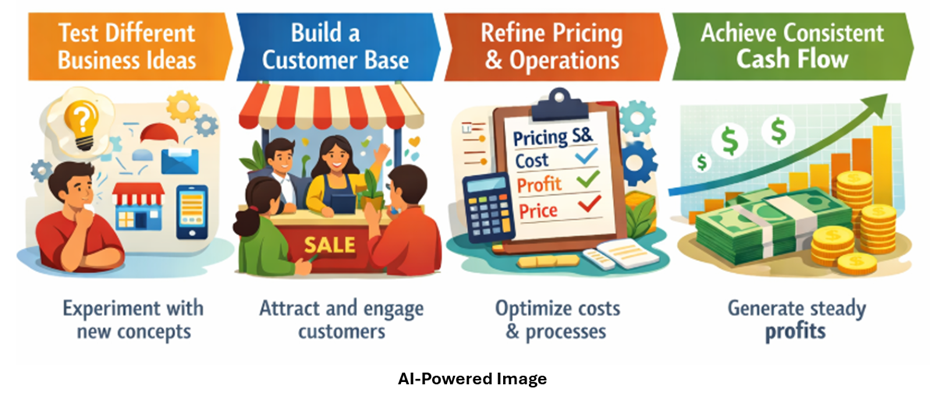
This period also allows individuals to learn from market feedback without the pressure of immediate financial dependence on the business.
Building Income Without Leaving Your Job
One of the key advantages of the soft landing strategy is the ability to generate income alongside a stable salary. This dual-income phase reduces reliance on savings and lowers financial risk.
During this stage, individuals can reinvest early earnings back into the business, improving its scalability and resilience. Over time, as business income grows, reliance on employment income can be gradually reduced.
This transition can also include shifting to part-time work, consulting roles, or flexible arrangements, further easing the move toward self-employment.
Choosing the Right Business Model
Not all businesses are suited for a pre-retirement transition. The focus should be on models that are manageable, scalable, and aligned with existing skills or experience.
Service-based businesses, consulting, niche retail, or small-scale digital ventures often fit well within this framework. These models typically require lower upfront investment and can be developed incrementally.
The goal is not rapid expansion but steady, predictable income that can complement retirement planning.
Managing Risk and Expectations
While the soft landing strategy reduces financial risk, it does not eliminate it entirely. Early-stage businesses may face inconsistent income, operational challenges, or slower-than-expected growth.
However, maintaining employment during the initial years provides a buffer, allowing individuals to adjust strategies without compromising financial stability.
Clear expectations, disciplined budgeting, and realistic timelines are essential to ensure the transition remains sustainable.
From Transition to Stability
As retirement approaches, the focus shifts from building the business to stabilising it. At this stage, the business should ideally generate consistent income with manageable workload requirements.
This allows individuals to enter retirement with an additional income stream, reducing dependence on savings and providing greater financial flexibility.
In some cases, the business may continue as a part-time venture, offering both income and engagement during retirement years.
Conclusion: A Gradual Shift, Not a Sudden Stop
The soft landing strategy reframes retirement as a transition rather than a fixed endpoint. By starting early and building gradually, individuals can move from salary to self-employment with greater control and reduced uncertainty.
This approach not only supports financial stability but also enables a more flexible and active retirement, where income generation and personal fulfilment can coexist.


 Nov 12, 2026





 Please wait processing your request...