
 CA
 NZ
 UK
 US
 IND

 AU

 Share
 X (Formerly Twitter)
 Whatsapp
 Facebook
 LinkedIn
 Telegram
 Email This Article
 Copy Link
 Summarize with AI
 Chat GPT
 Perplexity

Highlights
- More control over investments comes paired with more legal and operational responsibility.
- Trustees must satisfy the Sole Purpose Test in every decision the fund makes.
- Casual breaches in everyday transactions are the most common cause of audit issues.
- ATO penalties can be financial, reputational, and in extreme cases involve disqualification.
- Time spent administering an SMSF is the cost most people underestimate.
- Capability, not enthusiasm, decides whether "control" works in your favour.
- If you cannot answer basic compliance questions today, you are not yet ready to be a Trustee.
There is a particular kind of pitch that lands well in Australia. It usually starts with a complaint about super fund fees, mentions the words "my money", and ends with the suggestion that you take control of your retirement by setting up a self-managed super fund. The story is seductive because it has a kernel of truth. Yes, an SMSF gives you more control. The catch, and it is a serious one, is that more control comes wrapped in more responsibility, more paperwork, and more risk if things go off the rails. This article is about the trade-off most people only see clearly after they have signed up.
The promise: control
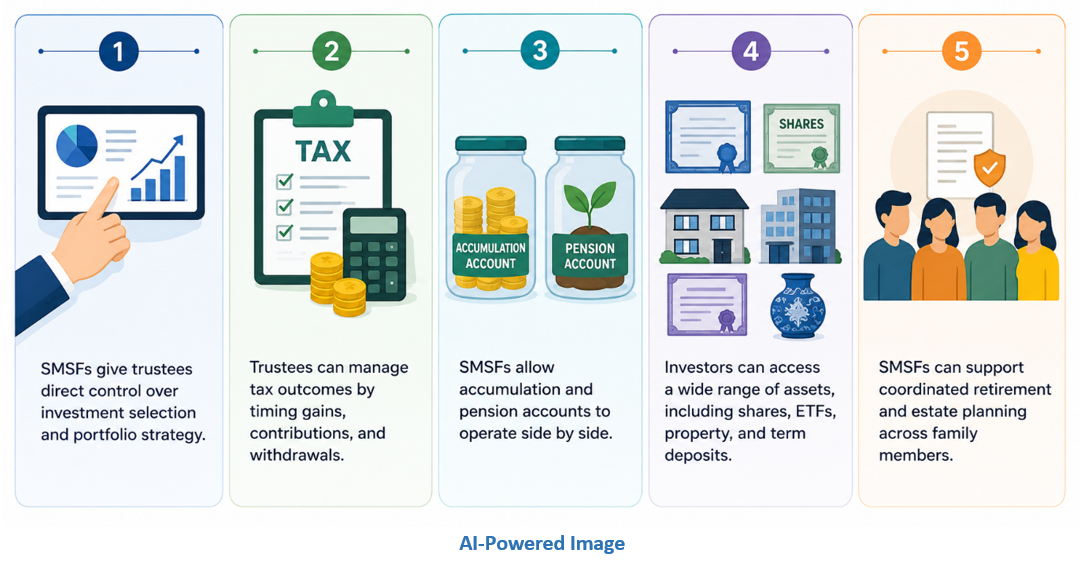
When people speak about SMSF "control", they usually mean three things. They want to choose the investments. They want to manage tax. And they want to design how money flows out in retirement. All three are achievable inside an SMSF and, used well, they can support a thoughtful long-term plan. Trustees can buy direct shares, term deposits, Exchange-traded funds, Managed Investments, residential and commercial property, and approved collectables. They can run accumulation and pension accounts side by side. They can decide when to crystallise gains, how to time contributions and how to coordinate strategies across spouses and adult children.
There is real value in that, particularly for trustees who have a clear view of the markets they understand and a willingness to make active decisions. Control is not a fiction. The problem is the second half of the sentence, which often goes unmentioned.
The reality: responsibility
Once you sign up, the law looks at you very differently. You become a trustee of a regulated fund. You must comply with the Superannuation Industry (Supervision) Act. You must keep separate fund records. You must produce financial statements, an Investment strategy, member statements and minutes of trustee decisions. You must engage an approved SMSF auditor every year. You must report to the ATO. And you must do all of this whether the markets are kind to you or not.
Those obligations do not pause if you change jobs, get divorced, fall ill, or move overseas. Many of the worst SMSF outcomes happen when life gets in the way and the trustee stops paying attention. A fund that drifts for two years can take twelve months and tens of thousands of dollars to bring back into compliance.
The Sole Purpose Test
Every decision you make as a trustee must pass the Sole Purpose Test. The fund exists for retirement benefits, full stop. That sounds obvious, but it has uncomfortable implications. You cannot live in a property the fund owns. You cannot use a fund-owned holiday rental for a family weekend. You cannot lend the fund's cash to your cousin's start-up. You cannot buy a vintage motorcycle, park it in your garage and call it a collectable investment. Each of these breaches the Sole Purpose Test and triggers consequences.
The Sole Purpose Test is the rule that catches well-meaning trustees most often. Most breaches do not start with bad intent. They start with a member thinking, just this once, no one will mind. The auditor will mind. The ATO will mind.
Hidden traps in everyday decisions
Many traps are not exotic. They are ordinary decisions made carelessly. Examples include paying a personal expense from the fund's bank account by mistake, accepting a non-concessional contribution that pushes a member over the cap, transferring an asset between the fund and a member at an inflated value, or forgetting to revalue real property at Market Value before the audit. Other traps appear when trustees innovate without checking the rules. Buying a residential property and renting it to a relative "at full market rate" is a classic in-house asset trap.
Each item looks small in isolation. Each one can cause an audit qualification, a contravention report, and in serious cases, additional tax. The cumulative effect of small breaches is sometimes worse than a single large one because it suggests poor governance to the regulator.
The cost of getting it wrong
When the ATO finds breaches, it has a range of tools. Education direction. Written advice to rectify. Enforceable undertakings. Administrative penalties on a per-trustee basis. Disqualification of trustees. And in the most serious cases, the fund can be made non-complying, which means a much higher tax rate on assessable income and the inclusion of asset value as taxable. None of that is hypothetical. The ATO publishes its enforcement statistics every year, and trustee disqualifications and non-compliance notices feature in every report.
Time is the silent cost
Even when nothing goes wrong, an SMSF still demands time. Reading prospectuses. Reviewing the investment strategy. Approving rollovers. Authorising payments. Signing tax returns. Reading the auditor's questions and responding with documentation. None of these are difficult tasks individually, but together they can consume a weekend a quarter, and more in a busy year. If you genuinely enjoy the process, you may not feel it. If you do not, the burden builds.
A useful exercise is to keep a log for three months. Every minute you spend on the fund. Every email. Every signature. At the end of the quarter, multiply by four for the annual figure. Most prospective trustees are surprised by the result.
Two cautionary scenarios
Consider Marco, a self-employed builder who set up an SMSF to buy a small commercial unit and Lease it to his Business. Done correctly, the structure is legitimate. Done casually, it can Fail. Marco missed a market rent review, used the fund's cash to repaint the unit without invoicing, and let his business pay strata fees the fund should have paid. The auditor flagged each item. The ATO required rectification. Marco spent a year and several thousand dollars putting things right.
Or consider Rita, who rolled her superannuation into an SMSF after a seminar promising property gains. The seminar's recommended apartment underperformed, the fund's cash buffer dried up, and Rita could not maintain the Loan repayments. She wound up the fund at a loss. Both scenarios are common and both could have been avoided with stronger questioning at the start.
When control still makes sense
None of this means an SMSF is wrong for everyone. For trustees with the balance, the time, the discipline and the support, an SMSF can deliver genuine flexibility. But "control" should be earned through capability, not assumed. If you are not prepared to do the work, the control collapses into responsibility you cannot shoulder. The trustees who make the structure work tend to share three habits: they respect the paperwork, they ask before they act, and they assume nothing.
Questions to test your readiness
Before committing, ask yourself a short set of questions. Could you produce a written investment strategy from memory? Do you know the in-house asset limit and how to measure it? Can you list your current contribution caps for the year? Do you know what conditions of release apply to you? Could you describe how the fund would pay a pension? If those questions feel hard, that is useful information. None of them needs to be hard to answer, but they all need to be answerable before you take on a trustee role.
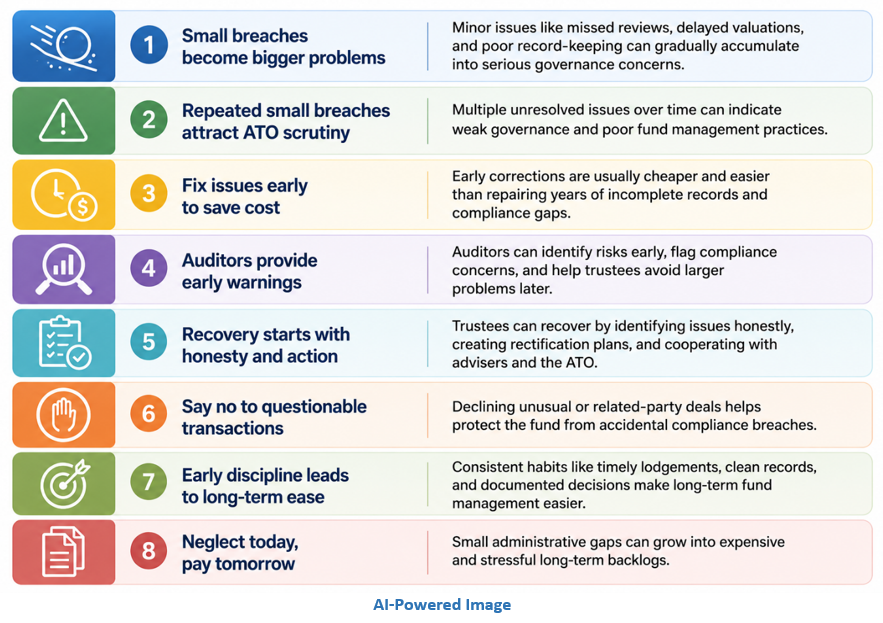
The role of professional team in protecting trustees
Trustees with strong professional support rarely fall into the worst version of the SMSF trap. Their Accountant catches small bookkeeping issues. Their auditor flags emerging compliance concerns. Their adviser questions strategies that drift from the trust deed or the Sole Purpose Test. The professionals are not infallible, but together they create a safety net. Trustees who try to save money by going it alone often discover that the savings disappear at the first audit qualification or rectification request.
FAQs:
Q: What is the Sole Purpose Test, and why does it trip up so many trustees?
A: The Sole Purpose Test requires every SMSF decision to solely benefit retirement savings—no personal use allowed. Trustees often breach it casually, like living in a fund-owned property or lending to family, leading to audit flags and ATO penalties.
Q: What are the most common everyday traps that cause SMSF audit issues?
A: Casual errors like paying personal expenses from the fund account, exceeding contribution caps, inflating asset transfers, or skipping property revaluations. These small slips accumulate, signaling poor governance to auditors and the ATO.
Q: How much time does running an SMSF really take?
A: Expect a weekend quarterly on tasks like strategy reviews, payments, tax returns, and auditor responses—more in busy years. Log your time for three months and multiply by four to reveal the hidden annual cost most underestimate.
Q: How can I tell if I'm ready to be an SMSF trustee?
A: Test yourself: Can you outline your investment strategy, contribution caps, in-house asset rules, conditions of release, and pension payment process? If not, build capability first—enthusiasm alone won't handle the compliance load.


 Nov 12, 2026





 Please wait processing your request...