
 CA
 NZ
 UK
 US
 IND

 AU

 Share
 X (Formerly Twitter)
 Whatsapp
 Facebook
 LinkedIn
 Telegram
 Email This Article
 Copy Link
 Summarize with AI
 Chat GPT
 Perplexity

Key Highlights
- Most Australians begin serious retirement planning too late, often within five years of stopping work
- Three financial forces (longevity, inflation and poor market timing) quietly erode even well-built nest eggs
- The superannuation system contains legal strategies that can materially improve your outcome, but only if you know they exist
- Government entitlements are routinely left unclaimed due to widespread eligibility misconceptions
- Estate planning failures are one of the most common and most avoidable causes of wealth loss at retirement
There's a particular kind of financial stress that tends to arrive in your late fifties. It doesn't announce itself dramatically. It surfaces quietly, in a conversation with a colleague who just retired, in a super statement you actually read for once, in the slow realisation that the finish line is closer than you thought and the preparation hasn't quite matched the timeline.
Australia has a world-class superannuation system. Yet a striking number of people arrive at retirement without a clear plan, not because they didn't care, but because the complexity of the system made it easy to defer. The good news is that even with limited time, the right moves can change the outcome significantly.
Three Risks That Don't Get Enough Airtime
Most retirement conversations focus on how much you've saved. Far fewer focus on what can erode it once you stop working.
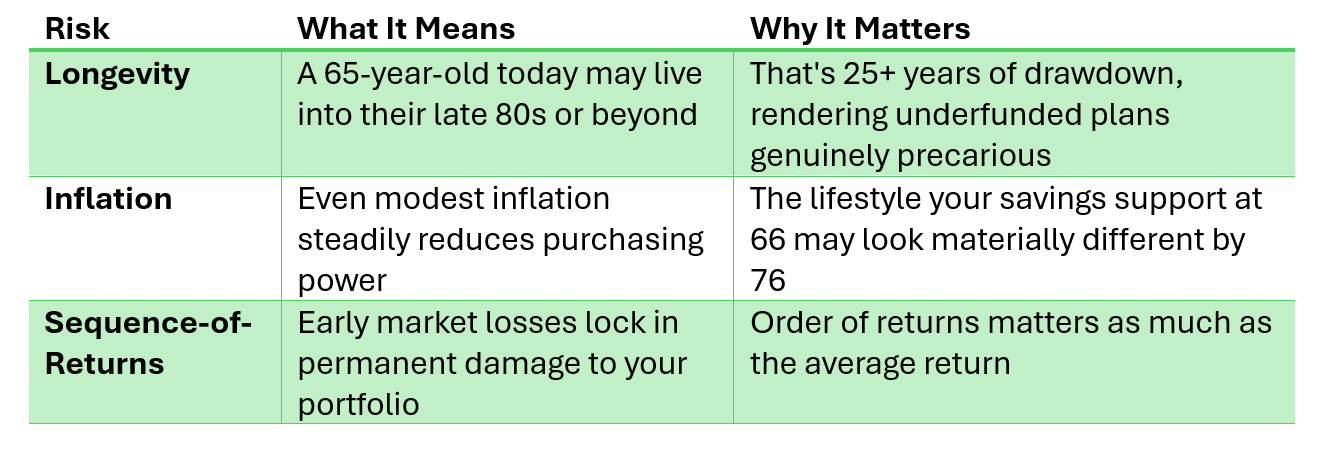
Living longer than your money lasts is the defining financial risk of modern retirement. A 65-year-old Australian today has a reasonable probability of living into their late eighties or beyond.
Inflation's slow erosion is easy to dismiss during accumulation, when returns tend to outpace it. In retirement, when you're drawing down rather than building up, even modest inflation steadily reduces what your money can actually buy.
Selling at the wrong time (known formally as sequence-of-returns risk) is perhaps the least understood threat. If markets fall sharply in the first few years of retirement and you're withdrawing regularly to live on, you lock in those losses. Later recoveries help less than you'd hope because you have fewer assets left to benefit from them.
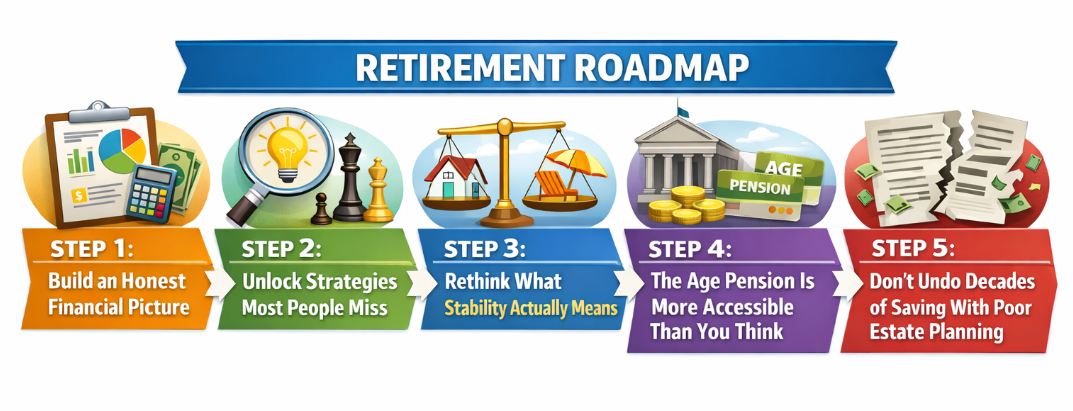
Step 1: Build an Honest Financial Picture
Vague optimism is not a retirement strategy. The starting point is a precise understanding of your current position: total super balance across all accounts, fees being paid, contribution rate, and projected balance at various retirement ages.
Many Australians unknowingly carry two, three, even four super accounts accumulated across different jobs, each charging its own fees, each diluting the compounding effect. Consolidation is one of the simplest, highest-impact actions available and costs nothing to do.
Once you have a clean picture, model it. Online calculators can show how sensitive your outcome is to relatively small changes, retiring two years later, contributing an extra $50 per week, or adjusting your investment mix. The variables are more powerful than most people expect.
Step 2: Unlock Strategies Most People Miss
The superannuation system rewards those who understand it. Several legitimate, legal strategies sit underused simply because they aren't well known.
From age 60, a transition-to-retirement arrangement allows you to draw a limited income from your super while still employed, and simultaneously direct more of your salary into super at a lower tax rate. It's one of the few strategies that can improve your retirement position without requiring you to earn more or spend less.
For those who took time out of the workforce to raise children, care for family members, or navigate career changes; catch-up contributions allow unused annual caps to be carried forward and used in later years, provided the balance sits below $500,000. This is a genuine opportunity to recover ground.
Older homeowners considering downsizing can contribute up to $300,000 each from property sale proceeds directly into super, bypassing the standard contribution caps. For asset-rich, super-light retirees, this can be transformative.
Step 3: Rethink What Stability Actually Means
The instinct to switch to a better-performing fund as retirement approaches is understandable but often counterproductive. Performance tables reflect the past. What matters near retirement is consistency, fee efficiency and not crystallising losses by moving at the wrong moment.
Industry funds, structured to return profits to members rather than shareholders, have a built-in cost advantage that compounds quietly over decades. Stability of management, clarity of fees and quality of member services matter more in late accumulation and early retirement than headline return figures.
Step 4: The Age Pension Is More Accessible Than You Think
A common and expensive misconception: that superannuation savings disqualify you from the Age Pension. They don't, not automatically.
Eligibility is determined by means testing across both income and assets. Many retirees with moderate super balances qualify for a partial pension that meaningfully supplements their drawdown income, particularly in the early years when spending tends to be higher.
Even those above the pension threshold often qualify for the Commonwealth Seniors Health Card, which reduces pharmaceutical and healthcare costs, a real-world saving that accumulates significantly over a long retirement.
Step 5: Don't Undo Decades of Saving With Poor Estate Planning
Insurance and estate planning sit at the end of most retirement checklists, and that's exactly the problem.
Super doesn't automatically form part of your estate. Without a binding beneficiary nomination, the fund trustee decides who receives it. That decision may not reflect your wishes, and by the time the issue surfaces, it's too late to fix.
A valid will, binding nominations and an Enduring Power of Attorney are not bureaucratic formalities. They are the documents that determine whether your wealth reaches the people you intended.
The Bottom Line
The Australians who retire with confidence don't all start with the largest balances. They start earlier, stay informed, and make deliberate decisions rather than default ones. The system contains more opportunity than most people realise. The question is whether you find it in time to use it.
Frequently Asked Questions
When can I access my superannuation?
Preservation age is 60 for most Australians. Full unrestricted access, regardless of employment, is available at 65.
Can I get the Age Pension if I have super?
Potentially yes. Eligibility depends on income and assets means tests, not simply whether you hold super. Partial pensions are available to many Australians with moderate balances.
What is a transition-to-retirement strategy?
It allows you to draw a capped income from your super from age 60 while still working, typically combined with salary sacrificing to reduce tax and accelerate your balance growth.
What if I haven't nominated a super beneficiary?
Your fund's trustee decides where the money goes. A binding nomination removes that discretion and ensures your wishes are legally enforceable.
Is it too late to improve things if I'm retiring soon?
Rarely. Catch-up contributions, downsizer strategies and transition-to-retirement arrangements can each improve outcomes meaningfully, even within a five-year window.


 Nov 12, 2026





 Please wait processing your request...